L-form bacteria
plural noun (n.pl.)
Definition
L-form bacteria originate from a strain of bacteria that lack cell walls while retaining the ability to grow. These cells are morphologically very unusual. L-form bacteria are formed as a result of unbalanced growth of normal bacterial cells in length and thickness and are therefore polymorphic.
Diagram of the development of an L-form bacterium:
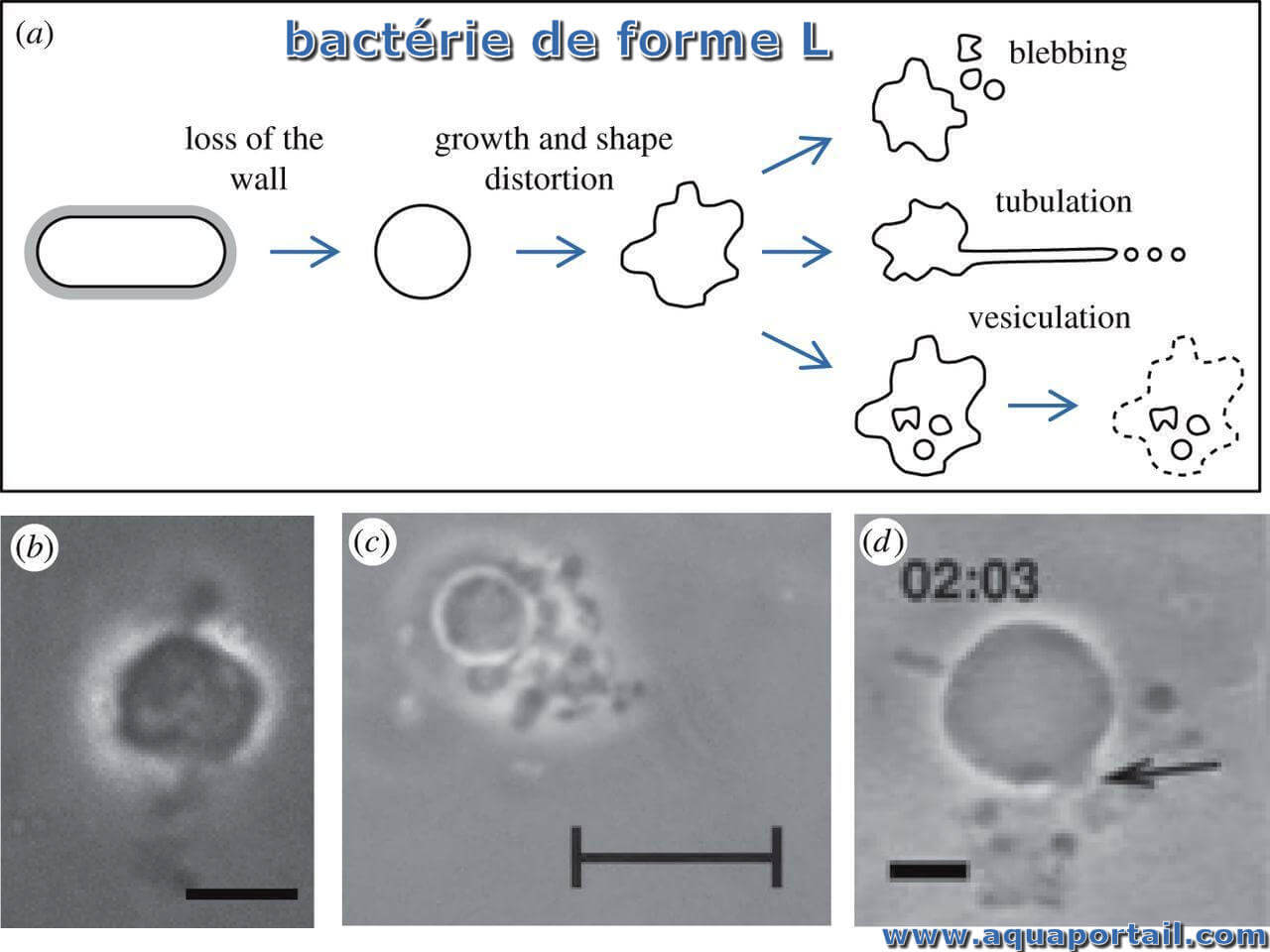
Proliferation of an L-form bacterium and its similarity to vesicle replication in vitro. (a) Diagram of L-form proliferation based on observations with defined primary L-forms of Bacillus subtilis with vesiculation. (b–d) Comparison of L-form bacteria and replicating lipid vesicles. (b) A large L-form of Bacillus subtilis surrounded by newly generated progeny blebs. (c) L-form cells from the urine of a Fanconi patient. (d) Proliferating lipid vesicle in vitro. scale bars: (c) 5 μm and (d,e) 10 μm.
Explanations
In L-form cultures, spherical, filamentous, or completely structureless cells are found, ranging in size from 0.2 to 50 microns (7.9 × 10⁻⁶ to 1.97 × 10⁻³ in). They easily pass through bacterial filters and are readily destroyed by mechanical stress. Unlike normal cells, L-form cells often contain large vacuoles. Their metabolic activity is very low. Cell division occurs in a non-standard manner, due to the formation of elementary bodies by budding from the cell surface or the vacuolar membrane.
L-form bacteria were first isolated in 1935 by Emmy Klieneberger-Nobel (1892–1985), who named the "L-forms" after the Lister Institute of Preventive medicine in London, where she worked. She observed these cells in a culture of Streptobacillus moniliformis bacteria isolated from rat ear fluid.
Two types of L-forms are distinguished:
- unstable L-forms: spheroplasts, which are capable of dividing but can revert to the original morphology
- stable L-forms: protoplasts, which are unable to revert to the shape of the original bacterium
Later, L-forms were described in a wide variety of bacterial species. It has been shown that L-forms arise spontaneously or are induced under the influence of agents that block cell wall synthesis: antibiotics (penicillins, cycloserine, cephalosporins, vancomycin), enzymes (lysozyme, amidase, endopeptidase), ultraviolet and X-rays, or the amino acid glycine.
Certain parasitic bacterial species, such as mycoplasmas, also lack a cell wall, but they are not considered L-forms because they do not originate from bacteria that normally possess a cell wall.
Synonyms, antonyms
Spanish translation: bacteria de forma L
1 synonym (similar meaning) for "l-form bacteria":
0 antonyms (opposite meaning).
Related words and expressions to L-FORM BACTERIA are directly connected by general or specific meaning.
The expression L-FORM BACTERIA is listed on page 1 of words starting with L in the dictionary glossary.
Related to "L-form bacteria"
bacterial artificial chromosome

A bacterial artificial chromosome (BAC) is a DNA construct, based on a functional fertility plasmid or F-factor, used for transformation and bacterial cloning...
denitrifier bacteria
Denitrifying bacteria, following the nitrification phase, enable the denitrification of an environment, that is, removing nitrogen present in the form...
lake

A lake is a large inland and continental body of freshwater, nearly stagnant or slow-moving.
lamprey

A lamprey is an aquatic vertebrate of the class Petromyzontida within the cyclostomes. Adult lampreys are characterized by a toothed, funnel-like sucking...
