Lamprey
noun (n.)
Definition
A lamprey is an aquatic vertebrate of the class Petromyzontida within the cyclostomes. Adult lampreys are characterized by a toothed, funnel-like sucking mouth lacking hinged jaws. Lampreys are jawless vertebrates inhabiting both freshwater rivers and marine waters.
A modern lamprey:

Nearly 49 species of lampreys remain alive today, alongside known fossil taxa. Although famous for rasping into the flesh of other fishes to feed on blood, only about 18 lamprey species are actually parasitic as adults.
Explanations
Lampreys represent a very ancient vertebrate lineage, though their exact phylogenetic relationship to hagfishes and jawed vertebrates remains a subject of active research.
Adult lampreys physically resemble eels in lacking scales and can measure from 13 to 100 cm (5 to 40 in) in length. Lacking paired fins, adult lampreys have large eyes, a single nostril on top of the head, and seven gill pores on each side of the head. Distinctive morphological traits such as their cartilaginous skeleton indicate that lampreys form a sister group to all living jawed vertebrates (gnathostomes) and represent one of the earliest-diverging vertebrate lineages.
Instead of true complete vertebrae, lampreys possess a series of cartilaginous structures called arcualia arranged above the notochord. Parasitic lampreys feed as adults by attaching their oral disc to a host animal and rasping away surface tissues with their horny teeth to reach blood and body fluids; while rare attachments to swimmers occur, these eel-like vertebrates do not normally prey on humans. Non-parasitic lampreys, which are typically freshwater species, do not feed as adults, surviving solely on reserves accumulated through filter feeding during their larval ammocoete stage.
Lampreys inhabit primarily coastal and fresh waters, though certain species travel considerable distances in the open ocean, as reflected by low reproductive isolation among populations, while some species are landlocked in lakes. They occur across most temperate regions except sub-Saharan Africa; their larvae (ammocoetes) have low tolerance for high water temperatures, explaining their absence from tropical zones. Lamprey populations can be impacted by overfishing, dams, and water pollution.
Adult lampreys spawn in rivers and die shortly afterward. Young larvae, called ammocoetes, spend several years burrowed in fine river sediments, filter-feeding on detritus and microorganisms before undergoing a metamorphosis lasting several months. Some species cease feeding after metamorphosis, whereas others migrate to the sea or large lakes to feed on fishes and occasionally marine mammals (as does the sea lamprey). Anadromous species begin attacking fish soon after metamorphosis as they swim downstream. River lamprey is also prized in traditional cuisine.
The toothed mouth of a lamprey:
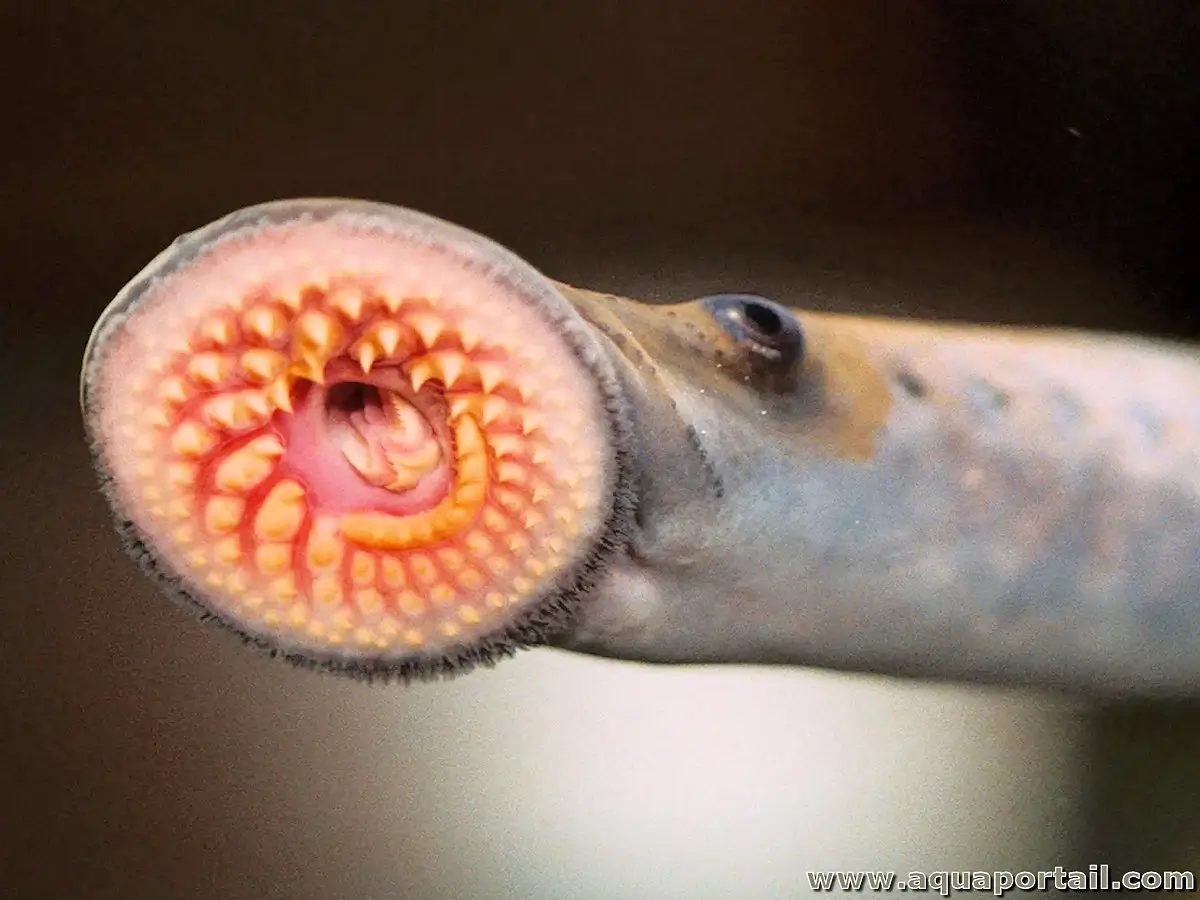
The toothed mouth of a lamprey. These hematophagous jawless vertebrates have persisted for hundreds of millions of years.
✅ Closely related to hagfishes, lampreys resemble eels but possess a jawless sucking mouth they attach to fish. Parasitic species rasp away tissues and blood from their host fish, supported by a cartilage ring and rows of keratinous teeth. Found in temperate rivers and coastal seas, lampreys measure 13 to 100 cm (5 to 40 in) and begin life as freshwater larvae dwelling in muddy river and lake beds where they filter microorganisms.
✅ The larval stage can last up to seven years! Following metamorphosis, the lamprey transforms into a free-swimming eel-like adult that—in parasitic species—attaches to fish. Roughly 50 extant species of lampreys are known.
Certain lamprey species are esteemed in gastronomy.
Synonyms, antonyms
Spanish translation: lamprea
2 synonyms (similar meaning) for "lamprey":
0 antonyms (opposite meaning).
Related words and expressions to LAMPREY are directly connected by general or specific meaning.
The word LAMPREY is listed on page 1 of words starting with L in the dictionary glossary.
Related to "lamprey"
L-form bacteria

L-form bacteria originate from a strain of bacteria that lack cell walls while retaining the ability to grow.
lake

A lake is a large inland and continental body of freshwater, nearly stagnant or slow-moving.
lanceolate

A leaf blade is said to be lanceolate when it has the appearance of a narrow lance. More generally, lanceolate indicates a lance-like or spearhead shape...
landscape

A landscape is a visual depiction representing a view of an inland natural environment, a portion of territory visible at once from a single vantage point.
