Parthenogenesis
noun (n.)
Definition
Parthenogenesis refers to the ability of a female organism, whether animal or plant, to reproduce autonomously without the intervention of a partner to fertilize an egg. Unlike self-fertilization, which involves the presence of both sexes on the same individual, parthenogenesis concerns only females. Thus, while self-fertilization represents a mode of sexual reproduction, parthenogenesis falls under asexual reproduction.The parthenogenetic cycle of aphids:
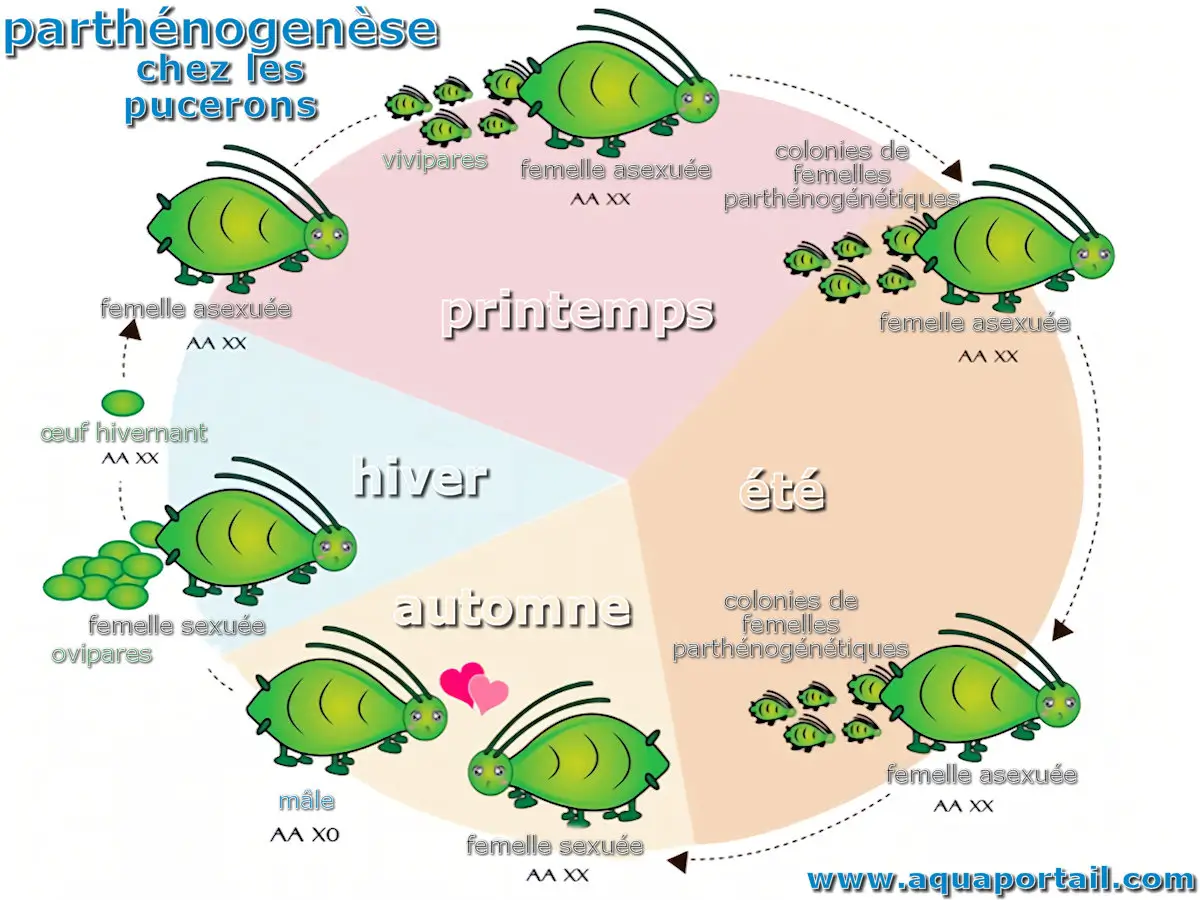
Parthenogenesis is a monoparental mode of reproduction based on the development of a female gamete unfertilized by a male gamete. When it occurs regularly, continuously, and naturally in the life cycle of certain animals, it is termed natural parthenogenesis. This can be divided into two categories: complete and incomplete.
Explanations
Parthenogenesis constitutes a process in which normally sexual species reproduce asexually without fertilization occurring. This reproduction is carried out exclusively by females. The egg develops without being fertilized by a male gamete.
Different types of parthenogenesis are observed across several groups of organisms. It occurs with some frequency in invertebrates such as flatworms, rotifers, tardigrades, crustaceans, and insects, as well as in certain amphibians and reptiles. This phenomenon is rarer in fishes, exceptional in birds, and can occasionally be encountered in plants.
Parthenogenesis is triggered by cleavage of the unfertilized egg. This activation can be induced by environmental factors, chemical agents, or stimuli such as electric shocks, among others. In certain situations, such as in some fish species, a phenomenon related to parthenogenesis, called gynogenesis (or pseudogamy), can occur involving interaction with a male gamete.
However, even though this contact is necessary, fertilization does not take place; the genetic material of the male gamete does not contribute to the final genome. In certain animal species and under specific conditions, an egg can thus give rise to a new individual without having been fertilized by a sperm cell.
The resulting organism, called a parthenote, cannot carry specifically male chromosomes. Depending on the sex-determination system, offspring may be restricted to just one sex, as in bees and other hymenopteran insects, where females are diploid (from fertilized eggs) and males are haploid (parthenogenesis).
Although the procedure has been artificially attempted with male gametes, no experiment has yet succeeded in developing viable embryos in mammals, as male cells are generally reduced to the sole function of fertilization, whereas the female egg possesses totipotency.
Types of parthenogenesis
Several kinds of parthenogenesis are distinguished, depending on whether it gives rise exclusively to males, only to females, or to both males and females, as well as whether it is accidental, artificial, cyclic, constant, diploid, facultative, geographic, haploid, male-producing, polyploid, regular, rudimentary, sporadic...
See also gynogenesis, androgenesis, and hybridogenesis.
Thus, one distinguishes:
- rudimentary parthenogenesis, if the egg aborts
- occasional or accidental parthenogenesis, if it is not the norm
- regular or normal parthenogenesis, if it is constant. It is obligate if it involves all eggs or facultative if it involves only certain eggs. It is cyclic if parthenogenetic generations alternate with non-parthenogenetic ones
- geographic parthenogenesis, if it occurs depending on the location where the individual is found
- larval parthenogenesis or paedogenesis, when it occurs at the larval stage.
Parthenogenesis is one of the modes of propagation in corals, as well as in many invertebrates such as the marbled crayfish Procambarus marmor, which self-reproduces in this way. In botany, certain plant groups involve parthenospores.
Depending on whether meiosis occurs or cannot be distinguished, the types of parthenogenesis are:
- diploid ameiotic parthenogenesis: meiosis does not occur and the egg is formed by mitosis and is therefore diploid. It can be considered asexual reproduction in the absence of haploid cells. This type is known in certain flatworms, rotifers, crustaceans, insects, and amphibians
- haploid meiotic parthenogenesis: a haploid egg is formed by meiosis and develops without being fertilized. This form is observed in certain flatworms, rotifers, annelids, insects (bees, wasps, ants), fishes, amphibians, and reptiles. Although syngamy does not occur, meiosis takes place, and thus genetic recombination. This type can therefore be considered a form of sexual reproduction. Sometimes the individual is haploid, though recombinant; at other times, the diploid state is restored by chromosome duplication, as in certain insects where the resulting "n" egg recombines with its own polar body, also "n", reforming a diploid cell from which a diploid adult emerges. In the latter case, even though a haploid female gamete produces an individual in every instance, three types exist:
- arrhenotokous: type of parthenogenesis where parthenogenetic offspring are male and females arise from sexual reproduction. It occurs in the vast majority of hymenopterans
- thelytokous: type of parthenogenesis where offspring are female
- amphitokous or deuterotokous: type of parthenogenesis where offspring consist of individuals of both sexes. It occurs in certain cladocerans among other groups.
There are many parthenogenetic animals, sometimes quite surprisingly: chickens, turkeys, stick insects, snails, Komodo dragons, sharks... The phenomenon of plant parthenogenesis also exists.
Human parthenogenesis
Parthenogenesis in humans never produces viable embryos, because unfertilized eggs lack specific gene-expression instructions from sperm (genomic imprinting). In general, our cells have two functional copies of each gene, one inherited from the mother and the other from the father.
Spontaneous parthenogenetic and androgenetic events occur in humans, but they lead to tumors: ovarian teratoma and hydatidiform mole, respectively.
Example with parthenogenesis in geckos
Parthenogenesis in Gekkonidae reptiles:

The gecko Lepidodactylus lugubris is a species reproducing by parthenogenesis. The evolutionary origin of this trait shows that eight species of geckos, belonging to the family Gekkonidae, are currently known to have populations composed wholly or partially of parthenogenetic females, i.e., without any male involvement, even when males exist.
The geographic distributions of these Lacertilia reptile species often overlap or coincide, and their phylogenetic origin is consistently Asian, Australasian, or Oceanian. This stems from an artifact linked to incomplete knowledge of lizard reproduction. Thus, it is very likely that unisexual forms will soon be discovered among African geckos as well.
The geographic range of parthenogenetic geckos is, depending on the case, restricted to an island (Taiwan, Hemidactylus stejnegeri), a continent (Australia, Heteronotia binoei), Southeast Asia only (Hemidactylus vietnamensis and H. karenorum), Oceania only (Nactus pelagicus), or both Southeast Asia and Oceania (Hemidactylus garnotii). However, some of these geckos occupy a much wider range spanning the Indian Ocean, Australasia, and Oceania (Lepidodactylus lugubris and Hemiphyllodactylus typus).
All forms studied in detail clearly show that unisexuality arose through hybridization of two cytogenetically and/or biochemically distinct species. Unisexuality appears to arise only very rarely relative to the possible number of such hybridizations. Island environments, which promote geographic isolation of phylogenetically close forms, appear conducive to the emergence of unisexuality through secondary contact of formerly separated forms. Unisexuality appears recent in extant forms (a few thousand years). In many cases, clonal diversity can be demonstrated that varies considerably depending on the taxon, as well as on the technique used to detect it (skin grafts; cytogenetics = karyotypes; biochemistry; morphology).
triploid clones, which do not occur in all cases, result from an additional cross between a bisexual male and a diploid (unisexual) clone. If this male belongs to one of the two parental species of the diploid clone, the triploids will then possess one chromosome set in duplicate. Conversely, if this male belongs to a third closely related species, the resulting triploid clones will exhibit three distinct, recognizable chromosome sets. Both cases occur in unisexual lizards.
Detailed analysis of all knowledge accumulated during our work and literature data allows us to formulate original hypotheses for the first time on the spatial and temporal evolution of unisexuality in geckos. Thus, all results converge to show that the evolution of unisexuality is a dynamic process involving the emergence and disappearance of numerous lineages within a given unisexual-bisexual complex (diploid and triploid clones; parental or non-parental yet phylogenetically close bisexual species; sterile hybrids between bisexual males and parthenogenetic females).
Thus, diploid clones appear to be displaced by triploid clones, while both eliminate the bisexual forms from which they originated, as well as other related bisexual forms. Over time, triploid clones become the sole survivors in a given unisexual-bisexual complex, and then gradually disappear due to their inability to renew their genome (elimination of diploid clones and bisexual forms).
All currently known cases of unisexuality in geckos actually correspond to a unisexual-bisexual complex. It includes several diploid and/or triploid clones, numerous bisexual species, whether known, not yet distinguished, or extinct, and occasionally sterile hybrids. Their study, which has only just begun in most cases, is highly informative and scientifically fascinating.
It can lead, as with Lepidodactylus lugubris, to the recognition of a large number of previously unknown bisexual species, many of them now rare or extinct and represented only in the collections of major world museums.
Synonyms, antonyms
Spanish translation: partenogénesis
6 synonyms (similar meaning) for "parthenogenesis":
- androgenesis
- apomixis
- gametogenesis
- geitonogamy
- gynogenesis
- hybridogenesis
3 antonyms (opposite meaning):
- hermaphroditism
- self-fertilization
- sexual reproduction
Related words and expressions to PARTHENOGENESIS are directly connected by general or specific meaning.
The word PARTHENOGENESIS is listed on page 1 of words starting with P in the dictionary glossary.
Related to "parthenogenesis"
parthenogenetic
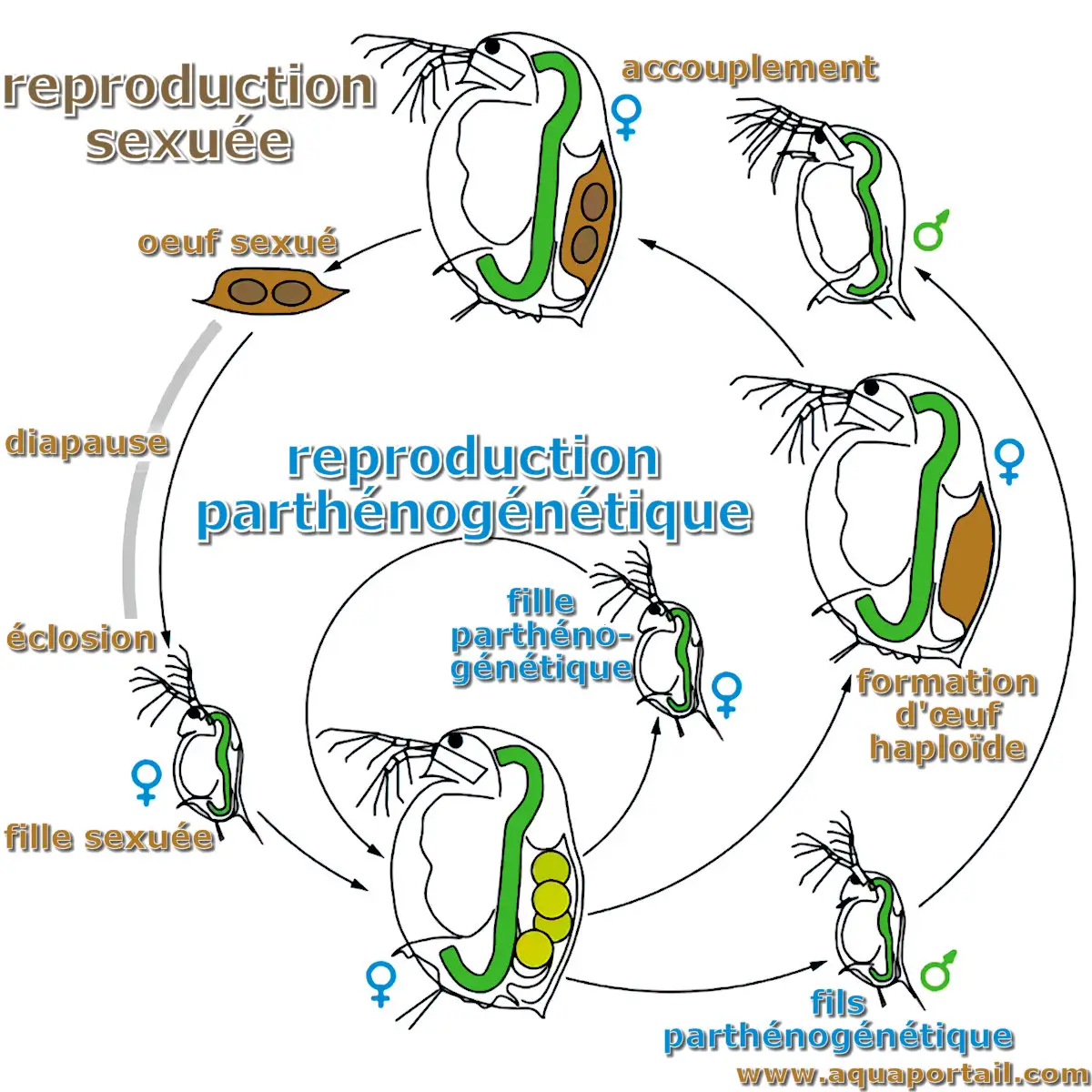
A parthenogenetic organism is an invertebrate (or occasionally vertebrate) animal capable of reproducing without fertilization, even though the species...
gametogenesis

Gametogenesis is the process by which cells undergo meiosis to form haploid gametes. It takes place in the gonads (female ovaries or male testes).
lipogenesis

Lipogenesis is the biosynthesis of fatty acids (lipids) and triglycerides from non-lipid precursors such as glucose or other substrates.
paedomorphosis

Paedomorphosis (juvenilization) is a phylogenetic change involving the retention of juvenile or even larval traits into a later (adult) stage.
