Wasp
noun (n.)
Definition
A wasp is an apocritan hymenopteran insect whose female possesses a venomous stinger. The best-known species is Vespula vulgaris, the yellow-and-black wasp that sometimes disrupts our outdoor activities as soon as temperatures rise.
The common wasp in flight:

The wasp Vespula vulgaris, shown here in mid-flight, is the most common in France and one of the two most frequent wasps in Europe.
Explanations
Wasps have a bad reputation, yet few species are aggressive among the tens of thousands of known species. They belong to the same group as hornets, which are in fact simply large wasps. However, wasps, much like bees and ants, play an important role in maintaining ecological balance and promoting biodiversity, notably through their role in pollination and pest control.
Stinging wasps are exclusively females because it is their ovipositor, a specialized egg-laying organ, that has metamorphosed into a venomous stinger. Only reproductive wasps that have not undergone this transformation can lay eggs.
Two broad groups of wasps are generally distinguished: social wasps and solitary wasps. Painful wasp stings are predominantly inflicted by colonial wasps.
Social wasps, such as yellowjackets, live in colonies organized according to a structured hierarchy. These colonies consist of a queen, workers, and males (drones), each fulfilling specific roles to ensure the survival of the colony. The queen's primary responsibility is reproduction, while workers build nests, forage, and care for the larvae. Males (drones) contribute to reproduction by mating with queens from other colonies.
Solitary wasps, which make up the majority of wasp species, lead an independent life and do not form colonies. Each female builds her own nest and lays her eggs there alone. These nests may be built in soil, wood, or plant stems, depending on the species. Solitary wasps are generally less aggressive than their social counterparts, prioritizing survival and reproduction over territory defense.
Ecological role
Wasps, whether colonial or solitary, are insects playing a major role in ecosystem balance by providing natural pest control. Without wasps, the world would be overrun by spiders, aphids, flies, and other potentially harmful insects.
In addition, certain wasp species, such as paper wasps, participate in pollination by foraging on flowers to feed on nectar. Although they are less efficient than bees in this role, their contribution to plant fertilization is far from negligible.
Biology
The physical characteristics of wasps vary by species, but they often feature a slender body, a narrow waist (the "wasp waist", scientifically called a petiole), and long legs. Their coloration can range from bright yellow and orange to more understated brown and black, enabling them either to warn predators or to camouflage themselves in their environment.
Wasps also possess powerful mandibles for chewing and cutting, as well as a stinger that serves as both a defense mechanism and a hunting tool. Unlike bees, which can sting only once because they lose their stinger after use, wasps can sting multiple times. This ability makes them formidable defenders of their nests.
Social species build complex nests from chewed wood fibers mixed with saliva. These nests are often found suspended from eaves, tree branches, or even underground. Solitary species dig burrows or use existing spaces in wood and plants, creating shelters adapted to their needs. The design and location of a nest often determine the safety and survival of its occupants.
Synonyms, antonyms
French translation:
guêpeSpanish translation: avispa
4 synonyms (similar meaning) for "wasp":
- drone
- hornet
- paper wasp
- spider wasp
0 antonyms (opposite meaning).
Related words and expressions to WASP are directly connected by general or specific meaning.
The word WASP is listed on page 1 of words starting with W in the dictionary glossary.
Related to "wasp"
Hymenoptera
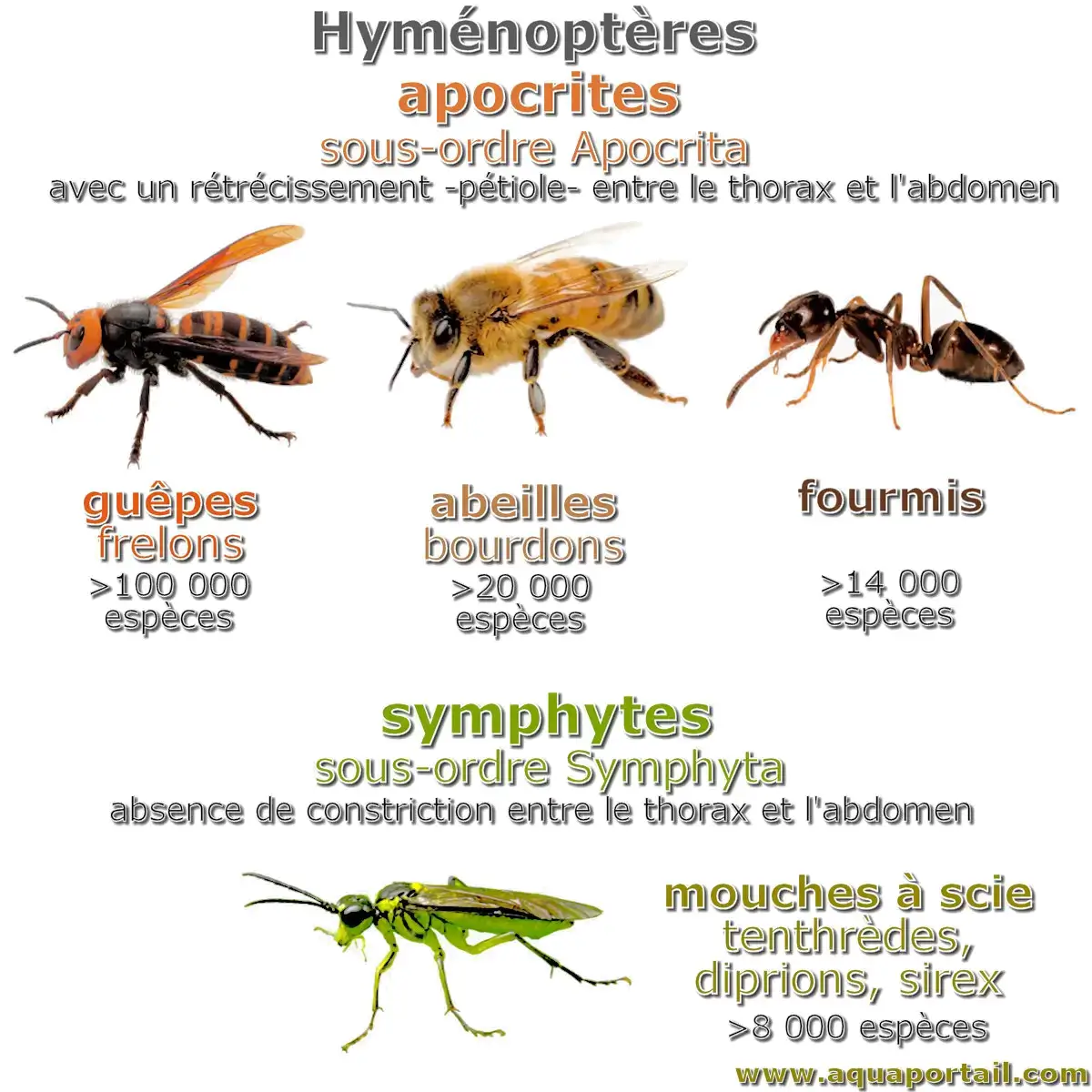
Hymenopterans, order Hymenoptera, are holometabolous insects with four membranous veined wings and a narrow waist (bees, wasps, ants, sawflies).
wakame

Wakame is the Japanese name, now a commercial name, for the brown alga Undaria pinnatifida. This kelp native to Japan, originating from the Sea of Japan...
wall

In everyday language, a wall (rampart) is an enclosed wall, a thick barrier intended for the protection and defense of a given site.
waste

Waste is any product or substance that is no longer suited for the purpose for which it was intended.
Simple summary
The wasp is a slender-waisted hymenopteran insect equipped with two pairs of wings and a stinger. It can be social or solitary and is known for its role as both a predator and a pollinator.
