Hymenoptera
proper noun
Definition
Hymenopterans, order Hymenoptera, are holometabolous insects with four membranous veined wings and a narrow waist (bees, wasps, ants, sawflies). In winged individuals, the two pairs of wings can hook together. In others, the wings are vestigial.
The 4 groups of hymenopterans (Hymenoptera):
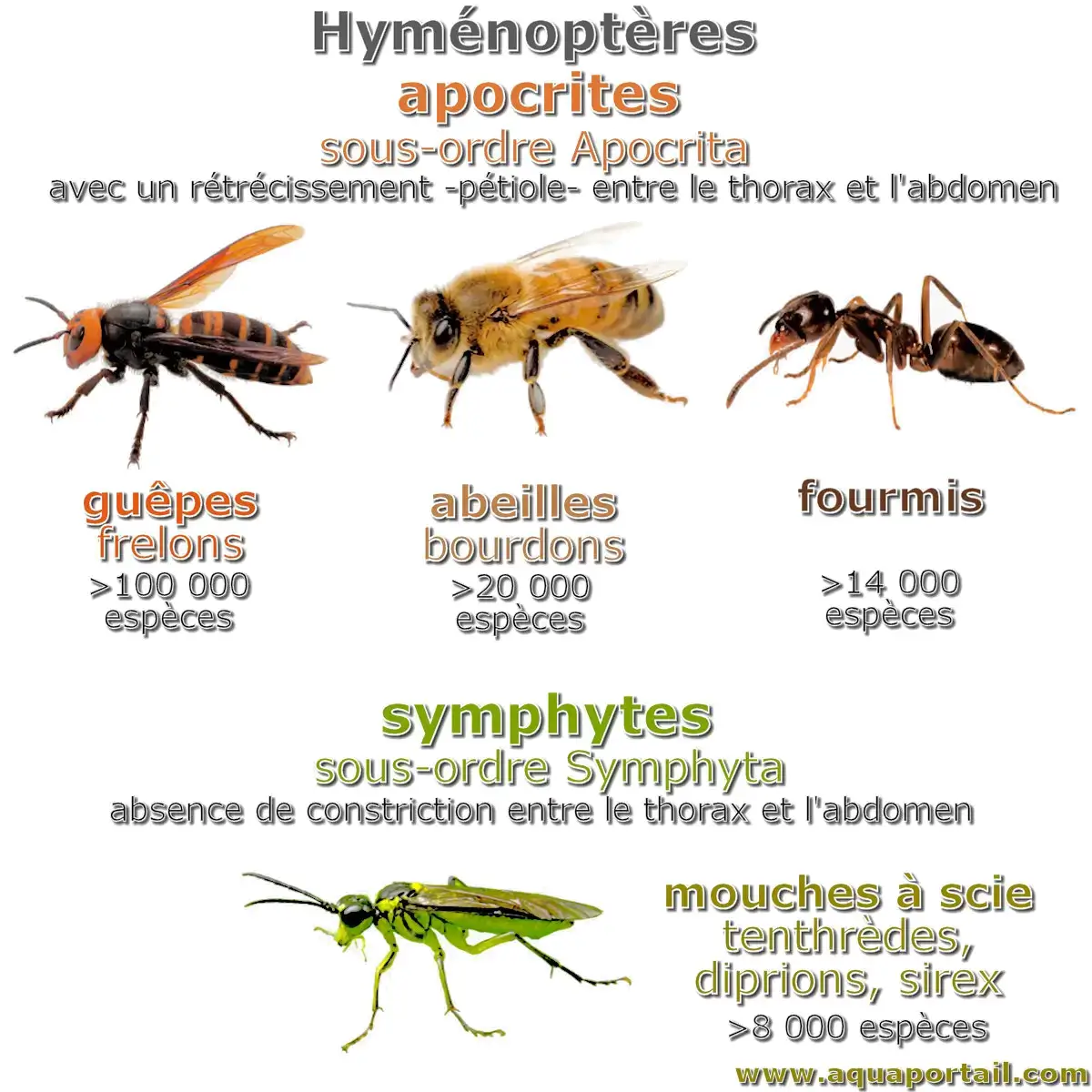
Hymenopterans (Hymenoptera) comprise two major suborders with Apocrita (wasps, bees, and ants) and Symphyta (sawflies, horntails). They constitute one of the most diverse and ecologically important orders in the class Insecta, grouping over 156,000 (in 2020) described species.
Explanations
A hymenopteran is characterized by two pairs of membranous wings, a marked constriction between the thorax and abdomen in many species, and sometimes complex social structures.
A characteristic of hymenopterans is the presence of a well-developed ovipositor which, in higher forms of the order, has transformed into a stinger. This transformation is exclusive to females, with the stinger evolving directly from the ovipositor. Consequently, male hymenopterans lack one. Only females can inflict stings.
The small size of many hymenopteran species poses identification difficulties, often complicating their classification, even at the family level. Thus, the smallest hymenopteran species is Kikiki huna, whose length does not exceed 150 µm (0.15 mm / 0.006 in). The largest and heaviest is the giant scoliid wasp Megascolia procer, with a body length of over 7.7 cm (3.0 in) and a wingspan of 11.6 cm (4.6 in).
Anatomy of a hymenopteran:
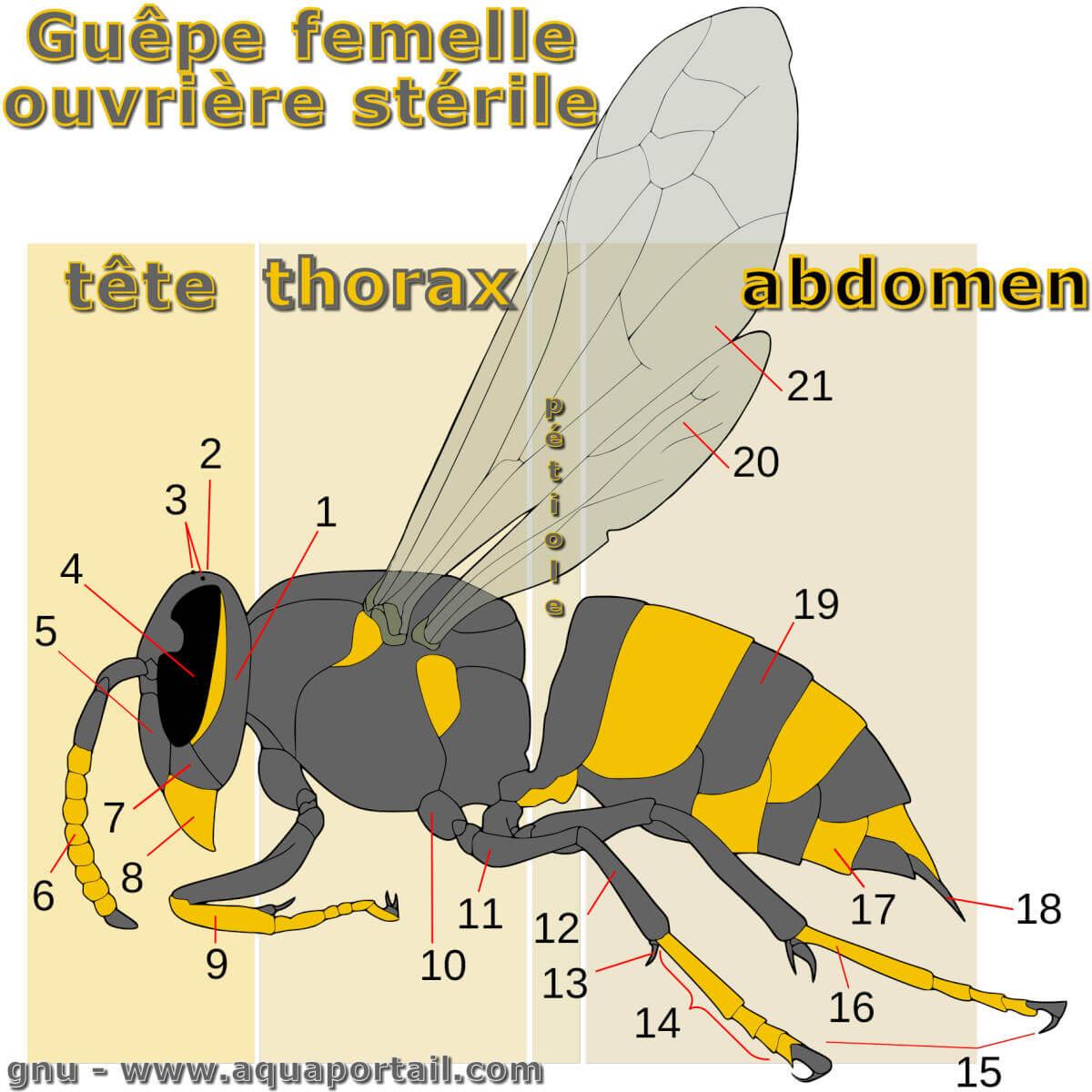
Hymenopterans (Hymenoptera) have specific structures such as the petiole (narrow waist) separating the thorax (mesosoma) and abdomen (metasome), and the clypeus behind the oculomalar space.
Hymenopterans are found in almost all terrestrial habitats, except for the most extreme environments, such as polar regions.
Characteristics
One of the defining morphological characteristics of hymenopterans is the presence of membranous wings in adults, generally two pairs linked by a row of hooks called hamuli. This adaptation facilitates synchronized wing movement in flight.
While most members of this order undergo complete metamorphosis, their larval forms can vary considerably depending on the species' ecological niche. Bee and ant larvae, for instance, are generally immobile and depend entirely on parental care to survive. Conversely, sawfly larvae resemble caterpillars and are herbivorous; they play an important role in decomposition and nutrient cycling.
⭐ Genetic tools such as genome sequencing of hymenopterans have provided a better understanding of the molecular mechanisms underlying traits like pheromone communication, caste differentiation, and disease resistance within different hymenopteran populations.
Reproduction
The reproductive strategies of hymenopterans are highly diverse. One of the most remarkable features of this order is its haplodiploid sex-determination system. In this system, fertilized eggs develop into diploid females, whereas unfertilized eggs develop into haploid males.
This mechanism has implications for the evolution of eusociality within various hymenopteran lineages. Eusociality, characterized by cooperative brood care, reproductive specialization, and overlapping generations within a colony, is exemplified by species such as the honey bee (Apis mellifera) and numerous ant species. The evolution of eusociality in hymenopterans sheds light on complex behaviors such as division of labor and kin selection.
Ecological importance
Hymenopterans are widely regarded as the most beneficial group to humans among all insect groups. One of their most important contributions is their role in pollination, a crucial process for the successful reproduction and development of many fruit and vegetable crops. Additionally, many Hymenoptera species offer substantial ecological benefits through their parasitic and predatory behaviors, particularly by regulating insect pest populations, thereby contributing to natural pest control.
The ecological role of hymenopterans extends well beyond their social behaviors. Bees, for example, are essential pollinators and contribute directly to the reproductive success of countless plant species. Their pollination services are indispensable not only to wild ecosystems, but also to global agricultural systems. Furthermore, many parasitic wasp species regulate pest populations by preying on or parasitizing other insects, thus providing natural pest control that reduces reliance on chemical pesticides.
Ants, another major group of hymenopterans, are important in ecosystem engineering through their contribution to soil aeration and nutrient redistribution. Their galleries improve soil structure and promote the infiltration of water and air to plant roots. Moreover, ants maintain mutualistic relationships with various organisms. For example, their interaction with plants bearing extrafloral nectaries enhances the protection of these plants, as ants defend them against herbivorous insects in exchange for nectar. Similarly, certain ants maintain mutualistic relationships with aphids, tending them for their honeydew while protecting them from predators.
Synonyms, antonyms
Spanish translation: himenópteros
3 synonyms (similar meaning) for "hymenoptera":
0 antonyms (opposite meaning).
Related words and expressions to HYMENOPTERA are directly connected by general or specific meaning.
The word HYMENOPTERA is listed on page 1 of words starting with H in the dictionary glossary.
Related to "Hymenoptera"
habitat

A habitat is the place or environment where an organism naturally lives and grows, its typical place of residence.
halitosis

Halitosis (bad breath) is primarily caused by sulfur-producing bacteria that normally live on the surface of the tongue and in the throat.
hallux

The hallux is the big toe (great toe) of a foot, homologous to the thumb of a hand. It is located on the medial (inner) side of the foot, whereas the little...
hand

The human hand, the most distal part of the upper limb, is a remarkable feat of engineering and evolution.
Simple summary
The order Hymenoptera comprises a highly diverse group of holometabolous insects across ecosystems worldwide. From their social structures and reproductive strategies to their roles as pollinators, predators, and mutualists, hymenopterans are key to maintaining ecological integrity. They remain indispensable to both natural ecosystems and human societies.
