Hypha
plural noun (n.pl.)
Definition
A hypha is a long, filamentous structure found in algae, fungi, or actinobacteria. Fungal hyphae consist of a chain of elongated tubular cells enclosed by a chitin-rich cell wall, forming a branching network of cylindrical filaments.
Structure of fungal hyphae:
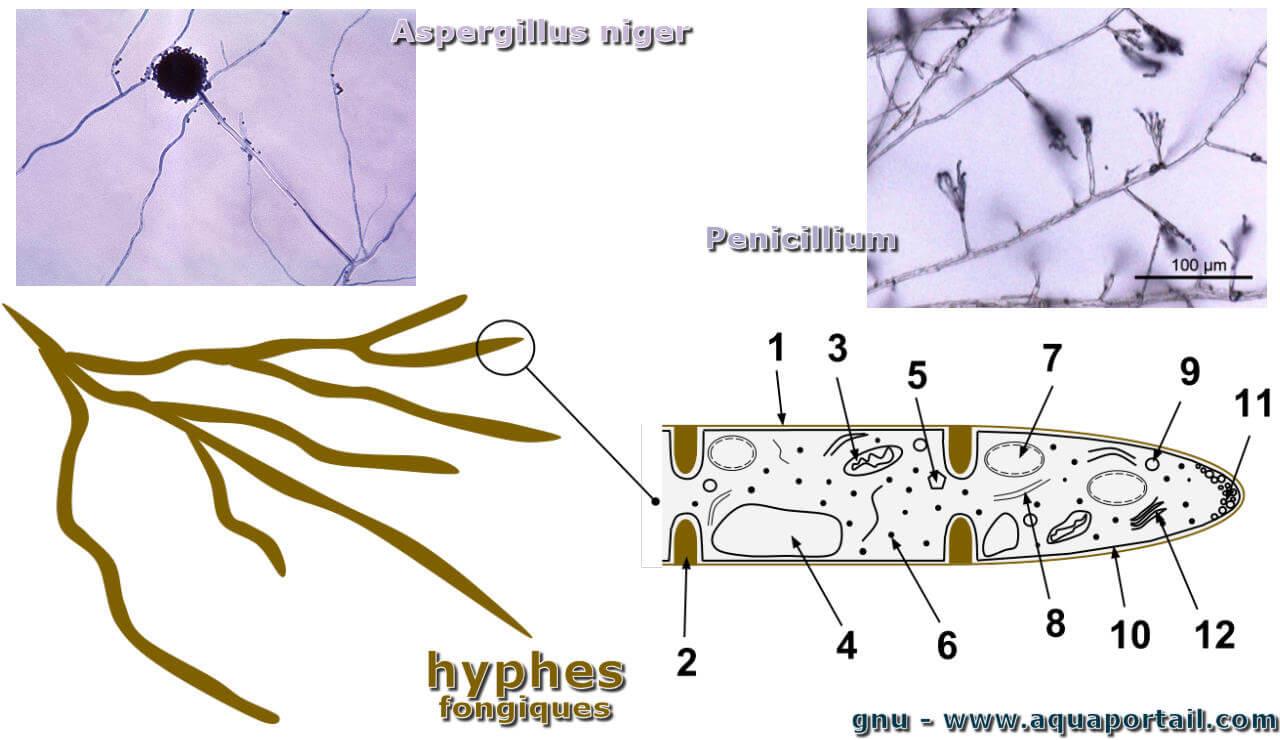
Fungal hyphal cells consist of: 1- hyphal cell wall, 2- septum, 3- mitochondrion, 4- vacuole, 5- crystalline ergosterol, 6- ribosome, 7- nucleus, 8- endoplasmic reticulum, 9- lipid body, 10- plasma membrane, 11- Spitzenkörper (growth vesicles), 12- Golgi apparatus. Illustrated are hyphae of Aspergillus niger and Penicillium.
Explanations
In brown algae, a hypha refers to a septate filament such as those forming the medulla of kelps. In fungi, it designates a tubular cell of filamentous fungi that may be subdivided by cross-walls (septa) into multicellular compartments and can branch extensively.
The collective network of cylindrical filaments forming the vegetative body of multicellular fungi is called the mycelium. Fungal hyphae take up NH4+ and NO3- via antiport and symport transport mechanisms, respectively.
A hypha is a long cellular filament in fungi or actinomycetes (actinobacteria) and the fundamental thread of the fungal mycelium. Hyphae may be septate (divided by cross-walls) or aseptate, a distinction historically separating Septomycetes and Siphomycetes. See mycelium and trumpet hypha.
A hyphal fragment pertains to fungi; fungal growth is described as hyphal because tissue morphogenesis requires coordinated growth across multiple hyphae.
Hyphae may exhibit septation dividing the filament by septa—perforated cross-walls creating partial cytoplasmic compartmentalization—whereas fungi lacking cross-walls are termed coenocytic.
Compartments of septate hyphae may be uninucleate or multinucleate, with nuclei and organelles migrating across compartments through septal pores to support growth and genetic exchange. Coenocytic hyphae, by contrast, may contain hundreds to thousands of nuclei within a continuous cytoplasmic filament.
Many haustorium-forming fungi possess specialized hyphae that penetrate living host tissues for digestion and nutrient absorption, while others adhere to substrates such as rock or bark. Plant roots form a specialized symbiotic interface with fungal hyphae known as mycorrhizae.
In symbiotic hyphae growing within or upon plants, the direct contact interface between fungus and plant remains remarkably consistent across diverse symbioses: fungal and plant protoplasts remain separated even when the fungus penetrates individual plant cells, leaving two plasma membranes—one fungal and one plant—between their respective cytosols.
These membranes harbor specialized transport channels regulating nutrient exchange, and are separated by a thin, permeable layer of extracellular matrix belonging to the apoplast, derived from both partners, allowing solutes to diffuse readily.
Certain normally unicellular yeasts, such as Saccharomyces cerevisiae, can also form hyphae or pseudohyphae under specific environmental conditions.
✅ See also a dimitic, monomitic, or trimitic hyphal system.
Types
The main types of structural and reproductive hyphae are:
- generative hyphae: relatively undifferentiated hyphae capable of forming reproductive structures; typically thin-walled, translucent, frequently septate, and often bearing clamp connections, sometimes embedded in a gelatinous matrix
- skeletal hyphae: thick-walled, unbranched or sparingly branched, mostly lacking clamp connections and septa, and often very long; they typically die early, becoming hollow and devoid of cytoplasm, imparting rigidity and strength to corky or woody fruiting bodies
- skeletoid hyphae: thick-walled generative hyphae possessing true septa and occasionally clamp connections
- binding (ligative) hyphae: thick-walled, intricately branched hyphae that weave together and reinforce the hyphal system
Skeletal and binding hyphae are generally devoid of living cytoplasm, which migrates continuously toward the growing hyphal tip, leaving hollow cell walls behind—giving many bracket polypores their tough, woody texture.
Hyphae of a mycelium:
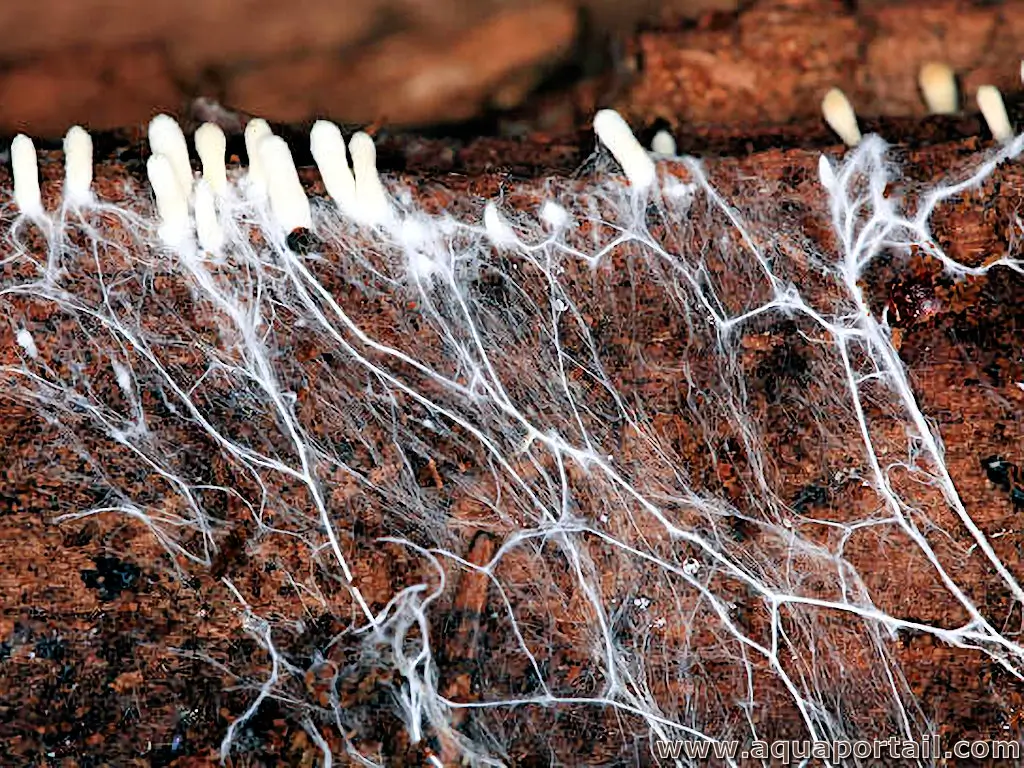
The mycelium forms the fundamental vegetative body of a fungus, comprising an extensive network of hyphae optimized for absorptive nutrition through a high surface-area-to-volume ratio. Fungi protect these networks with physical plugs called "Woronin bodies" alongside a genetic vegetative incompatibility system.
Certain septate fungi also produce specialized septate or aseptate conidiophores bearing asexual spores.
Yeasts reproduce asexually by budding blastoconidia, in which a daughter cell emerges at the pole of a parent cell and enlarges into a new yeast cell.
Septate hypha
A septate hypha is a hypha partitioned by cross-walls into uninucleate or multinucleate cell-like compartments.
Three primary structural hyphal types are recognized:
- binding: thick-walled, highly branched hyphae that bind tissues together
- generative: thin-walled, frequently septate, less differentiated hyphae
- skeletal: long, thick-walled hyphae with few septa
Specialized hyphae
Specialized hyphae have evolved for diverse ecological functions in specific fungal groups. Appressoria are flattened, swollen hyphal tips that adhere to host surfaces and drive narrow penetration pegs through cell walls, formed by many plant pathogens and sapstain fungi. Haustoria are enlarged, convoluted absorptive hyphal structures that invaginate the host plasma membrane after penetrating the cell wall.
Specialized hyphae occur in rusts, powdery mildews, and certain mycorrhizal fungi, while biotrophic mycoparasites invade host fungi using haustorium-like hyphae. Remarkable specializations also include nematode-trapping hyphae equipped with adhesive knobs or rapidly constricting rings.
⭐ chlamydospores are thick-walled resting cells capable of surviving prolonged unfavorable environmental conditions. Some hyphae synthesize melanin, a dark pigment shielding surface-growing molds from ultraviolet radiation.
Melanized hyphae also cover the outer rind of certain rhizomorphs and fungal propagules such as microsclerotia, serving a protective role. Spores are the reproductive dispersal units of fungi, commonly borne on specialized fertile hyphae.
Large fruiting bodies of certain Ascomycota and Basidiomycota also contain specialized structural hyphae. Tightly packed aggregations of thin-walled hyphae resembling parenchyma cells of vascular plants, termed pseudoparenchymatous hyphae, form the soft flesh of many fleshy ascomata and basidiocarps.
When inflated and spherical within the gill trama of a fruiting body (as in Russulales), these cells are called sphaerocysts and serve as key diagnostic traits. Three hyphal types combine in the tough fruiting bodies of wood-decay fungi: generative hyphae give rise to the spore-producing hymenial layers, while leathery or woody basidiocarps incorporate thick-walled, branched binding hyphae interwoven with generative hyphae.
Large woody bracket fruiting bodies such as Ganoderma applanatum also contain elongated, thick-walled, unbranched skeletal hyphae resembling wood fibers that confer hard, woody rigidity.
These three structural hyphal types (monomitic, dimitic, and trimitic hyphal systems) serve as foundational taxonomic criteria in classifying wood-decaying Basidiomycota: generative hyphae occur in all fruiting bodies, whereas individual species may additionally possess binding hyphae, skeletal hyphae, or both.
Synonyms, antonyms
French translation:
hypheSpanish translation: hifa
2 synonyms (similar meaning) for "hypha":
0 antonyms (opposite meaning).
Related words and expressions to HYPHA are directly connected by general or specific meaning.
The word HYPHA is listed on page 1 of words starting with H in the dictionary glossary.
Related to "hypha"
trumpet hypha

A trumpet hypha is a specialized medullary filament in brown algae of the order Laminariales whose cells have flared, trumpet-shaped ends.
habitat

A habitat is the place or environment where an organism naturally lives and grows, its typical place of residence.
halitosis

Halitosis (bad breath) is primarily caused by sulfur-producing bacteria that normally live on the surface of the tongue and in the throat.
hallux

The hallux is the big toe (great toe) of a foot, homologous to the thumb of a hand. It is located on the medial (inner) side of the foot, whereas the little...
Simple summary
Hypha designates a thread-like filament that forms the basic structural unit of fungi. These slender filaments grow and branch to form a network called a mycelium, enabling the fungus to absorb nutrients from its environment. Hyphae may be septate (divided into individual cells by cross-walls) or coenocytic (lacking cross-walls, forming a continuous cytoplasmic mass).
