Species
noun (n.)
Definition
Species refers to a group of morphologically similar individuals capable of interbreeding with one another and producing viable, non-sterile offspring. In systematic classification, species consist of individuals of taxa below the genus level.An animal, plant, or other kingdom species belongs to a population of identical organisms that can reproduce and give rise to offspring capable of reproducing in turn to perpetuate that species.
Two different species of crows:
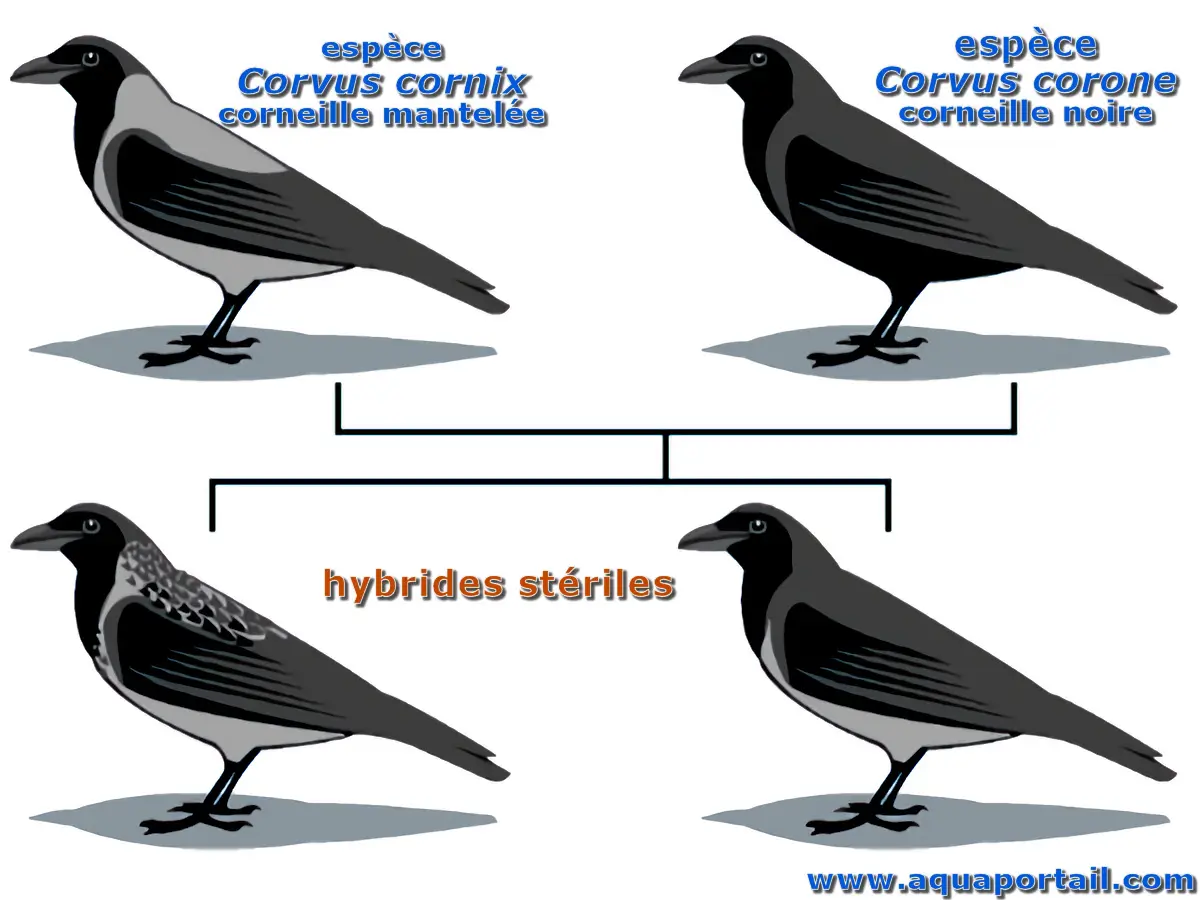
Hooded crows and carrion crows are distinct and mate largely within their own species. However, in certain regions, they hybridize. Hybrid offspring are sterile, whereas conspecific offspring (of the same species) are fertile.
Explanations
A species groups together biological populations potentially capable of interbreeding that are reproductively isolated from other groups. The species is the fundamental taxon of zoological nomenclature, which together with the genus precisely defines the binomial name of an organism.
⭐ See also chemical species in analytical chemistry.
In taxonomy
In taxonomy, if the vernacular name of a species is the goldfish, its scientific binomial is Carassius auratus, where Carassius is the genus (or "generic name") and auratus is the species (or "specific epithet"). For an aquarist, the species name is often the reference used to designate a fish, because while the genus may occasionally change in nomenclature, the species epithet generally remains invariable (aside from gender agreement) over time. Vernacular names are too variable and cannot serve as an international reference.
In other words, a species is characterized as a group of organisms, of living beings, descended from a common ancestor, sharing common traits and capable of reproducing only among themselves to produce fertile offspring: this is the principle of interfertility of a species. Generally, members of a species share a distinct geographical distribution. The species is therefore a fundamental grouping in the taxonomic hierarchy.
Species differs from the concept of breed or race.
A species also refers to a set of individuals sufficiently alike to interbreed and yield fertile descendants. The species constitutes a subdivision of the genus and is sometimes itself divided into subspecies. To designate an individual, the species name is paired with the genus name: this is the Linnaean binomial. A species differs from a hybrid (a cross between two species) by its ability to reproduce and produce offspring that are themselves capable of reproducing.
The word species comes from Latin species in taxonomy: its abbreviation naturally appears in sp.. This abbreviation is used in taxonomy to designate an undetermined species of a genus (Carassius sp.), whereas Carassius spp. designates all species of the genus. See also linneon, jordanon, Linnaean species, Jordanian species.
In biology
A workable biological definition of the word "species" and reliable methods for identifying particular species are essential for stating and testing biological theories and measuring biodiversity. Traditionally, numerous specimens of a proposed species must be studied by unifying taxonomists before the organism can be recognized as a species.
It is generally difficult to establish precise taxonomic classifications for extinct species known only from fossils: this is the case for Megalodon, for example, where taxonomic ambiguity persists today.
This shark is the species Triaenodon obesus:

By definition, a species is the basic unit of a taxon in systematics and nomenclature. Shown here is the shark Triaenodon obesus.
Some biologists view species as statistical phenomena, in contrast to the traditional view of a species as a class of organisms. In this perspective, a species is defined as a separately evolving lineage forming a single gene pool. Although properties such as DNA sequences and morphology are used to help separate closely related lineages, this definition has fuzzy boundaries.
However, the exact definition of the term "species" remains controversial, particularly among prokaryotes, a problem known as the species problem. Biologists have proposed a series of more precise definitions, but the definition used is a pragmatic choice depending on the characteristics of the species in question.
This textbook biological definition of species, while rigorous, is not strictly applicable in botany. Many plant forms readily produce fertile hybrids. In such cases, the applicability of this taxonomic definition is limited, and different categories are used based on somatic and/or phylogenetic diversity.
The definition of species can be refined according to the group (kingdom) to which the organism belongs: animal species, plant species, and bacterial species are the 3 main types.
Animal species
A species is termed animal if the organism belongs to vertebrates, invertebrates, and, historically, protozoa. Among vertebrates, mammals and fish in particular must be taken into account, as well as jawless fishes (agnathans).
Among invertebrates—the most diverse group with 1.5 million identified species—arthropods (including insects, arachnids, crustaceans, myriapods) and mollusks (gastropods, bivalves, cephalopods) must be considered.
Protozoa (unicellular eukaryotic protists) include various small organisms (amoebae, infusoria, etc.). The coral group is somewhat distinct: cnidarian animals living in symbiosis with unicellular algae (zooxanthellae), they are distinguished as coral species.
Plant species
A species is termed plant if the organism belongs to the plant kingdom: algae, terrestrial plants, aquatic plants, lichens, mosses, liverworts, etc. medicinal plants, aromatic plants, green plants, and others are found among plant species.
Bacterial species
A species is termed bacterial if the organism belongs to the domain of bacteria (prokaryotes): it encompasses various microorganisms (bacilli, cocci, etc.) distinct from protozoa and viruses (acellular), including what is commonly (though loosely) called body flora, such as gut flora.
Principle of interfertility
The most widely accepted definition, based on the principle of interfertility, is the biological species concept formulated by Ernst Mayr in 1942: a species is a population or group of populations whose individuals can actually or potentially interbreed and produce viable, fertile offspring under natural conditions.
✅ A species is the largest population unit within which gene flow is possible, and individuals of the same species are therefore reproductively isolated from other equivalent groups.
However, the interfertility criterion cannot always be verified: this is the case for fossils, asexual organisms, or rare and difficult-to-observe species. Other definitions may therefore be used:
- morphological species: a group of individuals defined by structural characteristics and meristic data (size, shape...);
- phylogenetic species: the smallest lineage of a population definable by a unique combination of diagnostic characters;
- ecological species: a group of organisms sharing the same niche, an ecological rather than purely geographical niche, such as an endemic organism;
- endemic species: an organism living in a specific, well-defined geographical area;
- phenetic species: a group of living organisms resembling one another (based on morphological, anatomical, embryological similarities, etc.) more than they resemble other equivalent groups.
Other non-biological meanings of the word "species"
The word "species" can refer to other concepts:
- In everyday French ("espèces"), it denotes banknotes and coins, i.e., cash currency in economics;
- In chemistry, a chemical species designates a molecular, ionic, or atomic ensemble with identical properties;
- In mathematics, a species refers to a class of similar geometric forms (cubes, squares, circles...);
- In religion, species denotes the consecrated bread and wine becoming the Body and Blood of Christ in the Christian Eucharist.
Expressions involving species
An associated species is a predator or prey of, or lives in a competitive relationship with, an exploited species.
An alien species occurs in a region to which it is not native; it is therefore a non-indigenous and, most often, introduced species.
A borderline species lives within a restricted distribution range, inhabiting the edges of a group's range and experiencing competitive pressure from other groups. In certain cases, one may also speak of vicariant species.
A transferred species designates any species transported and released, intentionally or accidentally, by humans into an environment within its current range where it did not originally occur. Many Lessepsian species introduced as stowaways on ship hulls are therefore transferred species.
A littoral species is an organism restricted to living as close as possible to the shoreline.
A protective species, or umbrella species, provides—often indirectly—protection to a large number of coexisting species in the same habitat that would otherwise be less well known and harder to protect. This is sometimes a predator that deters other, potentially more dangerous predators, thereby playing a protective role in its habitat.
A tamed species designates a species originally living in the wild that is raised by humans, not to be confused with a domesticated species.
Within the aquaculture sector, a commercial species refers to an aquatic, marine, benthic, cryptic, animal, or plant species that holds commercial value.
A Linnaean species is synonymous with a linneon, that is, a binomial adhering to the rules of species systematics and taxonomy based on a genus and species name to designate and identify an organism.
A genetically improved species designates a species whose production-related traits have been intentionally modified to improve either production efficiency or adaptation to specific production conditions through genetic technologies such as selective breeding, hybridization, chromosome manipulation, or gene and cellular technologies such as gene transfer. See also GMO.
The term "species" is often paired with a more specific qualifier, including this list:
- annual species,
- aquatic species,
- bacterial species,
- benthic species,
- cryptic species,
- endemic species,
- "endolithic" species,
- invasive species,
- exotic species,
- forage species,
- indigenous species (native plant),
- introduced species,
- marine species,
- naturalized species,
- non-indigenous species,
- type species,
- vicariant species,
- keystone species,
- macrospecies.
Species extinction
A species extinction (macrospecies) is a mass extinction applied to living organisms, though scientists, according to estimates from the University of Bristol, believe biodiversity could increase exponentially without human influence.
Synonyms, antonyms
Spanish translation: especie
6 synonyms (similar meaning) for "species":
- breed
- genus
- kind
- subspecies
- taxon
- type
1 antonym (opposite meaning):
Related words and expressions to SPECIES are directly connected by general or specific meaning.
The word SPECIES is listed on page 1 of words starting with S in the dictionary glossary.
Related to "species"
invasive species

An invasive (or encroaching) species refers to an organism that thrives at the expense of other species, outcompeting and displacing them.
model organism

A model organism is a non-human species extensively studied to understand specific biological phenomena, with the expectation that discoveries made...
genus

In biology, the genus is a unit of the systematic classification of living beings, a taxonomic rank within which species sharing common characteristics...
specific character

A specific character is a genetic character unique to a species, a characteristic trait of the species, and above all, one that is common to all individuals...
