Endemic
adjective (adj.)
Definition
Endemic denotes what is regularly present or prevalent within a particular geographic area, population, or environment. An endemic species or disease is restricted to a geographically delimited location.Hermann's tortoise is endemic to the lands north of the Mediterranean Sea :

The tortoise Testudo hermanni is a reptile endemic to Southern Europe.
Explanations
An endemic organism is specific to a particular, well-defined geographic region. Unlike cosmopolitan species, the endemism of such a species indicates that it is found nowhere else in the world. See endemic species and endemic plant.
An endemic disease is a disease that occurs consistently, on a regular basis, and without appreciable fluctuations, by definition of endemicity.
In biology
The opposite of endemic is cosmopolitan, because an organism is termed endemic when it lives only in a given region: a fish may be endemic to the Red sea. Endemism may be broad (continental), narrower (fish of the African Rift Great Lakes, for example), or very restricted (lake, river, stream, drainage basin), or tied to an ecoregion.
An endemic plant has a defined geographic distribution. For example, an endemic timber species is a tree, a forest species native to a region and found nowhere else.
An endemic organism has a limited geographic distribution, a limitation carrying significance with respect to biogeography and species history. This concept applies both to species and to higher taxonomic ranks (genera, families, etc.).
For example, the small gourami Malpulutta kretseri is endemic to Sri Lanka. All armored catfishes of the L–number system are endemic to South America, as are those classified under the A-number system for Apistogramma sp. or the C-number system for small Corydoras sp. catfishes.
Endemicity is the quality of being endemic. A taxon is endemic (paleoendemic or neoendemic) when it is confined to a specific area. In general, an endemic taxon should be accompanied by additional information indicating where its endemicity is exclusive.
In medicine
In medicine, an endemic disease remains confined to a delimited, known region or area; it is then called an endemic or endemic disease, remaining smaller in scale than an epidemic and contrasting with its antonym, a pandemic. Endemicity is permanent in character.
In epidemiology, endemic is a term used to refer to a pathological process that remains stationary within a given population or geographic area over long periods of time. It may involve infectious or non-infectious diseases, as the word can be applied to various conditions or physiological states.
An endemic disease persists in a host population of a given geographic region over time (years) at a stable level, including seasonal variations.
The degree of endemicity of a disease is classified according to transmission intensity:
- Hypoendemic: means that disease transmission is minimal and its effects are not significant.
- Mesoendemic: means that the disease is established in small communities. Transmission intensity varies depending on local circumstances.
- Hyperendemic: means that the intensity of disease transmission in the reference area is persistent yet temporary. Immunity is insufficient to prevent the effects of the disease.
- Holoendemic: means that the disease exhibits a high degree of intensity. Transmission is perennial, with a wide geographic distribution, resulting in an immune response across different age groups, particularly among adults.
In ascending order of disease spread or number of people affected, diseases are categorized as endemic, epidemic, and pandemic (the latter when affecting more than one continent).
Examples of endemic diseases include malaria in certain tropical or warm countries of the Americas, Southeast Asia, and Africa, Chagas disease, dengue, yellow fever, and pertussis, among others.
Synonyms, antonyms
Spanish translation: endémico
7 synonyms (similar meaning) for "endemic":
- chronic
- endemic plant
- endemic species
- endemosporadic
- micro-endemic
- permanent
- sedentary
5 antonyms (opposite meaning):
- cosmopolitan
- introduced species
- migratory
- nomadic
- pandemic
Related words and expressions to ENDEMIC are directly connected by general or specific meaning.
The word ENDEMIC is listed on page 1 of words starting with E in the dictionary glossary.
Related to "endemic"
pandemic

A pandemic is the widespread outbreak of an epidemic infectious disease across a vast geographic area at a given time.
epidemic
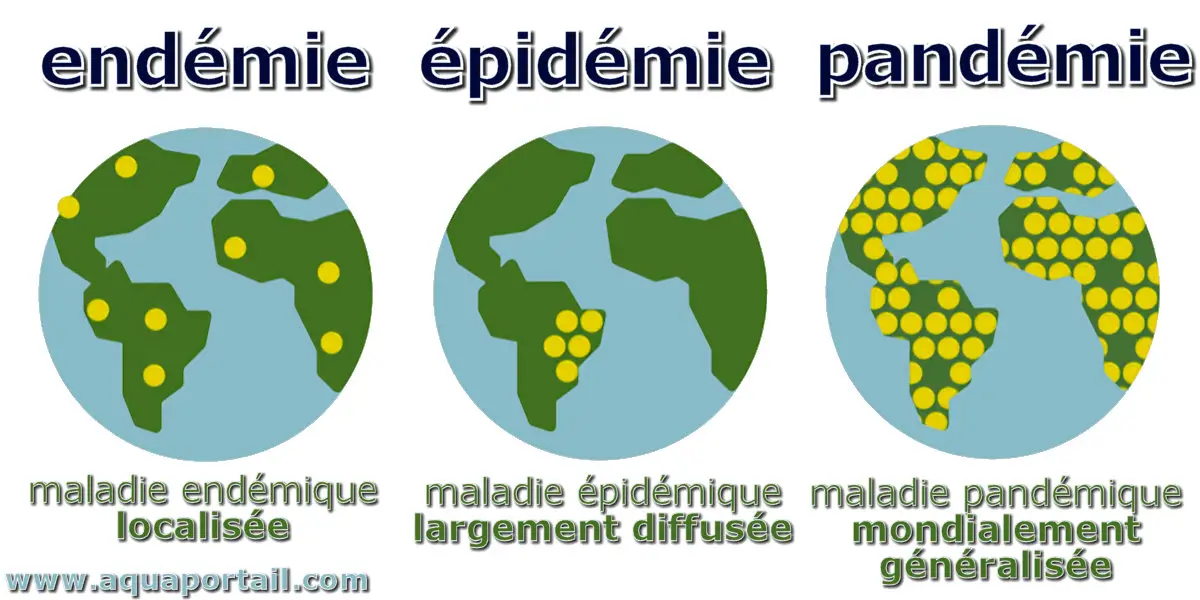
An epidemic is the widespread outbreak of an infectious disease within a community at a given time.
E=mc2

The formula E=mc2 (E = m. c²) is a mass-energy equivalence equation according to the theory of relativity developed by Albert Einstein. It expresses that...
Ecdysozoa

Ecdysozoans, of the superphylum Ecdysozoa, are protostomes undergoing ecdysis within Bilateria.
Simple summary
Endemic is often used in biology and medicine to describe species or diseases that are consistently present and restricted to a specific region. For example, an endemic disease is a disease that persists continuously in a given place, while an endemic species refers to a plant or animal native and unique to a particular area.
