Reproduction
noun (n.)
Definition
Reproduction refers to the biological process by which organisms produce offspring, thereby ensuring the continuity and perpetuation of their species. It occurs via two main mechanisms: asexual reproduction, where a single organism generates genetically identical offspring without the involvement of gametes, and sexual reproduction, which involves the fusion of specialized reproductive cells (gametes) from two parent organisms, giving rise to genetically diverse offspring.Reproduction in humans:
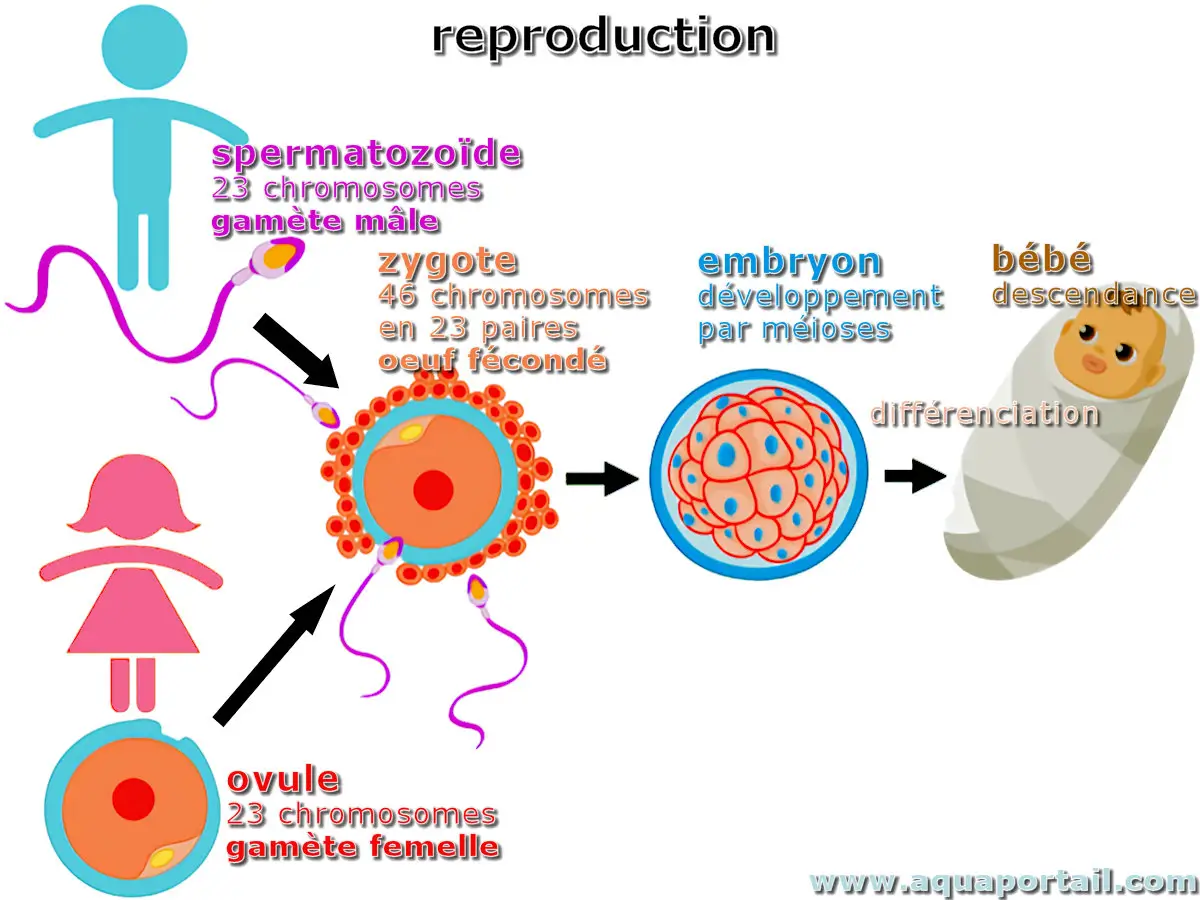
Human reproduction involves the union of male and female reproductive cells, called sperm and eggs, during sexual reproduction. It results in the formation of a zygote, which subsequently develops into an embryo and then a fetus in the female uterus.
Explanations
Reproduction is the function through which living beings perpetuate themselves via a reproductive system of parent organisms. The reproductive physiological process, sexual or asexual, consists of producing new individuals (procreation).
Reproduction is a fundamental characteristic of all evolving life because every individual organism exists only as the result of reproduction. For the two forms of reproduction in biology, see sexual reproduction and asexual reproduction.
In all cases, each offspring contains a portion of genetic material inherited from one (asexual) or more (sexual) parent organisms, the ancestors.
Reproduction with mutations, sometimes with reduction, refers to the use of artificially induced mutations during breeding.
In botany
In botany, the term reproduction is generally reserved for sexual reproduction. This involves the complementary processes of syngamy (fertilization) and meiosis (chromatic reduction). See the full article on plant reproduction.
Thus, there is not only the formation of a zygote, but also propagation via meiotic spores and certain other spores required to return to the gametophytic generation, such as carpospores or conchospores, excluding modes of vegetative propagation.
When plants multiply through other means (cloning, budding, division, etc.), the terms multiplication or propagation, and vegetative propagation, are preferred.
In zoology
A wide range of reproductive strategies are employed by different species. Some animals, such as humans, do not reach sexual maturity for many years after birth and even then produce few offspring.
Others reproduce rapidly; however, under normal circumstances, most offspring do not survive to adulthood.
Reproduction in vertebrate and invertebrate animals is most often sexual, involving the fertilization of eggs (ova) by sperm leading to egg production. Reproduction (as shown in the introductory photo of fish Corydoras) is thus a physiological function by which living organisms generate other living organisms resembling themselves.
Asexual reproduction (agamogenesis) without the involvement of sex cells differs from sexual reproduction, which involves sex cells called gametes.
Eggs resulting from male-female reproduction:

Fish eggs result from reproduction between a male and a female, called spawners (parent stock), which produce offspring.
For example, a rabbit (reaching maturity after 8 months) can produce 10–30 offspring per year, while a fruit fly (reaching maturity after 10–14 days) can produce up to 900 insects per year. These two primary strategies are known as K-selection (few offspring) and r-selection (many offspring).
However, which strategy is favored by evolution depends on a variety of circumstances! Thus, animals with few young can devote more resources to feeding and protecting each individual offspring, reducing the need to produce many descendants.
Conversely, animals with many offspring can allocate fewer resources to each individual descendant. Consequently, for these types of animals, many offspring commonly die shortly after birth, yet enough individuals generally survive to sustain the population.
Certain organisms such as bees and fruit flies (Drosophila), as well as fish like guppies and shrimp like the Red Cherry shrimp, store sperm in an organ called the spermatheca, thereby extending the duration of their fertility.
Other reproductive patterns also exist, including semelparity and iteroparity. Polycyclic animals reproduce intermittently throughout their lives. Semelparous organisms reproduce only once in their lifetime, such as annual plants (including all cereal crops) and certain species of salmon, spiders, bamboo, etc. They often die shortly after reproducing.
Iteroparous organisms produce offspring across successive cycles (e.g., seasonal breeders), such as perennial">perennial plants. Iteroparous animals survive across multiple seasons (or periodic environmental changes).
See also parasexuality (parasexual cycle) and the specific case of pelagic spawning.
Related expressions
Broodstock refers to specimens or species at the egg, larval, juvenile, or adult stage that can be bred in captivity for a first (and subsequent) generation, whether for aquaculture farming or for restocking in the wild to enhance natural populations.
Amixis refers to the inability of two species or breeds to interbreed due to physiological, behavioral, or geographic factors.
Terms relating to speciation carry the suffix "-patric" (adjective) or "-patry" (noun):
- allopatric (allopatry)
- parapatric
- peripatric (peripatry)
- philopatric (philopatry)
- sympatric (sympatry).
Line breeding is a father-daughter and mother-daughter breeding method used by geneticists to develop new "stable" varieties. In aquariums, aquarists use this inbreeding method to fix specific traits within a strain of fish or shrimp, such as the Red Cherry shrimp.
Synonyms, antonyms
Spanish translation: reproducción
9 synonyms (similar meaning) for "reproduction":
- copy
- duplication
- generation
- imitation
- multiplication
- perpetuation
- procreation
- propagation
- replication
0 antonyms (opposite meaning).
Related words and expressions to REPRODUCTION are directly connected by general or specific meaning.
The word REPRODUCTION is listed on page 1 of words starting with R in the dictionary glossary.
Related to "reproduction"
plant reproduction

Plant reproduction is of two types : sexual and asexual. Sexual reproduction is the fusion of male and female gametes within the flower in flowering plants.
generation

A generation is the average span of time between the birth of parents and that of their offspring.
regeneration

In biology, regeneration consists of the repair of an injured tissue or organ, or the (complete) restoration of a more or less lost or damaged organ.
reproductive system

The reproductive system (genital system) is the set of male or female genital organs. It encompasses the tissues, glands, and organs involved in sexual...
Simple summary
Reproduction is a stage of species perpetuation across generations, embedded in the organism's life cycle. It can be sexual, involving the exchange of gametes between two parents, or asexual, involving a single parent.
