Conchospore
noun (n.)
Definition
A conchospore is a diploid spore produced by the Conchocelis stage of Bangiales or Porphyra algae. Conchospores germinate in a bipolar manner to give rise to young chimeric thalli, thus completing the life cycle. Conchospores occupy the position in the reproductive cycle of these red algae where tetraspores are generally found, but unlike tetraspores, conchospores are not reductional (derived from meiosis).
Conchospores:
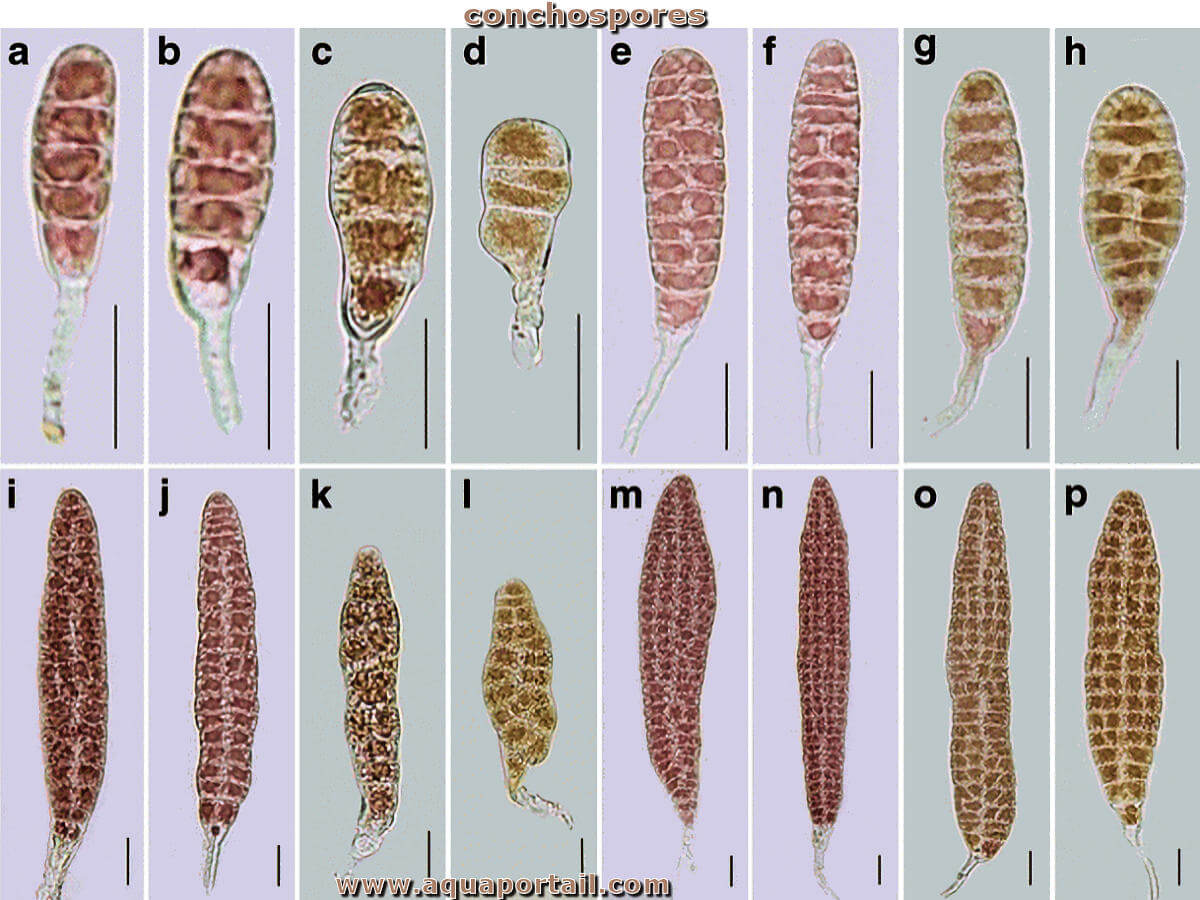
Growth and development of conchospore germlings of the wild-type strain (PC-WT) and the improved strain (TR-5) in Porphyra chauhanii after being cultured at 18, 23, 27, and 29 °C (64.4, 73.4, 80.6, and 84.2 °F) for 1 and 2 weeks, respectively.
Explanations
Porphyra has a heteromorphic life cycle with an alternation between a macroscopic leafy gametophytic phase and a filamentous sporophyte called the conchocelis phase. Porphyra reproduces through both sexual and asexual modes of reproduction. In sexual reproduction, certain mature vegetative cells differentiate into carpogonia, and others on the same or a different thallus differentiate into colorless spermatangia. After fertilization, the carpogonium divides to form packets of spores called zygotospores (carpospores). After release, zygotospores generally germinate unipolarly to produce the filamentous conchocelis phase.
Conchocelis can survive under unfavorable environmental conditions, but give rise to conchosporangia and conchospores under suitable conditions.
In asexual reproduction, the vegetative cells of certain species directly form spores called archeospores, which can germinate directly to form the thallus. Recently, it has been discovered that in addition to these two modes of reproduction, Porphyra also reproduces via endosporangia or endospores, which ultimately give rise to the thallus.
Study on early conchospore development in Porphyra yezoensis
Porphyra yezoensis Ueda (Rhodophyta) is an economically important alga with a typical dimorphic life cycle consisting of a leafy gametophyte and a filamentous sporophyte. Recently, it has been recognized as a model system for fundamental and applied studies in marine biological sciences. The conchospore, a major spore linking the two distinct multicellular phases of the life cycle, is the most widely used in breeding P. yezoensis. In this study, early conchospore development, including attachment and cell wall formation, was investigated using fluorescent reagent staining and scanning electron microscopy detection.
Results showed:
- the cell wall began to be generated after 4 h of culture in attached conchospores
- initially released conchospores were naked cells with a filmy, amorphous substance on the surface, and they attached firmly to fibers via mucilaginous substances actively secreted after contact with the fibers
- cellulase and pectolyase inhibited conchospore attachment in different ways
- only attached conchospores generated cell walls and developed normally, unlike those in suspension.
This indicated that cellulose played a crucial role in permanent attachment just as pectin did in initial attachment. Conchospore attachment appeared to trigger cell wall formation and subsequent development. The effects of light on conchospore development were also discussed. Results showed that high-intensity (200 μmol/m2·s) and long-wavelength (≥ 580 nm) light facilitated the division rate of conchospores.
Synonyms, antonyms
Spanish translation: concospora
1 synonym (similar meaning) for "conchospore":
0 antonyms (opposite meaning).
Related words and expressions to CONCHOSPORE are directly connected by general or specific meaning.
The word CONCHOSPORE is listed on page 1 of words starting with C in the dictionary glossary.
Related to "conchospore"
aplanospore

An aplanospore is a non-swimming spore (as opposed to a planospore or a zoospore). Such spores lack flagella but may possess features of swimming cells such...
archaeospore

In red algae, an archaeospore is the contents of an ordinary vegetative cell which, released without prior mitosis, functions as a spore.
autospore

An autospore is each of the non-motile spores (aplanospores) produced by division and differentiation of the contents of a coccoid unicellular organism.
auxospore
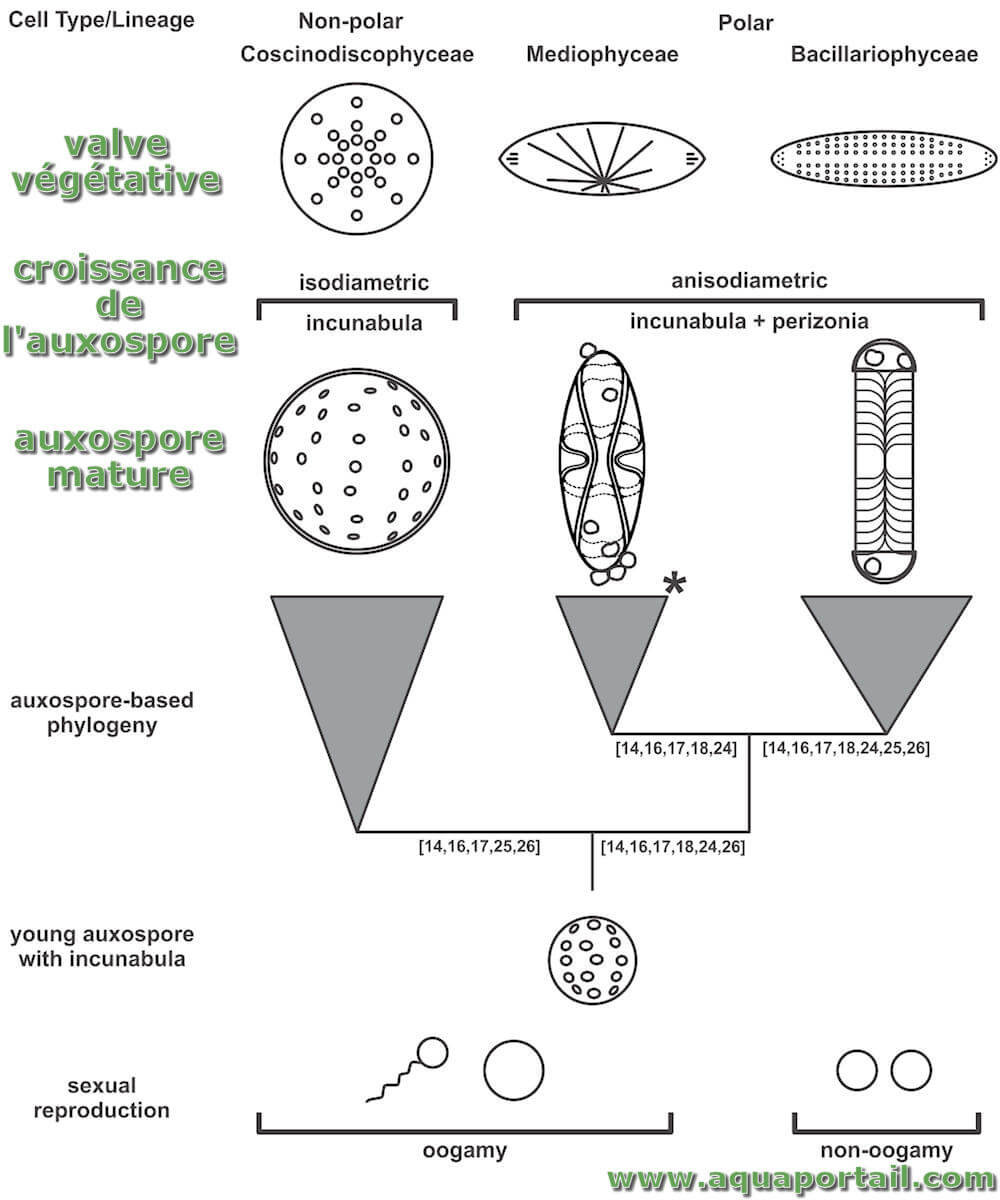
An auxospore is a reproductive cell in diatoms generally resulting from the union of two smaller cells or their contents and associated with the rejuvenation...
