Zygotospore
noun (n.)
Definition
A zygotospore is a spore resulting directly from the division of the zygote (as in Porphyra). After fertilization, the carpogonium divides to form packets of spores called zygotospores (carpospores).
After release, zygotospores generally germinate unipolarly to produce the filamentous conchocelis phase. Conchocelis can survive under unfavorable environmental conditions, yet give rise to conchosporangia and conchospores under suitable conditions.
Zygotospores of Porphyra linearis:

Release and germination of zygotospores of Porphyra linearis from Ireland: (1) Release of zygotospores; (2) Petri dish containing five scallop shells with conchocelis patches and conchocelis tufts floating in the medium; (3) Conchosporangial cluster removed from shells; (4) Release of conchospores; (5) Estimation of conchocelis growth by area in mm2 of conchocelis phase in the shell; (6) Estimation of conchosporangia production by number of conchosporangial colonies per mm2 of conchocelis.
Explanations
The biphasic life cycle of Porphyra comprises a foliose gametophytic stage (blade) and a heteromorphic filamentous sporophytic stage (Conchocelis). The blade may be one or two cell layers thick, and each cell contains one or two star-shaped plastids.
Blade morphology ranges from long and narrow to round and heavily ruffled (lanceolate to pseudo-umbilicate). This morphological variation can be quite diverse even within a single species. Blades can reach one meter (3.3 ft) in length; however, individuals often do not exceed 30 cm (11.8 in).
Reproductive development is either hermaphroditic (monoecious) or with separate male and female thalli (dioecious). Individuals may also produce asexual spores, or reproduction may even be exclusively asexual.
Asexual reproduction proceeds via archeospores, neutral spores, endospores, and agamospores. In hermaphroditic thalli, sexual differentiation of cells occurs either in sectors of the blade or diffusely across the blade, varying by species. Fertilization occurs when a non-flagellated spermatium fertilizes a single-celled female gamete retained within the blade.
Mitotic amplification of the zygote subsequently takes place through lateral and periclinal divisions; the number of cell divisions can be used to identify species in certain cases. Release of the resulting (diploid) zygotospores normally takes place at the blade margin with a distal bias.
Zygotospores germinate into the Conchocelis phase of the Porphyra life cycle.
The Conchocelis stage of Porphyra exhibits unipolar germination from a zygotospore (formerly carpospore); it penetrates calcareous materials (such as oyster shells) and grows within them. The Conchocelis stage consists of microscopic branched filaments containing pit plugs between cells.
During reproductive maturation of this stage, several conchosporangia emerge from the shell. Conchospores are released and undergo meiosis during bipolar germination, giving rise to the haploid blade. Certain spores ("monospores") that do not undergo meiosis regenerate the Conchocelis phase.
Cultivation of Conchocelis
In Asia, conchocelis cultivation begins around mid-spring (March/April). In nature, the conchocelis phase develops inside oysters, mussels, clams, or scallops.
However, in Japan, artificial substrates made of transparent vinyl films coated with calcite granules are beginning to be used as a substitute for mollusk shells. Usually, oyster shells or artificial shells are placed at the bottom of shallow tanks filled with seawater to allow seeding.
Seeding can be accomplished by introducing chopped pieces of fertile (mature) Porphyra blades into the seeding tank, which are removed after zygotospore release.
The zygotospore suspension can be prepared artificially by air-drying fertile thalli overnight and then immersing them in seawater for 4 to 5 hours the next morning (this induces massive release of zygotospores) or by grinding fertile blades and separating the zygotospore suspension by filtration. The zygotospore suspension is then introduced into the seeding tank, where the spores settle onto the calcareous substrate.
An alternative, increasingly popular method is mass cultivation of conchocelis that are then seeded directly onto calcareous substrates. The advantage of this technique is the use of defined strains that yield a more uniform harvest.
In each case, the seeded substrates are kept in large tanks (0.25 to 0.5 m / 0.8 to 1.6 ft deep). Shell substrates are either suspended vertically or spread across the bottom. The conchocelis is allowed to grow through the rest of the summer under low light levels (25–50 μmol photons/m2·s), at a 16:8 h L:D photoperiod and 23 °C (73.4 °F).
Recently, bioreactors have been developed for cultivating "free-living conchocelis" of North American native Porphyra species in the laboratory. In this method, conchocelis clones are vegetatively propagated to produce sufficient biomass for mass production of conchospores.
Large quantities of conchocelis can be produced and maintained in bioreactors under controlled temperature, light, photoperiod, and salinity. The conchocelis are induced en masse to produce swollen fertile reproductive filaments, forming conchosporangia and conchospores. The process is less cumbersome and requires less labor. Mass release of conchospores can be induced on demand and seeded onto nets.
Synonyms, antonyms
Spanish translation: zigotospora
2 synonyms (similar meaning) for "zygotospore":
0 antonyms (opposite meaning).
Related words and expressions to ZYGOTOSPORE are directly connected by general or specific meaning.
The word ZYGOTOSPORE is listed on page 1 of words starting with Z in the dictionary glossary.
Related to "zygotospore"
aplanospore

An aplanospore is a non-swimming spore (as opposed to a planospore or a zoospore). Such spores lack flagella but may possess features of swimming cells such...
archaeospore

In red algae, an archaeospore is the contents of an ordinary vegetative cell which, released without prior mitosis, functions as a spore.
autospore

An autospore is each of the non-motile spores (aplanospores) produced by division and differentiation of the contents of a coccoid unicellular organism.
auxospore
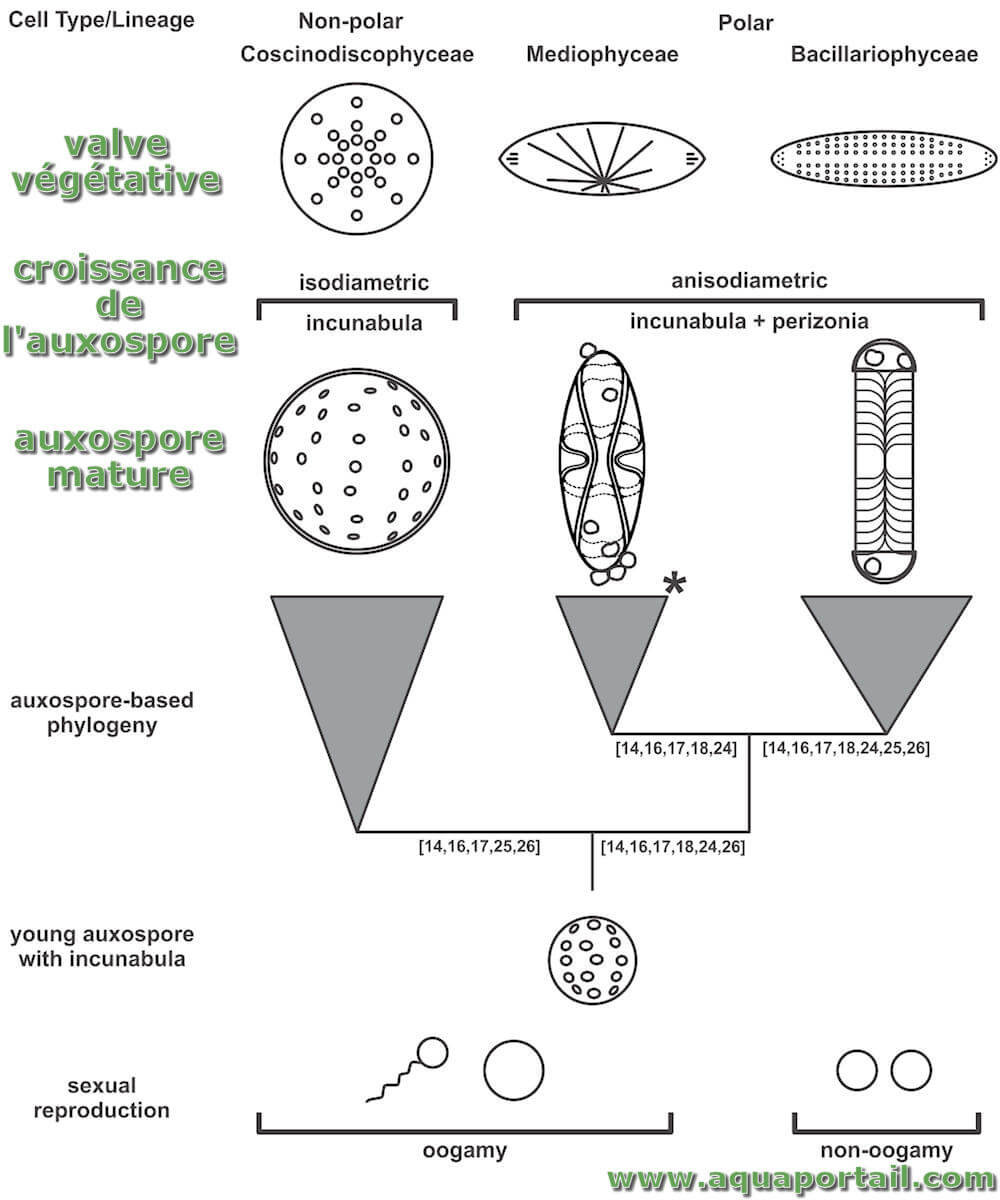
An auxospore is a reproductive cell in diatoms generally resulting from the union of two smaller cells or their contents and associated with the rejuvenation...
