Nautilus
noun (n.)
Definition
A nautilus is a pelagic marine cephalopod of the family Nautilidae whose major characteristic is an external shell containing a series of air chambers, with which the animal controls its buoyancy.
Nautiluses are among the most beautiful and unusual creatures in the ocean. However, they suffer from the high-volume trade in their unique, spiraled, and geometrically perfect shells.
A nautilus Nautilus pompilius:
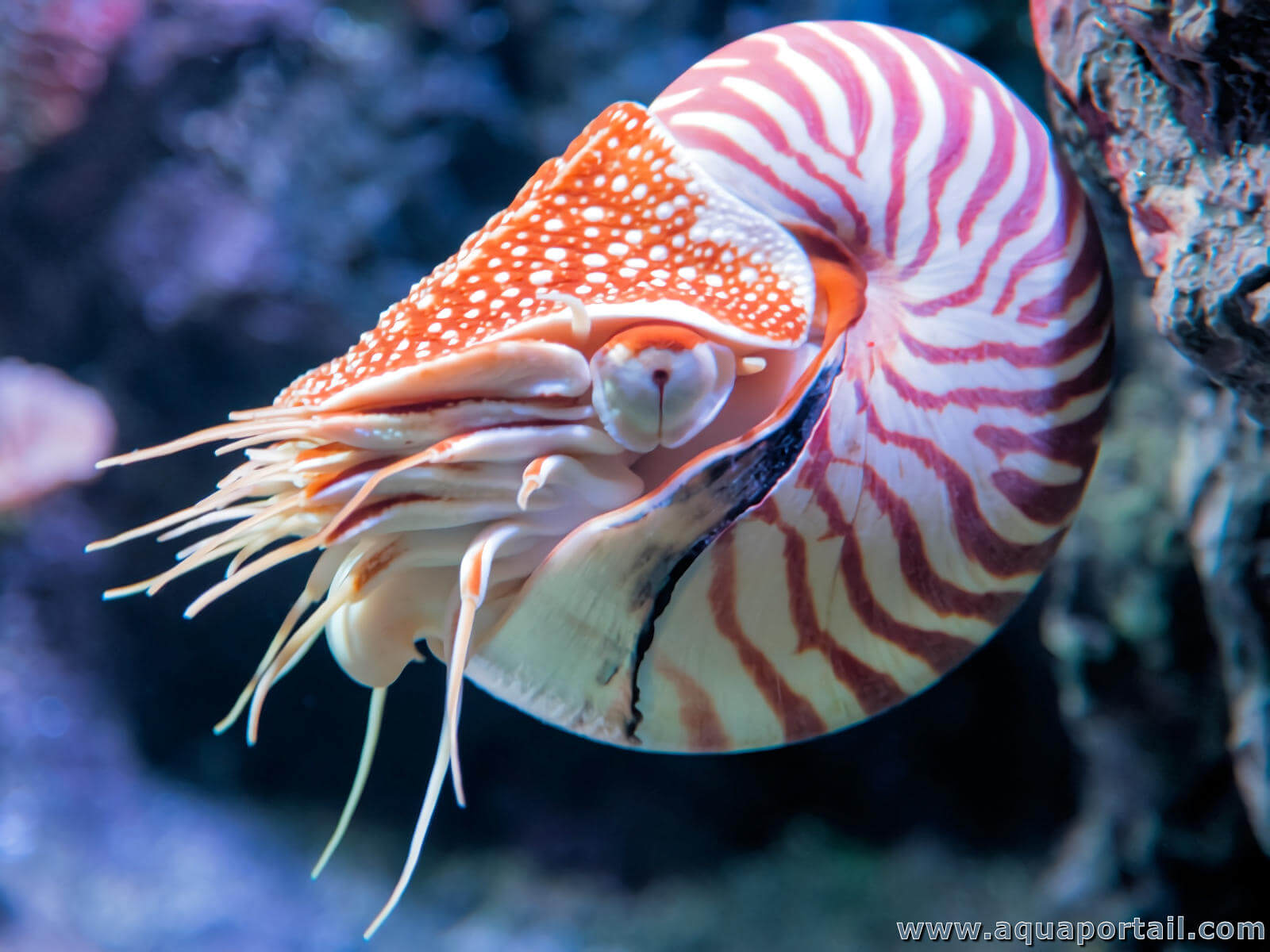
Nautilus pompilius is the largest of the living species, and also the most widespread. The pearly chambered nautilus lives in deep reefs (between 100 and 700 m / 328 and 2,297 ft) of the tropical Indo-Pacific.
Explanations
Although Nautilus is the type genus of the family Nautilidae, other nautilus genera have existed since the Early Triassic (252 Ma). The oldest known fossil discoveries of this genus date back to the Late Eocene (40 Ma). Nautiluses existed before dinosaurs and survived all major global extinctions!
Unique life-history traits such as slow growth rates, low fecundity, and long generation and gestation times also make the chambered nautilus vulnerable even to low levels of fishing intensity. In this sense, the species is more like oceanic sharks than its cousins, squids and octopuses. Chambered nautiluses have a very limited rebound capacity because migration and population dispersal are restricted, resulting in isolated populations with low or zero connectivity. The loss of isolated populations therefore represents a loss of genetic biodiversity and a potential loss of unique subspecies.
Movement between nautilus populations is limited due to physiological constraints and geographical barriers.
Nautiluses are opportunistic benthic nekton scavengers with up to 90 small oral tentacles used to feed on fish, crustaceans, other invertebrates, and detrital matter associated with deep benthic reef habitats.
Most information on reproduction is based on animals in captivity. Nautiluses reproduce sexually. Females produce a relatively small number of eggs (10 to 20) per year, and gestation lasts about 10 to 12 months.
Nautiluses grow slowly, about 2 mm (0.08 in) per month, and can live up to 20 years (or more), reaching maturity relatively late at around 14–16 years.
Barnacles inside a nautilus shell:
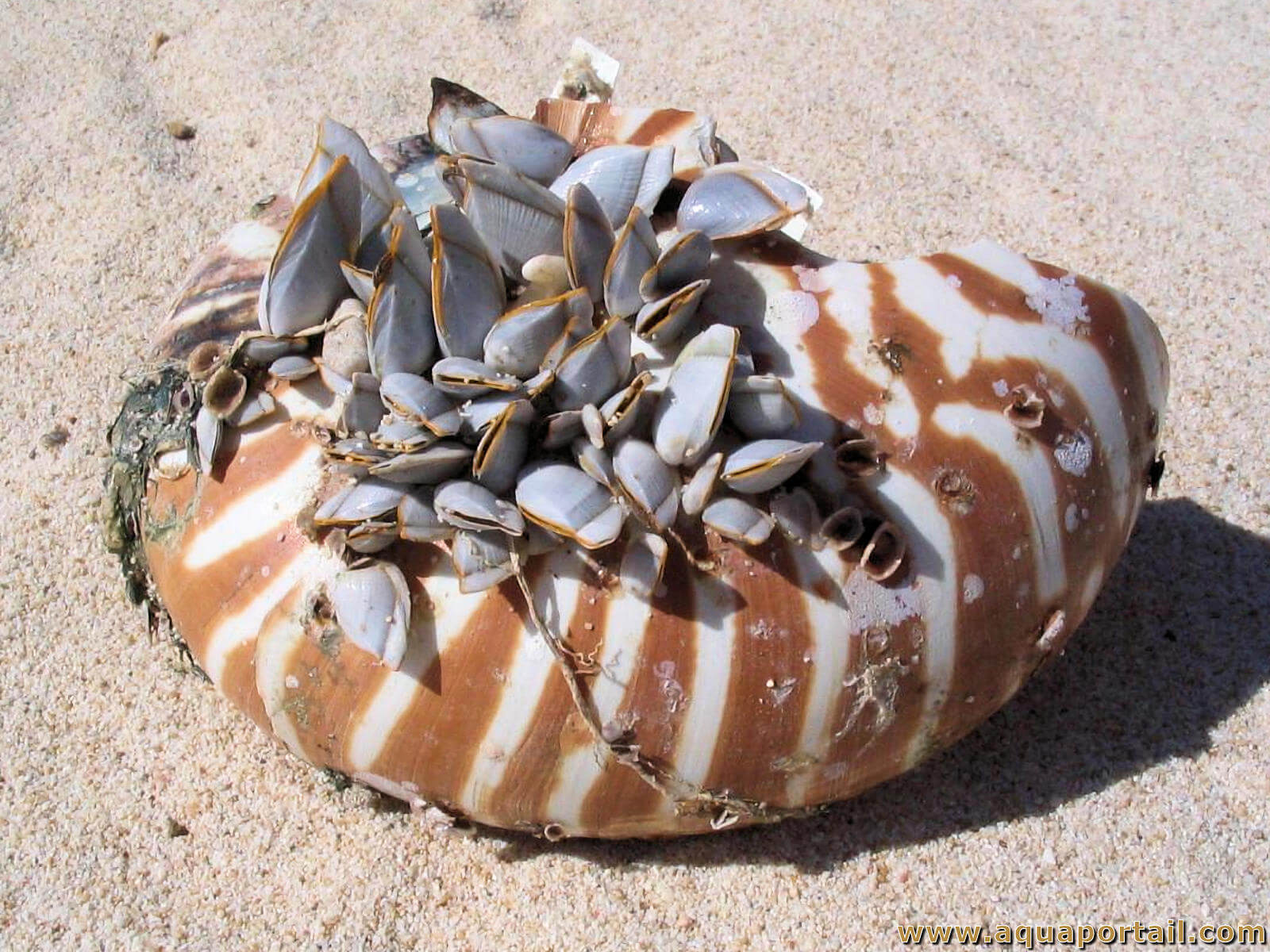
The goose barnacle species Lepas anserifera, a cirripede, occupies the shell of a Nautilus.
Often traded as whole shells (the most valuable product), nautiluses are also used in jewelry and trimmings, and are threatened with extinction due to excessive overfishing to satisfy the shell trade.
The modern world has honored nautiluses by naming things after them, two notable examples being the USS Nautilus, the world's first nuclear-powered submarine launched in 1954, and a line of exercise equipment called Nautilus, named after the pulleys that are modeled after the cross-sections of a nautilus shell.
Anatomy
Nautiluses are cephalopods, invertebrates characterized by a basic anatomy consisting of a head, a body, and a podium (foot), as well as at least eight arms extending from the base of their head. The chambered nautilus has ninety tentacles protruding from its shell, none of which have suckers.
The chambered or pearly nautilus (Nautilus pompilius) is a charismatic cephalopod species known for its exceptional, chambered spiral shell. It belongs to a family that has barely changed since its appearance in the fossil record around 250 million years ago, leading scientists to describe it as a "living fossil".
Nautilidae is the only family of cephalopods comprising species with true external shells. The shells are large, lightweight, and resemble a round-bottomed boat. They are distinguished above all by their internal partitioning or chambering, with the septa connected by a tube called the siphuncle. The chambers are filled with a gas allowing the animal to float. The animal controls its buoyancy by introducing water into or removing it from the chambers.
Internal anatomy of the nautilus:
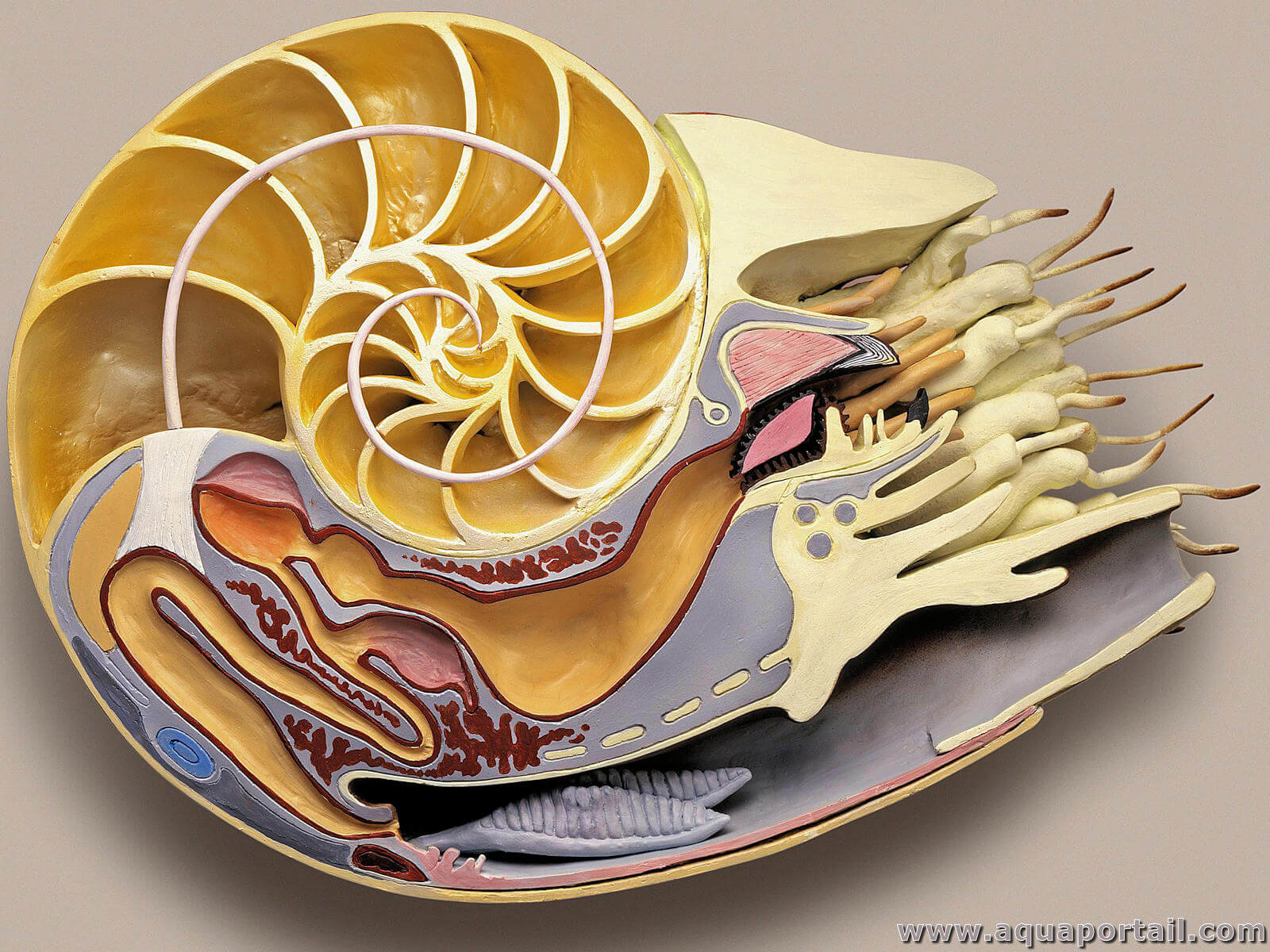
The spiral shell is specific to the nautilus. It has about 90 tentacles that it uses to catch prey. A nautilus can hide completely inside its shell by blocking the opening with a leathery hood formed by two specially folded tentacles.
Nautiluses live in spiral shells with white coloration on their underside and darker orange stripes that form a spiral or whorl along the top and sides. Unlike other shelled animals that find a new shelter as they grow, nautiluses grow into their shell; as their soft bodies grow, they extend forward into the chambered shell and the older chambers they previously occupied become sealed off. Nautiluses can withdraw their body completely into their shell and close the opening with a tough organ called the hood.
In addition to serving as protection for its body and organs, the nautilus shell contains a complex system of chambers that help the animal move gas to control its buoyancy in the water column. This is similar to how submarines fill and empty ballast tanks to stay level or float neutrally in the water. A specialized tubular organ called a siphon, located at the center of its body and between its tentacles, allows the animal to move water and gases into and out of its body cavity and regulate buoyancy. The nautilus can also use its siphon to forcefully push water out of its body cavity and propel the animal forward like jet propulsion. The way the siphon directs the water jet determines the direction of movement.
Nautilus and Fibonacci spiral:
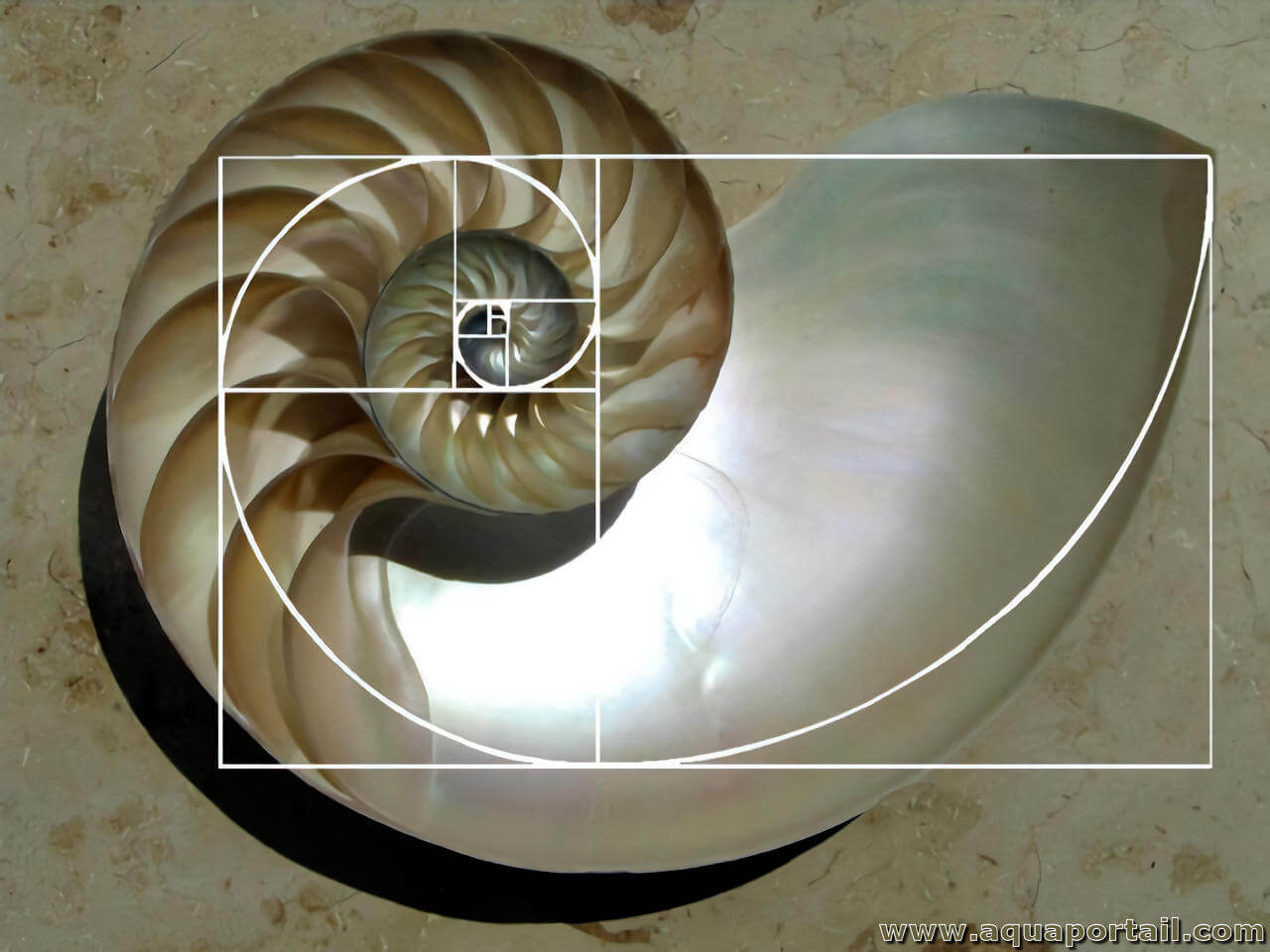
The Fibonacci spiral is found in the spiral structure of the shell of certain mollusks, such as the nautilus.
Its fractal shell designs are so alluring that consumer demand for nautilus shells is pushing the animals toward extinction.
The animal is widely used in biomimicry, for its anatomical organization as well as its rather distinctive nacre.
Diet and habitat
Nautiluses are carnivores that use both active hunting and passive scavenging strategies to feed. They typically search for crustaceans or invertebrates living in the water column or on the ocean floor. To find their food, chemosensory organs (chemoreceptors) on their tentacles detect what we would consider odors from their prey. They can use their siphons to uncover creatures hidden in sediment, and because these nautiluses lack suction organs on their tentacles, they capture prey by wrapping several tentacles around their target and pulling it toward their mouth.
Natural predators of the nautilus include octopuses, sharks, triggerfish, and groupers.
The chambered nautilus lives primarily on or near reefs in the western Pacific Ocean and parts of the coastal Indian Ocean, notably near the National Marine Sanctuary of American Samoa and Rose Atoll Marine National Monument. The species is pelagic, meaning it lives in the water column, which is unique for shelled invertebrates, which tend to live on the seabed or attached to a reef. They spend most of their time hovering in the water column along the reef with their tentacles dangling, migrating vertically at sunset to feed and returning to the depths at sunrise. Throughout their range, they live in smaller, isolated populations and do not appear to travel very far from their reefs.
Slow lifestyle
The life history of a chambered nautilus makes the species highly vulnerable to environmental changes. Contributing traits include low reproductive rates, slow individual growth, and delayed sexual maturity. Unlike most other cephalopods, chambered nautiluses live longer and can reproduce more than once during their lifetime (squids and other cephalopods often die shortly after reproduction). Scientists believe the maximum lifespan of a nautilus is over 20 years. Outside of reproduction, nautiluses are not very social animals and spend much of their time alone.
Chambered nautilus larvae hatch from eggs after about a year of incubation. The species reproduces via internal fertilization where males use specialized tentacles to transfer sperm to females. Once fertilized, females lay several eggs, one at a time, attaching the membrane-covered eggs to a hard surface with one of their tentacles. Nautilus hatchlings are the largest of any cephalopod, yet are not fully developed until they reach full body size at around 10 to 15 years of age.
Classification and species
The nautilus family, Nautilidae (order Nautilida), contains two living genera, Allonautilus (2 species) and Nautilus (4 living species). The nautilus species are:
- Allonautilus perforatus
- Allonautilus scrobiculatus
- Nautilus belauensis
- Nautilus macromphalus
- Nautilus pompilius
- Nautilus stenomphalus
However, recent genetic data have shown that there are only three extant species: Allonautilus scrobiculatus, Nautilus macromphalus, and Nautilus pompilius, with N. belauensis and N. stenomphalus both subsumed (perhaps as subspecies) under N. pompilius.
Threats to nautiluses
Heavy overexploitation to supply the international shell trade (nacre and the distinctive shape of the animal), habitat degradation, and inadequate existing regulatory mechanisms are driving down populations. For example, unique populations in the Philippines have declined by 80% and have disappeared in other regions.
Chambered nautilus populations are now at risk of extinction due to overfishing to satisfy the international shell trade market. Evidence shows that unique nautilus populations have been harvested unsustainably in parts of the Philippines and that local extirpations have already occurred. Other fished nautilus populations are also believed to be in decline.
✅ All nautilus species have been listed in "Appendix II" of the CITES treaty since 2016. Thus, trade in nautiluses may continue but is regulated by a permitting system, ensuring that trade is both sustainable and fully monitored.
⛔ During the 2000–2010 decade, more than 900,000 nautilus-derived products were imported into the United States alone, and Europe is believed to be another major importer.
Synonyms, antonyms
Spanish translation: nautilo
1 synonym (similar meaning) for "nautilus":
0 antonyms (opposite meaning).
Related words and expressions to NAUTILUS are directly connected by general or specific meaning.
The word NAUTILUS is listed on page 1 of words starting with N in the dictionary glossary.
Related to "nautilus"
nanobacterium
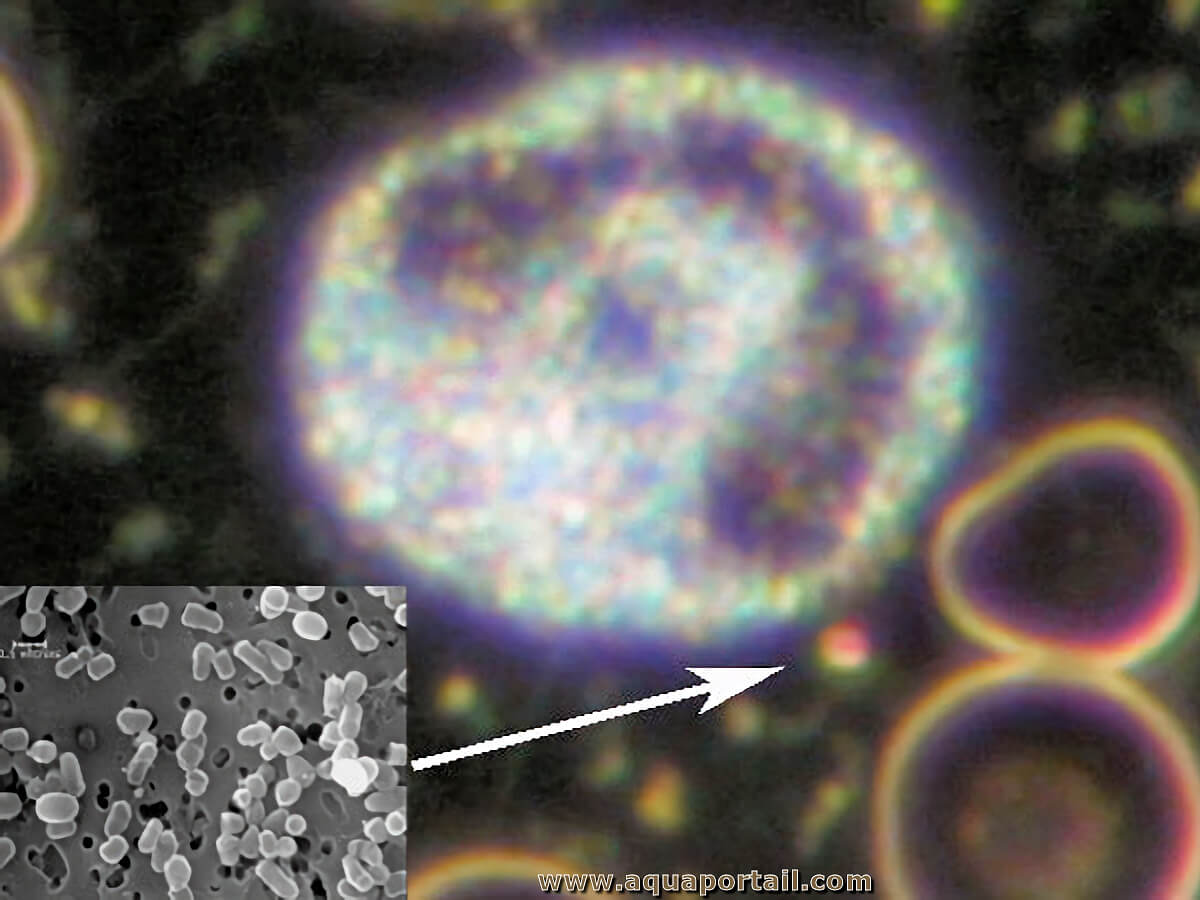
A nanobacterium is a submicron particle initially described as a hypothetical bacterial microorganism the size of a nanobe.
nanobe
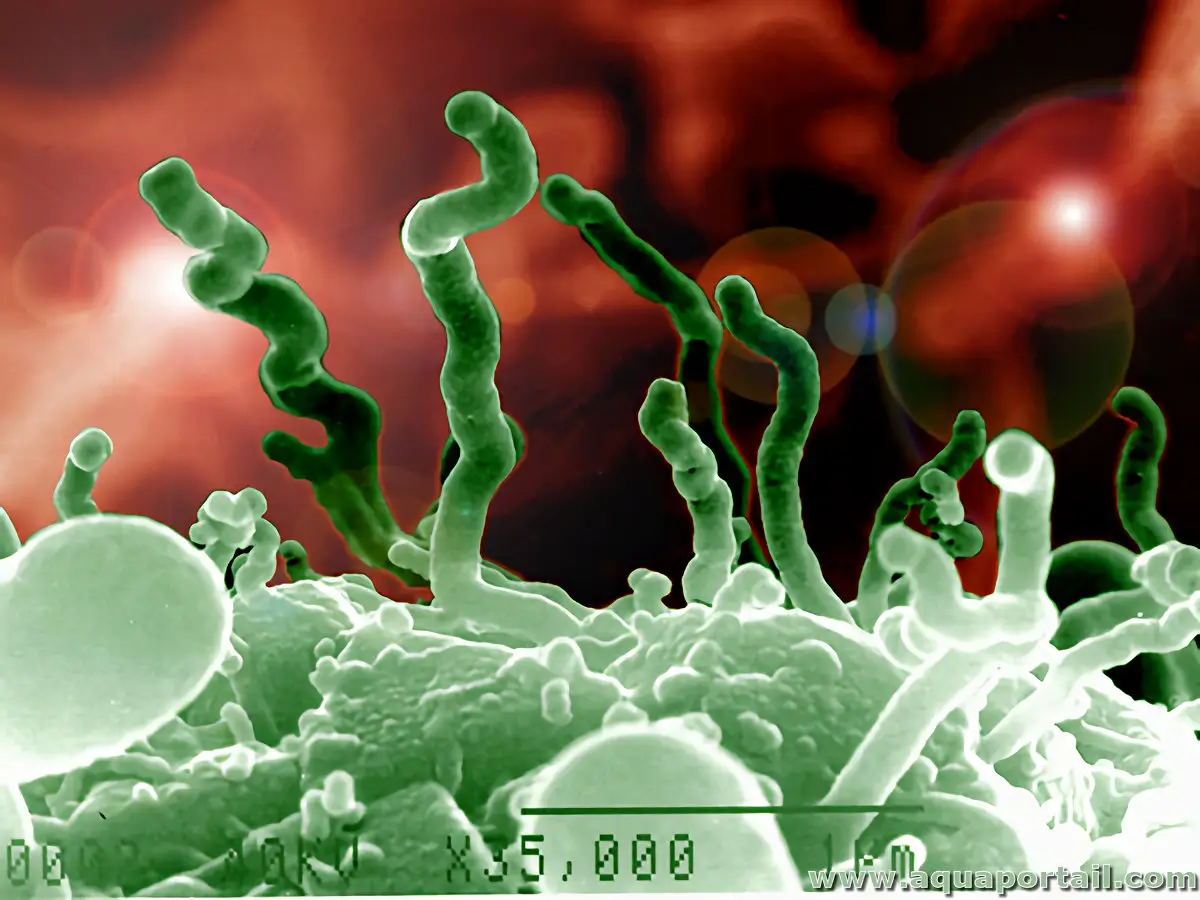
A nanobe is a tiny filamentous structure initially proposed as a hypothetical nanometer-scale microbe discovered in certain rocks and sediments, closely...
natural environment

The natural environment is the environment of nature that characterizes a habitat area with an artificially unmodified biotope, integrating an ecosystem where...
natural swimming pool

The principle of an ecological swimming pool, or natural swimming pool, is relatively simple : private swimming pools are becoming increasingly numerous...
