Nematocyst
noun (n.)
Definition
In certain cnidarians, nematocysts, or cnidocysts, are organelles enclosing a thread-like structure. These stinging cells are generally present in the tentacles and discharge upon contact with prey detected by the cnidocil.
Some nematocysts inject venom, while others adhere to prey; these are ptychocysts. They can also coil like a lasso around prey; these are spirocysts. A nematoblast is an immature nematocyst. It is a complex intracellular structure containing a tightly coiled tubule.
The nematocyst is a compressible part of the cnidocyte:
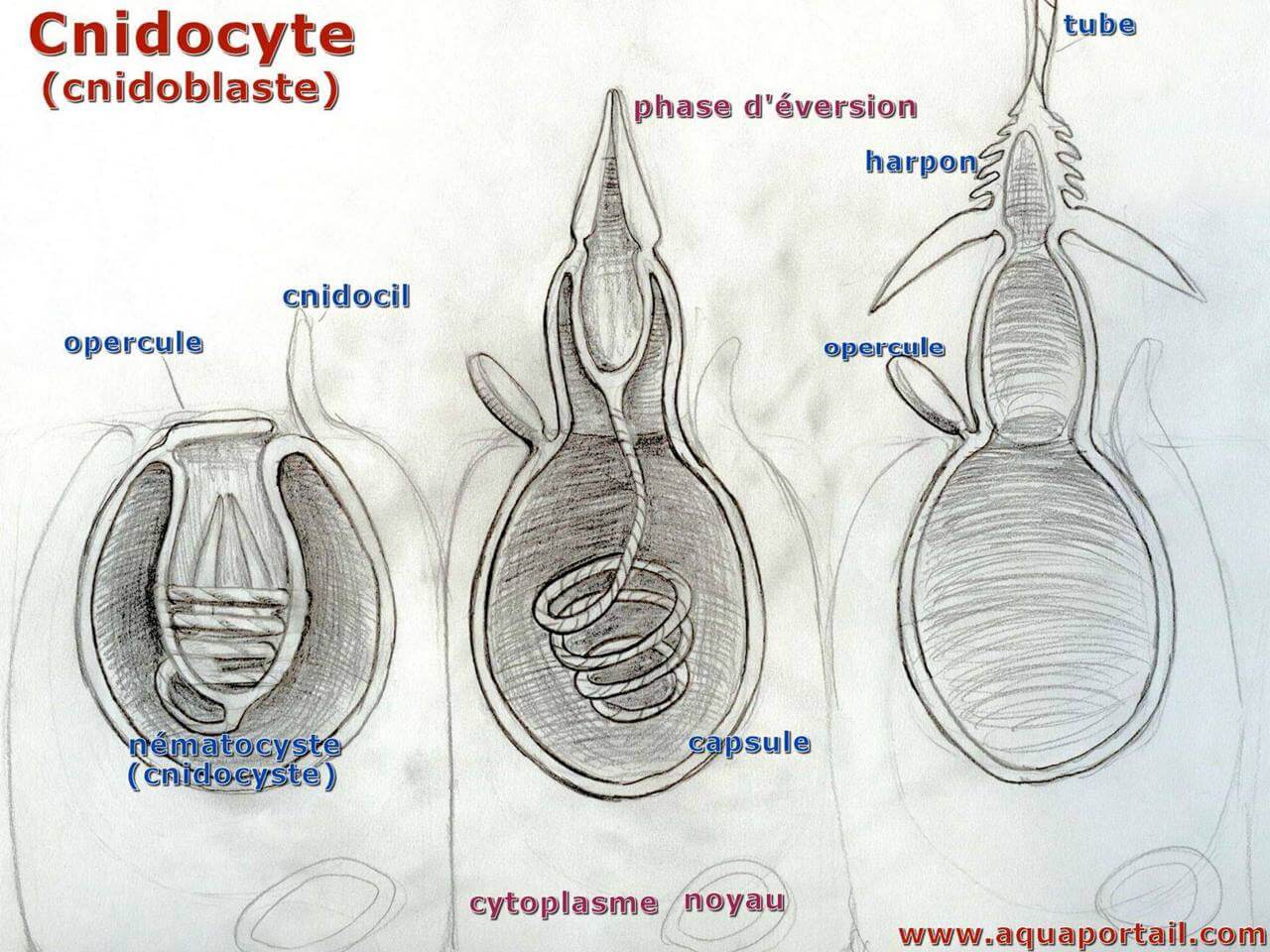
The nematocyst (cnidocyst) is a part of the cnidocyte housing the entire eversion structure of the venomous harpoon containing the toxin.
Explanations
A nematocyst is thus a stinging capsule of cnidarians containing a coiled harpoon-shaped filament. Nematocysts are thin capsules made of a chitin-like material and containing a coiled tubular "thread", or filament, which is a continuation of the narrowed end of the capsule. The latter is covered by a small cap or operculum. The interior of the undischarged filament may bear tiny spines or barbs.
Not all nematocysts are barbed or inject venom. Some, for instance, do not penetrate the prey but recoil rapidly like a spring after discharge, ensnaring and holding part of the captured prey in the coiled filament.
An everted nematocyst:
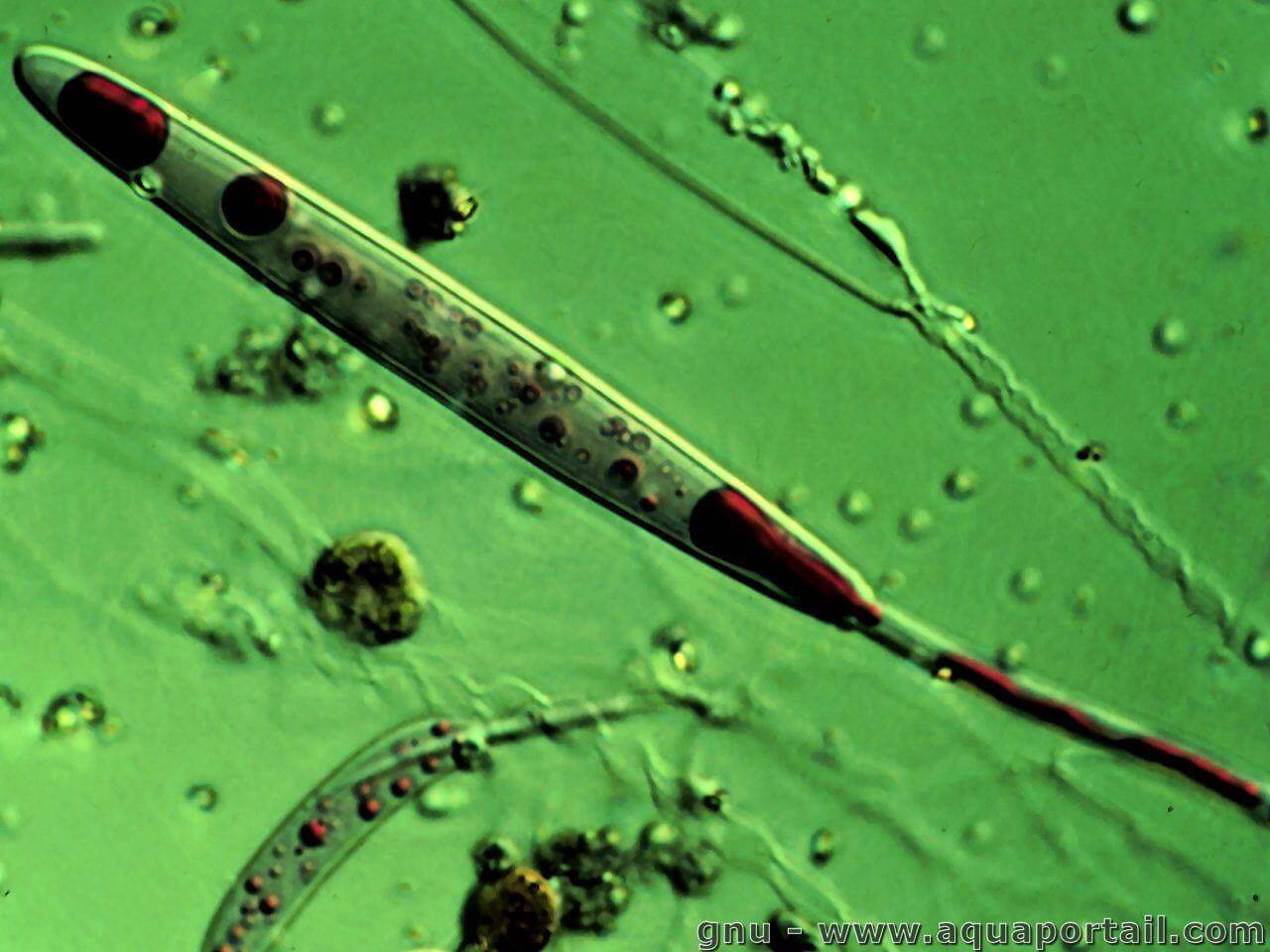
Upon expulsion from the cnidocyte, the everted nematocyst is ejected at very high speed to drive in the harpoon loaded to inject venom into the prey.
In dinophyte algae, each of the spindle-shaped corpuscles containing a long coiled filament or several rods and resembling the cnidocysts of coelenterates.
With the exception of anthozoans, nematocysts are equipped with a hair-like trigger called a cnidocil (on the cnidocyte), which is a modified cilium. Anthozoan cnidocytes possess a somewhat different ciliated mechanoreceptor. In certain sea anemones, and perhaps in other cnidarians, small organic molecules from prey "tune" the mechanoreceptors, sensitizing them to the vibration frequency of swimming prey. Tactile stimulation discharges the nematocyst.
⭐ A taeniocyst is an accessory component of certain nematocysts. See also ptychocyst, which is a specialized type of nematocyst.
Recent tests indicate that discharge results from a combination of tensile forces generated during nematocyst formation and the astonishing internal osmotic pressure: 140 atmospheres (2,057 psi). When discharge is triggered, the high internal osmotic pressure causes water to rush into the capsule. The operculum opens, and the rapid rise in hydrostatic pressure inside the capsule drives the filament outward with tremendous force as it everts. At the everted tip of the filament, spines flare outward like tiny sword-shaped blades. This miniature weapon injects venom as it penetrates the prey.
The nematocysts of most cnidarians are harmless to humans and are a nuisance at worst. However, the stings of Physalia physalis and certain jellyfish are extremely painful and, in some cases, dangerous.
Ptychocyst
A ptychocyst is a specialized type of nematocyst found in tube-dwelling anemones of the order Ceriantharia, burrowing anemones living partly inside a tube.
Ptychocysts help construct the sedimentary tube, acting like cement, in which these animals live.
Ptychocysts are highly modified stinging capsules that do not serve for defense. The sticky tubule is not coiled in a spiral but folded in a zigzag pattern; unlike spirocysts, it lacks lateral threads. Triggered by cilia, the adhesive fibers entangle and form a firm, finely woven Felt-like sheath around the polyp, serving as both protection and a dwelling tube.
Stenotele
A stenotele is a penetrating stinging nematocyst, thus a cnidocyst, whose filament is equipped with piercing stylets to inject venom and cause envenomation to paralyze or kill prey. It is fitted at its distal end with a lid (operculum).
The spiral filament is armed with spiral rows of spines.
Taeniocyst
A taeniocyst is the accessory structure of the specialized nematocysts in certain dinophytes, such as the alga Polykrikos schwartzii. The role of the nematocyst-taeniocyst complex may be prey capture. Individuals possess multiple nuclei and several pairs of flagella, with two heterokont flagella in the sulcus and cingulum.
A nematocyst with taeniocyst:
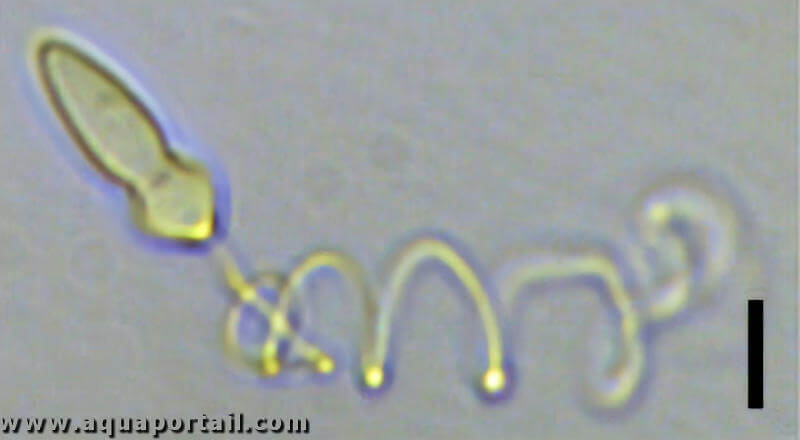
Light micrograph of the taeniocyst of a nematocyst from Polykrikos kofoidii. scale bar = 10 microns (3.9 × 10⁻⁴ in).
Polykrikos is one of the genera in the family Polykrikaceae, comprising dinoflagellates that form athecate pseudocolonies. Polykrikos species are characterized by a sophisticated ballistic apparatus, termed the nematocyst-taeniocyst complex, enabling them to prey on a variety of organisms. Polykrikos has been found to regulate algal blooms by feeding on toxic dinoflagellates. However, some data also indicate that Polykrikos can be toxic to fish.
Within the group, there is some variation in organelle presentation, though trichocysts, nematocysts, taeniocysts, mucocysts, and plastids have been observed across different members of the taxon.
The cytoplasm of Polykrikos is characterized by extensive networks of rough endoplasmic reticulum, Golgi complexes, and vacuoles. Polykrikos species are known to produce extrusomes. One of these is a nematocyst formed in zooids. Another extrusome found in the organism is the rod-shaped taeniocyst, situated distally to the nematocyst and previously mistaken for a nematocyst precursor. Together, these organelles form a taeniocyst-nematocyst complex considered the strongest synapomorphy for the Polykrikos clade.
Synonyms, antonyms
Spanish translation: nematocisto
2 synonyms (similar meaning) for "nematocyst":
0 antonyms (opposite meaning).
Related words and expressions to NEMATOCYST are directly connected by general or specific meaning.
The word NEMATOCYST is listed on page 1 of words starting with N in the dictionary glossary.
Related to "nematocyst"
sagittocyst

A sagittocyst is a capsule containing a spindle-shaped needle produced by epidermal cells of certain flatworms (acoels).
nematode

Nematodes are elongated roundworms whose adult and larval stages parasitize various aquatic species.
aerocyst

An aerocyst is a specialized organ in the form of a gas-filled vesicle, often simply filled with air, though in algae this nitrogen-rich gas vesicle acts...
nanobacterium
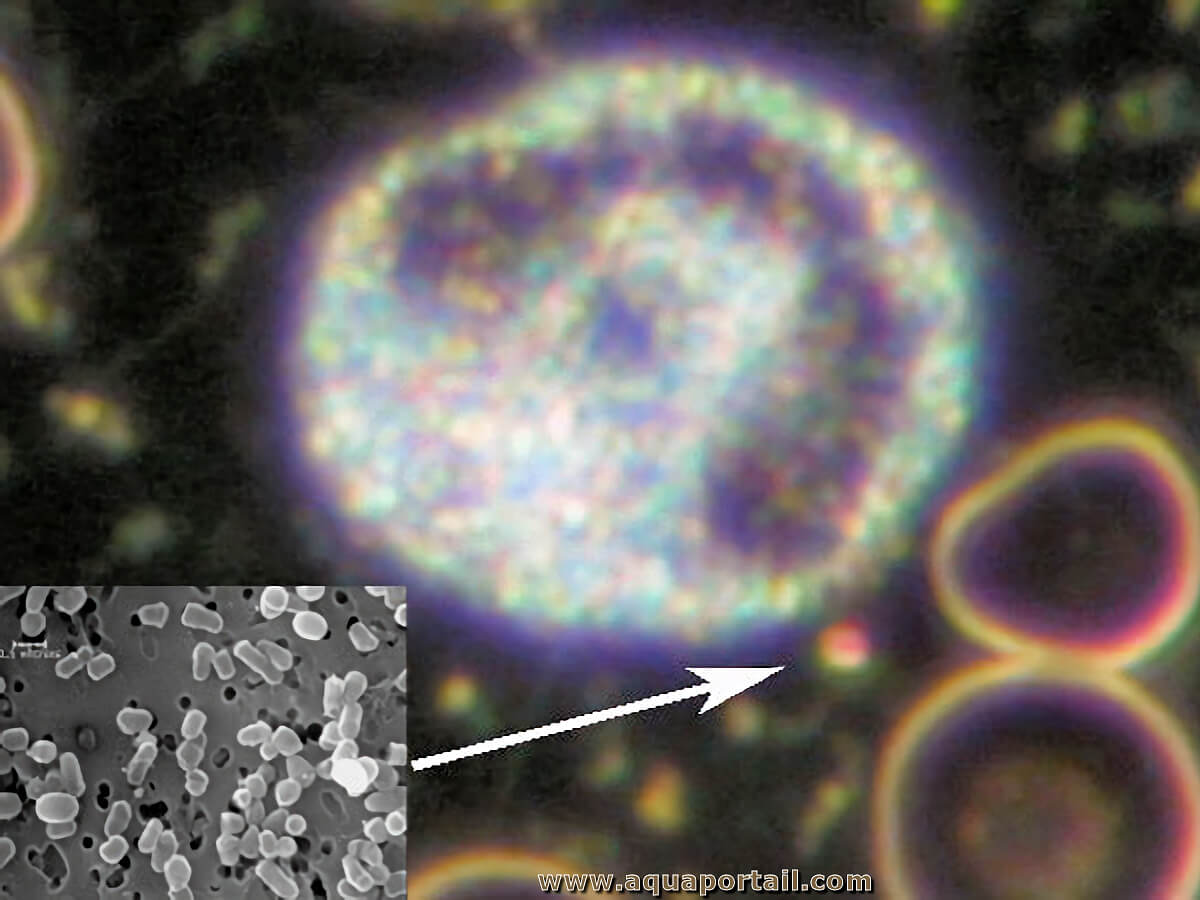
A nanobacterium is a submicron particle initially described as a hypothetical bacterial microorganism the size of a nanobe.
