Trichome
noun (n.)
Definition
A trichome is an outgrowth of epidermal origin in plants, a plant hair on an organ whose forms, glandular or non-glandular, are highly variable. Trichomes, unicellular or multicellular, may be found living or dead at maturity and possess sufficiently constant characters across different species to be of great value for plant identification.
Trichomes of a large-flowered evening primrose:
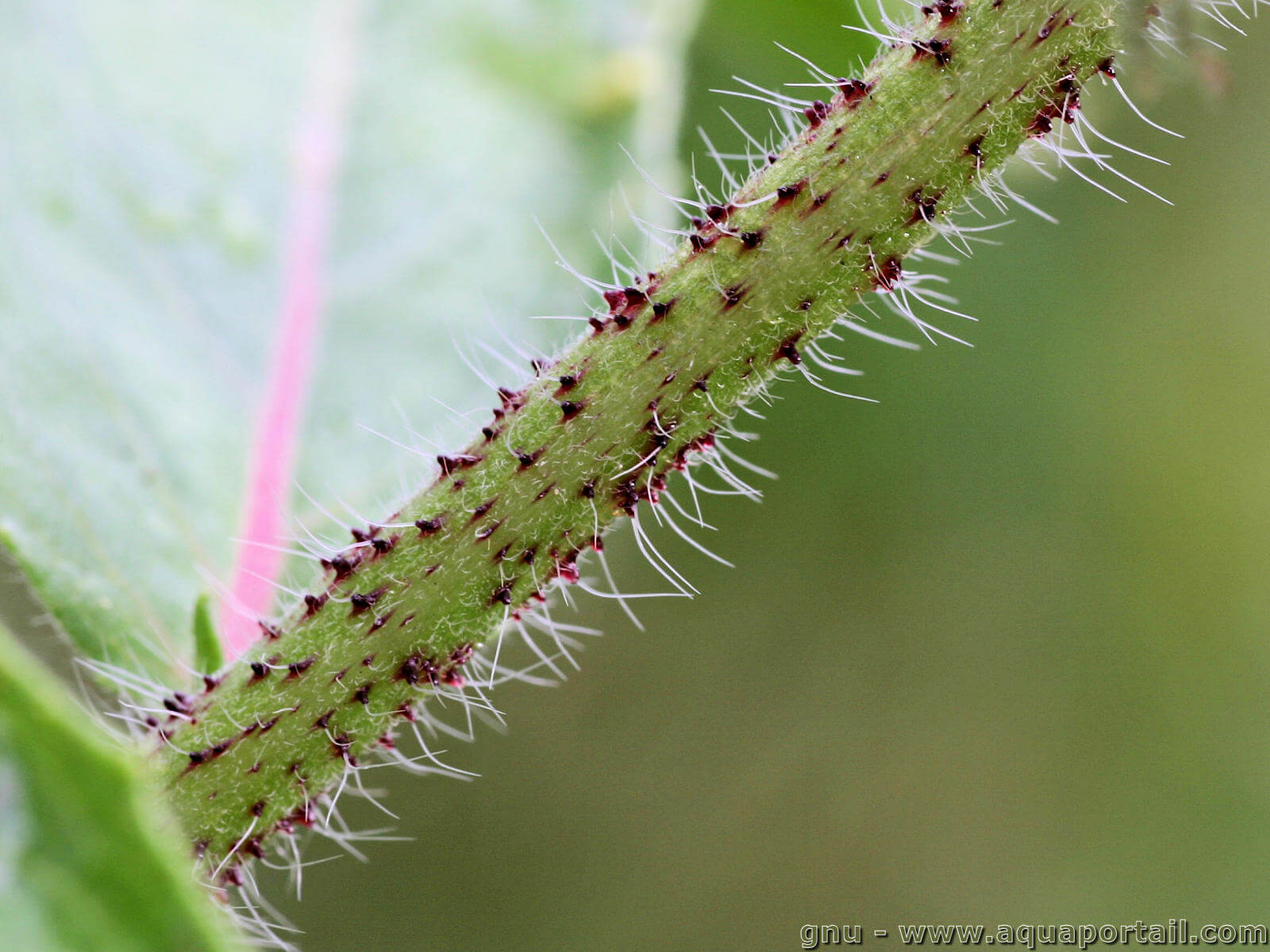
The simple, non-glandular, non-absorptive trichomes on the stems of the red-sepaled evening primrose Oenothera glazioviana make this flowering plant a pubescent plant.
Explanations
If a plant organ (root, stem, leaf) bears trichomes, it is pubescent, hirsute, hispid, downy, villous, puberulent, strigose, tomentose, or velvety, depending on the shape and density of the hairs, as opposed to glabrous for a hairless organ (smooth surface without hairiness).
Sometimes trichomes are inconspicuous and look more like bulges of epidermal cells (papillary cells). This is common on petals and many fleshy leaves. Trichomes are of two types: glandular (with glands that produce substances) and non-glandular (which secrete only their own cell wall). They sometimes take the form of scales or papillae. They are typical of carnivorous plants. Trichomes are often mineralized, impregnated with silica and calcium.
✅ A trichome is also the name given to the filaments of cyanobacteria and certain unicellular eukaryotes.
Trichome sizes vary considerably. Most often, a single hair, scale, or gland is clearly visible with a magnifying glass or microscope (sometimes high-powered). The longest trichomes (up to 5–6 cm / 2.0–2.4 in) cover cotton seeds.
Physiology
Trichomes may consist of one or more epidermal cells (as opposed to an emergence, which also includes hypodermal layers). Depending on the plant, they can be found in various forms across the entire plant surface. They occur as protective, supportive, and glandular hairs, and in the root region as root hairs. They are sometimes regularly arranged on the epidermis, with their base extending over several plant cells (8 to 10 epidermal cells).
Typically, a trichome is formed from a single epidermal cell whose DNA content and growth are multiplied many times over. The trichome is hollow and may branch several times during its development. The surface of a trichome is covered with countless pointed or warty outgrowths. Cytoplasm and nucleus are found only in the basal part, where calcium carbonate crystals are also present.
In low-rainfall areas, trichome density is increased. The more trichomes or more branched trichomes there are, the higher the light refraction at the plant surface, resulting in reduced light incidence and therefore lower temperature in the photosynthetically active organs concerned.
Increased light refraction, which ultimately leads to reduced water loss, is clearly visible in the silvery-white shimmer of certain leaves or stem axes. Conversely, there are also hydathodes, glands that actively release water through guttation via droplet exudation. Trichomes also protect the plant from pest infestations, acting as a physical barrier to insects. Glandular hairs actively deter insects through the production of essential oils.
Simple (non-glandular) trichomes
Non-glandular trichomes can serve several functions:
- protection against mechanical damage, such as scratches on leaves, occurring in the trichomes rather than the epidermis
- protection against excessive light radiation; trichomes cast shadows onto the epidermis. This occurs, for example, in olive leaves
- maintenance of a suitable microclimate by retaining moisture at the epidermal surface.
Simple and strigose trichomes:

The trichomes of common borage are simple, non-glandular, hard, and stiff, pointing in the same parallel direction. These trichomes are strigose.
Non-glandular trichomes can also be subdivided into several types:
- simple unicellular: a single epidermal cell extending from the base with a hair-like projection. It is covered with cuticle, has a nucleus, a large vacuole, and other organelles. While trichome growth continues, the nucleus is positioned in the apical part, where development takes place. An example of this trichome type is root hairs (absorptive roots with root hairs)
- simple multicellular: a stack of superimposed cells, with the lowest cell embedded in the epidermis
- stellate: has various branches radiating from the same point. It can be unicellular (branching at the base of the epidermis) or multicellular (several cells inserted at the base of the epidermis)
- peltate (vasculiform): a special type of stellate trichome. They are multicellular. A stalk cell rises from between epidermal cells, and from there a group of cells radiates around the entire perimeter. These trichomes are abundant on olive leaves
- branched: may be unicellular or multicellular. They differ from appressed forms in that branches arise at different levels (at varying heights)
- candelabra-branched: a particular type of branched trichome. They are always multicellular, with arms radiating from multiple points at the same level (though independent extensions also occur)
- woolly: multicellular, forming a more or less thick rising column of cells. They are very abundant, covering the entire surface and creating velvety textures.
Glandular trichomes
Glandular trichomes are those possessing secretory cells. The cuticle of the epidermal tissue is thin, covers all cells, and can separate from the cell wall because it has a high concentration of pectin underneath, making this the weakest part of the wall framework.
Glandular trichomes can also be unicellular or multicellular; they are generally more durable than simple ones. A unicellular trichome is a horn-shaped cell whose dilated portion is embedded in subepidermal tissue. In this respect, such trichomes are often regarded as stinging hairs. Inside the horn-shaped cell, fluid rich in histamine and acetylcholine is injected into the skin, causing burning sensations. The upper part of the trichome gradually tapers into a thin-walled head that breaks easily. Upon contact, the head snaps off and the fluid from the horn-shaped cell enters the skin.
Multicellular trichomes generally have a unicellular or multicellular stalk terminating in a spherical head covered by a cuticle. ✅ The head cells synthesize essential oils that pass through the outer cell wall and accumulate beneath the cuticle. As a very large amount of essential oil builds up beneath the cuticle, unable to withstand the pressure, the cuticle ruptures and the essential oil flows out. Usually, in this case, the cells die; rarely does the cuticle regenerate. In deadly nightshade, the terminal cell of the trichome detaches due to wall mucilage connecting it to the basal cell.
⭐ In pelargonium, for example, the glandular hair consists of a multicellular stalk and a unicellular head that secretes essential oils into the space between the cellulose membrane and the cuticle. When the cuticle ruptures, the secretions are released, after which a new cuticle can form and a new droplet of secretion can accumulate.
✅ Salt-excreting halophytes (certain types of quinoa) adapt to excessive salt concentrations using a mechanism that releases incoming salts via ion transport against the concentration gradient, thereby keeping sodium and chloride concentrations in the cytosol low. In these plants, salts absorbed with the transpiration stream are delivered first through vessels and then via the symplast into living vesicular cells (trichomes present in the epidermis of stems and leaves). Inside a bladder cell, ions are secreted into a large central vacuole. When salt accumulates heavily, the trichomes burst and salt reaches the leaf or stem surface as a powdery coating. New cells form to replace the burst ones. Because there is a steep salt concentration gradient from mesophyll cells to bladder cells, ion transfer into their vacuoles is an active process requiring energy consumption.
Algal trichomes
Certain algae, usually filamentous, elongate their terminal cell into a hair-like structure called a trichome. The same term is applied to such structures in certain cyanobacteria, such as spirulina and oscillatoria. These structures play an important role in preventing soil erosion, especially in cold desert climates. The filamentous sheaths form a persistent sticky network that helps stabilize soil structure.
Botanical importance
The various forms of trichomes are used taxonomically to identify plants. Because trichomes form on leaf surfaces according to established patterns, they also serve as a model for patterning in biological systems.
The formation of stellate trichomes in the model plant thale cress Arabidopsis thaliana is initiated by the protein GLABROUS1. Deactivation of this gene results in loss of hair formation on the leaves. This phenotype has been used in genome-editing experiments. Trichomes can therefore serve as a visual marker to optimize genome-editing methods such as CRISPR/Cas9.
Synonyms, antonyms
Spanish translation: tricoma
1 synonym (similar meaning) for "trichome":
0 antonyms (opposite meaning).
Related words and expressions to TRICHOME are directly connected by general or specific meaning.
The word TRICHOME is listed on page 1 of words starting with T in the dictionary glossary.
Related to "trichome"
heterotrichous
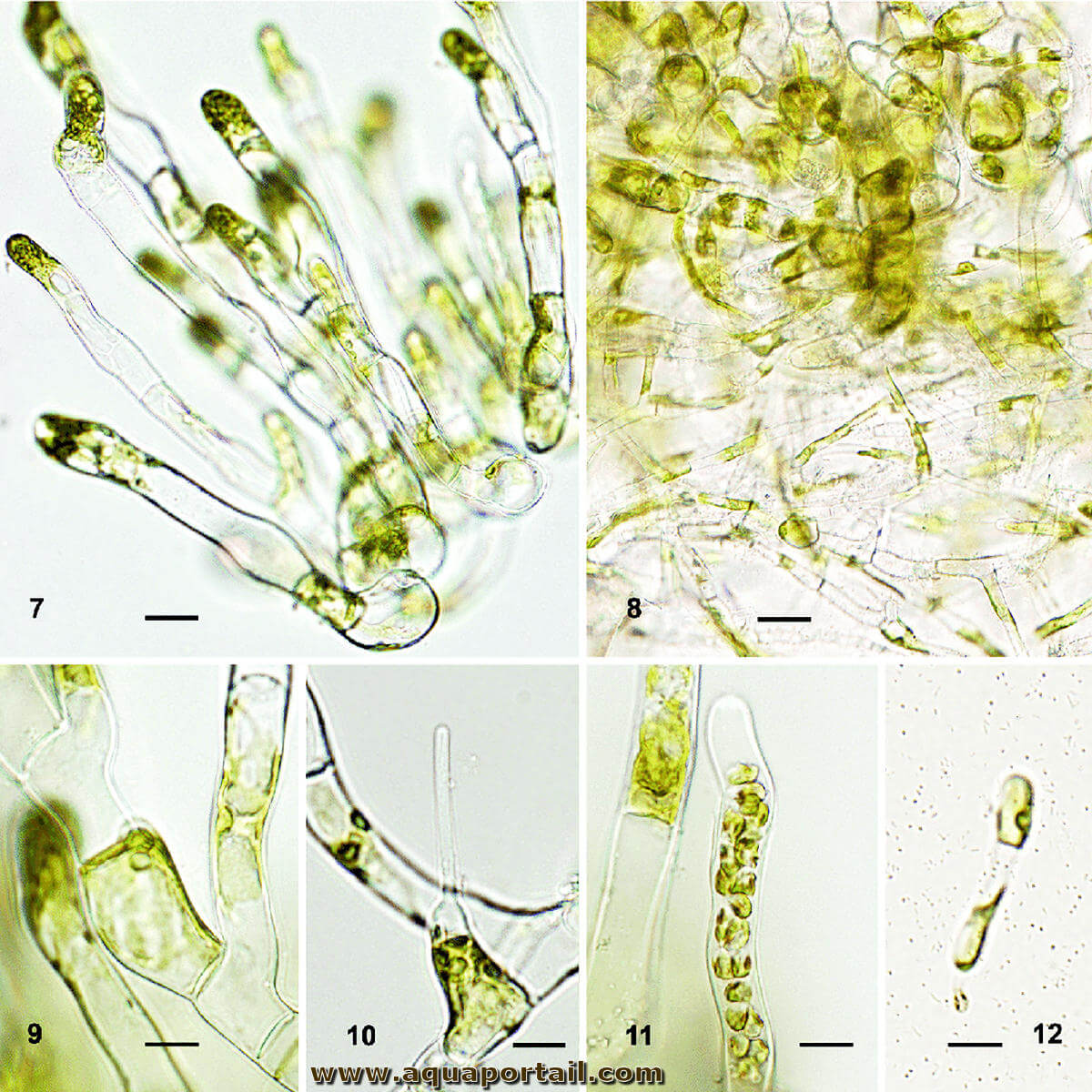
A heterotrichous organ has a vegetative apparatus comprising prostrate filaments and erect filaments.
trichoblast

A trichoblast is any of the uniseriate lateral branchlets, branched or unbranched, pigmented or colorless, originating from the apical portion of the thallus...
trichocyst

A trichocyst is a small rod-shaped secretory structure found near the surface of ciliates and dinoflagellates containing an extensible filament.
trichotomy

A trichotomy is divisible by three, with a division into three categories (just as a dichotomy divides into two).
