Triassic
proper noun
Definition
The Triassic is a geological period of Earth during the Mesozoic Era, spanning from 252 to 201 million years ago (Ma). The Triassic occupies the first position preceding the Jurassic. It began 252 Ma and ended 201 Ma. It owes its name to three rock layers.
As with most geological periods, the exact start and end dates are uncertain by a few hundred thousand years. In the case of this period, the beginning and end are marked by major extinction events: the Permian-Triassic mass extinction and the Triassic-Jurassic extinction.
Map of the Earth during the Triassic:
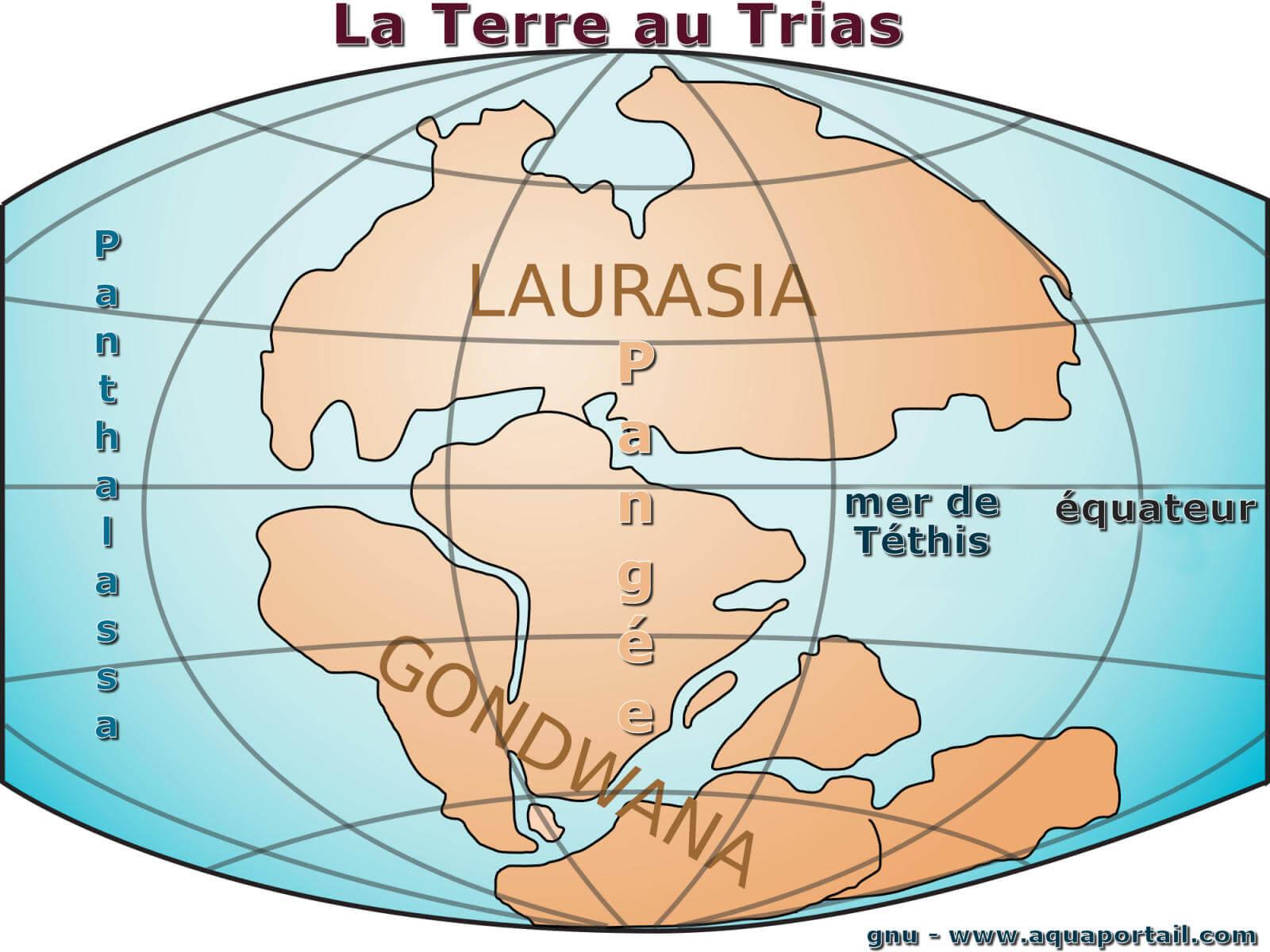
During the Triassic, the map of Earth showed almost only a single supercontinent: Pangaea.
Explanations
During the Triassic, almost all of Earth's landmasses were concentrated in a single supercontinent centered roughly on the equator, called Pangaea (Pangaea, "the entire Earth"). This continent was shaped like a "C", and to the east, in the hollow of the "C", lay the Tethys sea, while surrounding it was the Panthalassa Ocean ("the universal ocean"). All deep-ocean sediments deposited during the Triassic have disappeared through the subduction of oceanic plates, so very little is known about the open ocean during the Triassic.
The supercontinent Pangaea began to break apart during this period, particularly in the Late Triassic, though it had not yet separated. Laurasia (Laurasia) included North America, Europe, and much of present-day Asia. Gondwana comprised Africa, Arabia, India, Australia, Antarctica, and South America. Pangaea drifted very slowly northward during this period, and the supercontinent began showing the first signs of rifting, with gaps appearing in eastern North America, central and western Europe, and northwestern Africa. The earliest marine sediments, in the rift that marked the initial breakup of Pangaea and separated New Jersey from Morocco, date to the Late Triassic; in the United States, these coarse sediments form the "Newark" Supergroup.
Sea level rose slightly during the Early Triassic; however, the volume of emerged land areas remained very high. The Tethys Sea, which formed a broad gulf, became a route of marine invasion. Although the dominant terrestrial plants of the Triassic differed from those of the Permian, distribution patterns across Pangaea remained (southern Gondwanan flora, Siberian flora, and Laurasian flora adapted to drier and warmer conditions in equatorial latitudes).
The first mammals, evolved from mammal-like reptiles, appeared during this period, perhaps due to climatic changes and continental drift, which LED to the great Triassic marine regression: all landmasses were united (the opposite of a marine transgression) forming the supercontinent Pangaea (still divided at the start of the Jurassic), which is why carbonates came to predominate.
It is characterized primarily by the appearance of the first dinosaurs, initially represented by small, bipedal, carnivorous forms. However, by the end of the period, they had already diversified on a large scale and had become the dominant vertebrates across the entire planet, leading to the extinction of earlier groups such as archosaurs and the most primitive mammals, with a few exceptions.
The Triassic climate was generally hot and dry, leading to the formation of deserts and evaporites. The vast size of Pangaea limited the moderating effect of the ocean; its continental climate was highly seasonal, with very hot summers and very cold winters. Strong monsoons likely occurred at the equator. There is no evidence of glaciation near either pole; in fact, the polar regions were apparently humid and temperate, a suitable climate for reptile-like creatures.
Terrestrial plants did not experience a major extinction at the end of the Paleozoic Era. The transition from late Paleozoic to Mesozoic types began before the start of the Mesozoic Era. Thus, conditions were very similar to the Permian. Plants that flourished in Laurasia were adapted to its hot, dry climate: Cycadaceae. Among the arboreal vegetation were conifers and ginkgos. Ferns predominated in humid areas, along with cycads having a palm-like morphology and some predecessors of modern pines. Gondwana, being much more humid, was populated by gigantic forests of ferns and volcanic conifers.
There is evidence that beetles were involved in the pollination of certain gymnosperms, but otherwise few of these plants attempted to attract insects; it even appears that cycad cones were designed to deter them. More than half of known insect species were equipped to bore, nibble, and suck plant tissues.
Synonyms, antonyms
French translation:
TriasSpanish translation: Triásico
0 synonyms (similar meaning) for "triassic".
0 antonyms (opposite meaning).
Related words and expressions to TRIASSIC are directly connected by general or specific meaning.
The word TRIASSIC is listed on page 1 of words starting with T in the dictionary glossary.
Related to "Triassic"
Jurassic

The Jurassic is a geological period of the Mesozoic Era in Earth's history. The Jurassic began approximately 201. 3 million years ago and ended about...
tagma

A tagma is a group of fused segments formed by series of metameres differentiated from the rest of an arthropod's body.
tapeworm

The tapeworm, or solitary worm, is a long, ribbon-like, segmented flatworm, a parasitic cestode of the genus Taenia.
taxon

In biology, a taxon is a taxonomic unit recognized by international codes within a given classification, or a systematic unit such as a family, genus...
