Syncytium
noun (n.)
Definition
A syncytium is a cytoplasmic territory containing multiple nuclei. It is formed by the fusion of individual cells (e.g., mammalian striated muscle) or by incomplete cell division (e.g., in insects).
A syncytium is a specialized cellular structure characterized by the presence of multiple nuclei within a single cytoplasmic mass.
Syncytia in striated muscle:
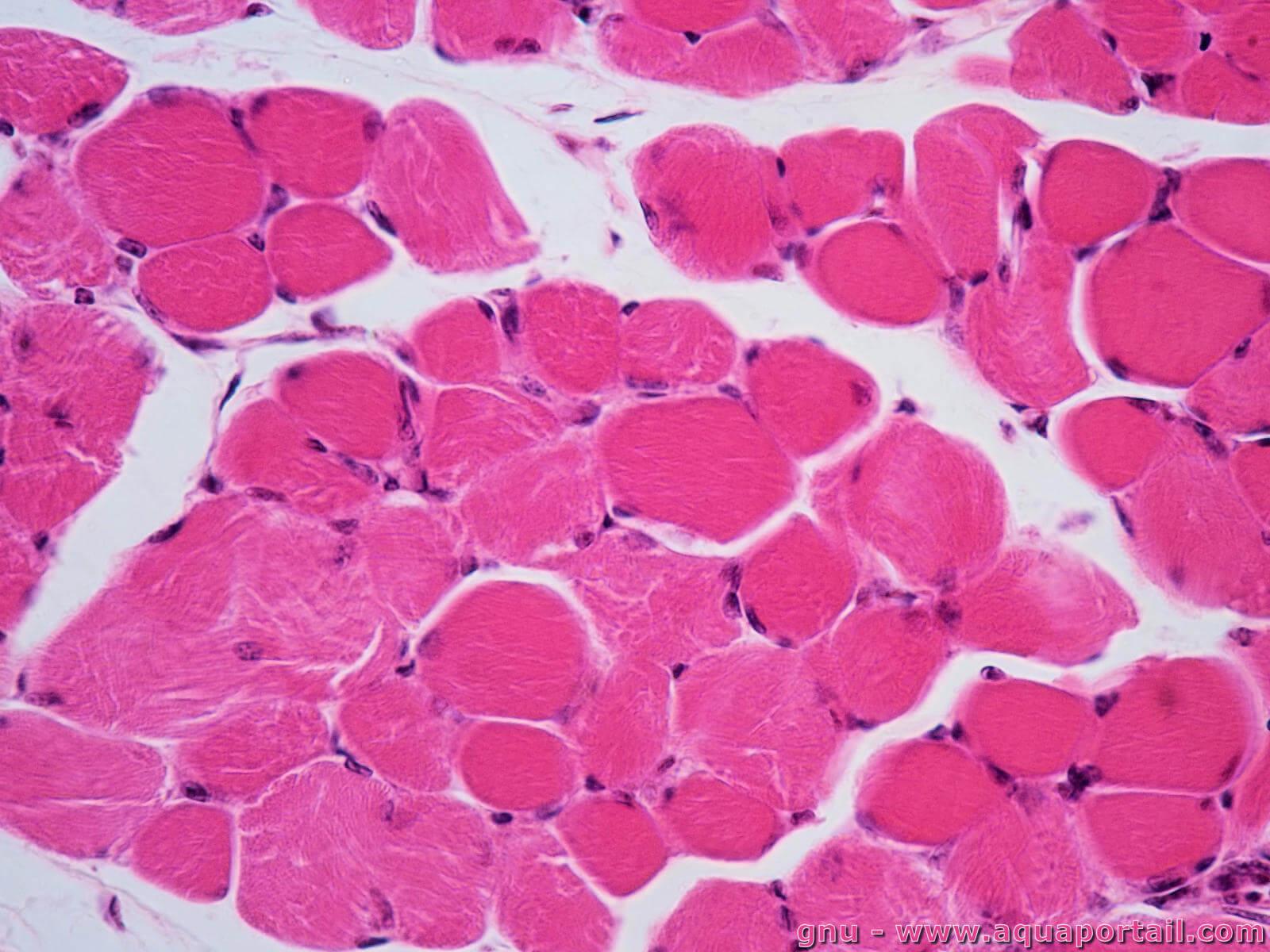
At the periphery of each syncytial cell (a syncytium), several nuclei are observed in this cross-section of striated skeletal muscle.
Explanations
Most cells in eukaryotic organisms of plants and animals have a single nucleus; syncytiums (or syncytia) are special forms. However, in certain organisms, they are not merely usual structures, but also constitute the most predominant stage of the life cycle, notably in certain nematodes or slime molds (myxomycetes), among others.
It is necessary to differentiate a syncytium from a plasmodium, which is another type of multinucleate structure obtained by the fusion of motile gametes or amoeboid cells of myxomycetes (mycetozoans) followed by nuclear divisions.
The function of a syncytium varies depending on the organism evaluated, although in general it can be stated that it operates as a single coordinated unit composed of several structurally and functionally linked cells that allow the exchange of molecules and electrical impulses. In addition to resulting from an organism's normal developmental plan, a syncytium can arise as a consequence of infectious agents caused by viruses and other pathogens.
A syncytium generally allows rapid and efficient coordination among the different parts of the structure. For example, in skeletal muscles, this facilitates synchronized contraction along the entire length of the fiber.
The activity of second-stage juveniles of parasitic nematodes such as Heterodera or Globodera (potato cyst nematodes) at the permanent feeding site in the host induces cell wall thickening, cytoplasmic densification, and the fusion of three to ten cells around the parasite's head. The resulting syncytium exhibits high metabolic activity, essential for nourishing the juvenile. The host, on the other hand, experiences limited root functionality because the syncytium interrupts sieve and xylem vessels. The effect is reduced plant growth and yield, accelerating senescence.
See yolk syncytium and myotube.
A syncytium can be formed in two ways: by cell fusion or by nuclear division without cytokinesis. In unicellular or amoeboid organisms, the fusion of the cytoplasm of individuals of the same species, without fusion of nuclei, results in a multinucleate amoeboid mass called a plasmodium, a common method in myxomycetes. Nuclear division without cytokinesis, on the other hand, allows the primitive cell to grow through successive divisions of its nucleus without segmenting its cytoplasm. This mechanism can lead to unicellular multinucleate individuals or participate in the formation of multicellular organisms. Groups featuring syncytial or coenocytic organisms include protozoa, such as the ciliate Opalina ranarum and several species of radiolarians, as well as thallophytes, including siphonous algae and slime molds.
✅ A syncytium is a multinucleate cytoplasmic mass bounded by a membrane. Strictly speaking, this multinucleated structure results from the fusion of several uninucleate cells. A syncytium should not be confused with a coenocyte, which is a cell containing many nuclei when mitosis occurs without subsequent cytokinesis.
In multicellular organisms, a syncytium can be formed by fusion or incomplete cell division. Many insects, such as the fruit fly Drosophila melanogaster, lay eggs that initially develop as syncytial blastoderms, that is, early in embryo formation, through incomplete cell division separating nuclei without cytokinesis. Consequently, nuclei multiply within a common cytoplasmic space. Conversely, large skeletal muscle fibers are formed by the fusion of individual muscle cells. Myoblasts (precursor cells of muscle fibers) undergo a cellular differentiation process driven by transcription factors such as MyoD1/2 that regulate their proliferation in the presence of growth factors. In the absence of insulin-like growth factor (IGF), myoblasts stop proliferating and begin to fuse, forming a single cell with multiple nuclei.
Influence of syncytia on cardiac muscle contractions
Syncytia play a crucial role in the coordinated and efficient contraction of cardiac muscle.
Although the myocardium is not a true histological syncytium (each cell being surrounded by a membrane), it acts as a functional syncytium. This means that excitation can propagate easily from one cell to another under normal physiological conditions.
Cardiomyocytes are connected to one another by gap junctions (nexuses) at the intercalated discs. These junctions allow rapid spread of electrical excitation from cell to cell, ensuring synchronized contraction of the entire cardiac muscle.
Thanks to this organization as a functional syncytium, the heart contracts as a single unit. Unlike skeletal muscles where only individually stimulated fibers contract, in cardiac muscle the entire organ contracts in a coordinated manner.
Although cardiomyocytes function as a syncytium, the initiation of contractions is triggered by the nodal tissue (sinoatrial node of Keith and Flack, atrioventricular node of Tawara). Excitation then spreads throughout the myocardium via the conducting tissue (bundle of His and Purkinje network), ensuring coordinated and efficient contraction.
Thus, the syncytial functioning of cardiac muscle enables rapid, synchronized, and powerful contraction of the entire organ, essential to its role as an effective pump in the circulatory system.
Synonyms, antonyms
Spanish translation: sincitio
3 synonyms (similar meaning) for "syncytium":
0 antonyms (opposite meaning).
Related words and expressions to SYNCYTIUM are directly connected by general or specific meaning.
The word SYNCYTIUM is listed on page 1 of words starting with S in the dictionary glossary.
Related to "syncytium"
coenocyte

A coenocyte (cenocyte or pilocyte) is a multinucleate cell resulting from multiple nuclear divisions without cytokinesis.
saccharide

A saccharide is a carbohydrate, a biomolecule composed of carbon, hydrogen, and oxygen atoms, usually with a hydrogen-to-oxygen atomic ratio of 2 :1.
saccule

A saccule is a flattened cellular cavity shaped like a small concave disk and bounded by a membrane, a stack of which forms a dictyosome.
sagittocyst

A sagittocyst is a capsule containing a spindle-shaped needle produced by epidermal cells of certain flatworms (acoels).
