Haplodiploidy
noun (n.)
Definition
Haplodiploidy is a form of sex determination in which one sex carries only a single set of chromosomes (haploid) and the other sex carries a double set of chromosomes (diploid). Usually, the male sex is haploid.Offspring diagram of haplodiploidy:

In hymenopterans, haplodiploidy, or the sex-determination system, involves haploid males (drones) and diploid females (queens and workers). In a eusocial colony with a single queen, females are exceptionally closely related.
Explanations
Haplodiploidy is the name given to the sex-determination system of hymenopterans (ants, bees, and wasps), thysanopterans (thrips), a few beetles (bark weevils, scolytines), and rotifers. The haplodiploid sex-determination system is also present in certain mites of the family Tetranychidae (spider mites), in certain scale insects, and other hemipterans.
In the haplodiploid system, a form of ploidy, sex is determined by the number of chromosome sets an individual receives. An individual born from the combination of a sperm and an egg is a female, whereas an unfertilized egg develops into a male. Thus, the haploid male has half as many chromosomes as the diploid female. This system creates a series of peculiarities: a male has no male parent (father) and cannot have male offspring, yet has a grandfather and can have grandsons. His genetic heritage is passed only to females and, through them, to subsequent generations. The haplodiploid system fostered the evolution of eusociality in hymenopterans.
✅ The haplodiploid sex-determination system was discovered in the honeybee in 1845 by J. Dzierzon.
Mechanisms
Several models have been proposed to explain the haplodiploid sex-determination system. The most widely accepted model is that of complementary alleles. According to this model, if an individual is heterozygous for certain alleles, it develops as a female, whereas if it is homozygous or hemizygous, it develops as a male. In other words, fertilized eggs are diploid and develop as females. Unfertilized eggs are haploid and become males. Occasionally, diploid males occur because the alleles are homozygous. In this case, they are generally sterile since their sperm does not undergo normal meiosis and the resulting fertilized eggs are triploid and non-viable.
After mating, the fertile female stores sperm in an internal sac called the spermatheca. The female controls the release of stored sperm as eggs pass through the oviduct, enabling her to control the proportion of males and females she produces. Social hymenopterans can regulate the sex ratio within the colony.
Sex determination in the honeybee
Male bees receive all their genetic material from the queen mother, meaning they have no father. Females have 32 chromosomes and males only 16. Males produce sperm with a single set of chromosomes. All sperm from a given male are genetically identical except in the event of mutation. Females, workers and queens alike, receive half of their chromosomes from the mother and the other half from the father.
Daughters sired by the same father share 3/4 of their genes, meaning they are more closely related to their sisters than to their mother.
Generally, the queen mates with more than one male, in which case relatedness proportions differ for half-brothers and half-sisters. Certain unfertilized workers can lay eggs that are all male. In rare cases, in the South African subspecies Apis mellifera capensis, these workers can produce workers and even queens. The eggs they produce result from a modified meiosis (automixis) and are diploid. This is a phenomenon called thelytokous parthenogenesis (or apomictic in a broad sense).
Evolution
Because the male genome is also shared with the mother and siblings, resulting in a high degree of relatedness, haplodiploidy is thought to promote colony formation. On the other hand, sex determination in termites is not haplodiploid, yet highly developed forms of social organization have evolved across all lineages of this order of hemimetabolous insects (hemimetabolism).
In well-studied honeybees, it has been found that, unlike in mammals, sex determination is governed by a specific gene (the csd gene). If it is present in two different versions (in heterozygous fertilized eggs), females are created. If it is present in only one version (in unfertilized eggs), males are created. Inbreeding can cause this gene to be present in fertilized eggs in two identical versions. Diploid males then arise. However, worker bees eliminate their larvae shortly after the egg hatches.
Species
In more than 100,000 species of hymenopterans (ants, bees, wasps, and others), unfertilized eggs produce males that are therefore haploid. Haplodiploidy is also found in certain bark beetles (tribe Xyloborini and members of the same genus as Coccotrypes in the tribe Dryocoetini), in numerous thrips, certain scale insects, mites, and the oxyuroid group (pinworms, nematodes).
Synonyms, antonyms
Spanish translation: haplodiploidía
2 synonyms (similar meaning) for "haplodiploidy":
- haplodiploid system
- sex-determination system
0 antonyms (opposite meaning).
Related words and expressions to HAPLODIPLOIDY are directly connected by general or specific meaning.
The word HAPLODIPLOIDY is listed on page 1 of words starting with H in the dictionary glossary.
Related to "haplodiploidy"
haplodiplont

A haplodiplont, or haplodiplobiont, is an organism that is partly haploid and partly diploid during its life cycle (for example, Batrachospermum borne...
haplodiplontic
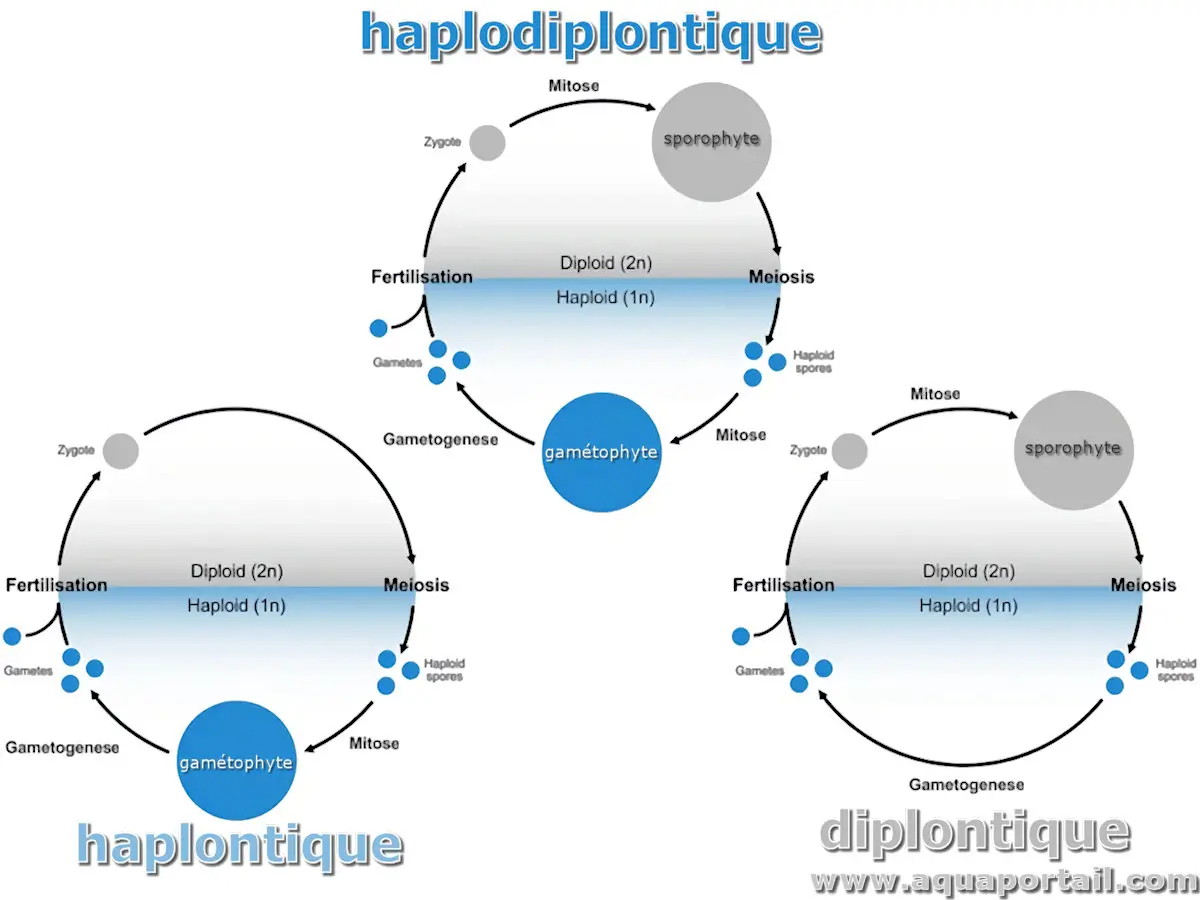
Haplodiplontic, or haplodiplobiontic, describes a developmental life cycle comprising both a haploid phase and a diploid phase, involving an alternation...
haplobiont

A haplobiont is an organism represented by a single type of free-living individual in nature, in contrast to a diplobiont.
habitat

A habitat is the place or environment where an organism naturally lives and grows, its typical place of residence.
