Signal peptide
noun phrase (n. phr.)
Definition
A signal peptide is a short peptide located at the N-terminus of a protein, carrying information for protein secretion. They are ubiquitous across all prokaryotes and eukaryotes. They enable a protein to be targeted to the endocellular membrane system.
Signal peptides have not traditionally been regarded as secreted or released cell products measurable in circulation, as it was assumed that the signal peptide was degraded after cleavage from the prepropeptide.
Organization of a signal peptide:
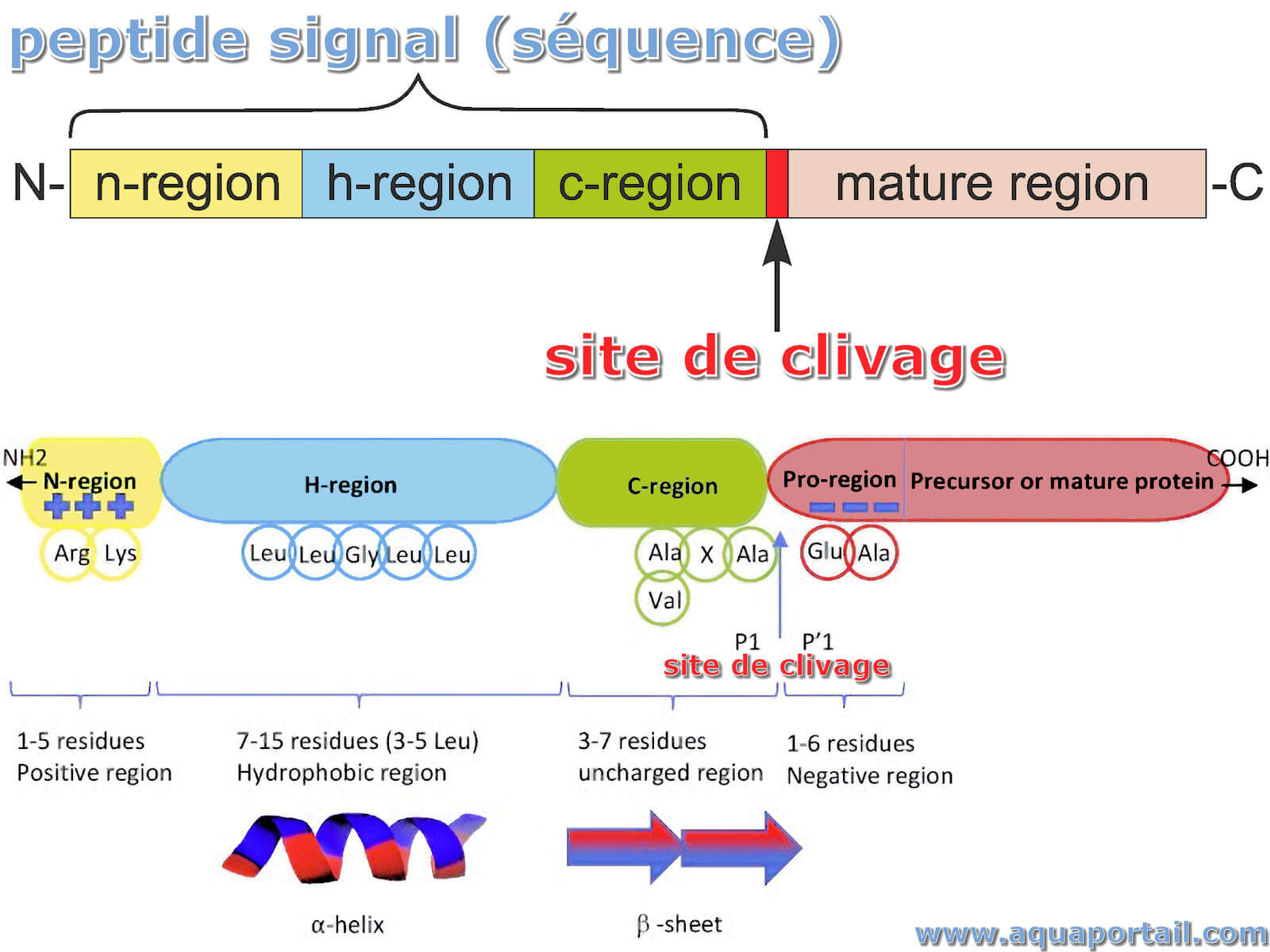
Organization of a typical signal peptide. The lengths of the signal sequence regions are not drawn to scale.
Signal sequence
The signal sequence is a short peptide chain, 15 to 50 amino acids long, present at the N-terminus of many newly synthesized secretory proteins. The signal sequence, along with the transit peptide, is an amino acid sequence of a protein. This amino acid sequence determines the destination, intracellular transport pathway, and secretion efficiency of the protein.
Explanations
Signal peptides are N-terminal presequences responsible for targeting proteins to the endomembrane system and subsequent subcellular or extracellular compartments, thereby conditioning their proper functioning. The importance of signal peptides drives the development of new computational methods for their detection. These methods utilize machine-learning systems trained on datasets comprising signal peptides from diverse protein types and taxonomic groups.
Consequently, prediction accuracy is high for signal peptides well represented in databases, but may be lower in atypical cases. Such atypical signal peptides occur in proteins found in apicomplexan parasites, the causative agents of malaria and toxoplasmosis. Apicomplexan proteins exhibit a unique amino acid composition due to their AT-biased genomes. Therefore, a new, more flexible and universal probabilistic model was designed for recognizing atypical eukaryotic signal peptides. This approach, called "SignalHsmm", incorporates knowledge of signal peptide structure and physicochemical properties of amino acids. It can recognize signal peptides from malaria parasites and related species more accurately than popular programs. Moreover, it remains sufficiently universal to predict other signal peptides on par with top prediction tools.
Secretory proteins are released by cells (such as in glands); they play roles in organelles like the endoplasmic reticulum and Golgi complex, and are integrated into cell membranes. Signal peptides ensure that these proteins are transported to their correct destination. Signal peptides are generally cleaved upon arrival.
Signal peptides occur on so-called type I membrane proteins. No true signal peptide is present in type II and type III membrane proteins: there, the leading transmembrane domain functions as a signal sequence. A transmembrane domain is biochemically similar to a signal peptide, except that it is not cleaved. Transmembrane domains resemble specialized peptides that transport a protein to its target (targeting peptides).
Occurrence and importance
Signal sequences are generally found in proteins destined outside the cell, in biomembranes, or in compartments. A signal sequence is typically required for transport into the endoplasmic reticulum, chloroplasts, mitochondria, peroxisomes, or the cell nucleus and their membranes. By combining different signal sequences, proteins can be imported into multiple organelles simultaneously, such as the mitochondrion and chloroplast.
Although bacterial cells are not compartmentalized, bacterial proteins can possess signal sequences. These can direct proteins to be transported into the cell membrane or extracellular space.
Target compartments
Transport into the lumen or membrane of the endoplasmic reticulum (ER) can occur during protein biosynthesis (cotranslational protein transport, translocation) or solely as a finished protein previously synthesized in the cytoplasm (post-translational protein transport). Proteins with more hydrophilic signal sequences are preferentially transported post-translationally.
However, proteins with more hydrophobic signal sequences are transported cotranslationally. This process occurs on the rough endoplasmic reticulum, which is studded with ribosomes. The transport mechanism is complex and involves not only the ribosome and its bound mRNA, but also interacting proteins such as the signal recognition particle (SRP) and ribosome-associated proteins. An SRP receptor and the tunnel protein complex (SEC complex, Translocon) are also required in the ER membrane.
All secretory proteins and most membrane-integrated proteins possess a signal sequence with a 15- to 50-amino-acid signal peptide at their N-terminus exhibiting specific properties. Signal sequences may also be located internally within a protein or at the C-terminus.
The exact sequence of individual amino acids is less important than their physical properties: a central hydrophobic core (h) is flanked at the N-terminus (n) by positively charged amino acids and at the C-terminus (c) by polar amino acids. The C-terminal region often contains helix">helix-breaking amino acids such as proline or glycine. The N-terminal region is the least conserved. In most cases, the signal sequence is cleaved from the mature protein by signal peptidase (SPase) after membrane passage. The cleavage site is defined by small, uncharged amino acid residues at positions -3 and -1 of the polar C-terminal region of the signal sequence.
The amino acid sequence KDEL ensures protein transport into and retention within the endoplasmic reticulum; in the case of secretory proteins bearing a KDEL sequence, the signal sequence in the ER is proteolytically cleaved, as otherwise they would be retained by KDELR1, 2, and 3 receptors, among others.
For certain transmembrane proteins, the first transmembrane domain also serves as the signal sequence. This segment, also called a signal-anchor sequence, is distinguished by a longer hydrophobic core region and the absence of a signal peptidase cleavage site compared to a normal signal sequence.
The majority of proteins transported to the ER possess an N-terminal signal or signal-anchor sequences. However, there are also integral membrane proteins inserted into the ER membrane without an N-terminal signal sequence. These proteins are recognized via a hydrophobic segment located at the C-terminus. How these proteins insert into the ER membrane has not yet been clarified.
Adaptins bind to the signal peptide and from there recruit clathrins and other accessory proteins upon binding to clathrins.
Cell nucleus
A signal sequence, here called a nuclear localization signal (NLS, prototypical sequence PKKKRKV), is also required for post-translational import of proteins into the cell nucleus. This is recognized by a nuclear import receptor, which is transported with it into the nucleus. Proteins are exported from the cell nucleus using an NES (nuclear export signal) via exportin and Ran-GTP with a typical G-protein mechanism. The NES consists of the sequence LxxxLxxLxL, with L representing aliphatic amino acids such as leucine and x representing any amino acid.
Mitochondrion
The protein is imported into the mitochondrion post-translationally, i.e., once protein biosynthesis is complete. All import processes occur via the same transport machinery, the TOM complex (translocase of the outer membrane) of the outer mitochondrial membrane. There are also several other protein complexes that ensure integration of proteins into the outer mitochondrial membrane (SAM complex, sorting and assembly machinery) and import into the inner mitochondrial membrane and mitochondrial matrix (TIM complexes, translocase of the inner membrane).
Protein precursors can be divided into two groups: the first group consists of proteins with N-terminal signals destined for the mitochondrial matrix, certain inner membrane proteins, and the intermembrane space between the outer and inner membranes. The amino acid residues carry positive charges, interact with organelle import receptors, and direct the protein to its destination across the inner membrane. They generally consist of 20 to 40 amino acids forming an amphipathic α-helix recognized by the import machinery. The presequence is cleaved by a peptidase after import.
The second group includes all outer membrane proteins, many inner membrane proteins, and intermembrane space proteins. They carry only internal signals that cannot be cleaved.
Chloroplast
The protein is imported into chloroplasts post-translationally via the TOC (Translocon at the Outer Chloroplast membrane) and TIC (Translocon at the Inner Chloroplast membrane) protein complexes.
Plastid signal peptides are located at the N-terminus of the protein precursor and possess specific physical properties: they are rich in amino acids with hydroxylated residues, lack acidic residues, and do not form secondary structure. The presequence is phosphorylated and interacts with Hsp70 and 14-3-3 proteins, which escort the protein to the translocon. After import, the signal sequence is cleaved by a peptidase. Outer membrane proteins do not require an N-terminal signal peptide; their integration mechanism remains unknown.
Proteins destined for the thylakoid membrane or lumen may also contain additional targeting sequences.
Peroxisome
Post-translational import of proteins into the peroxisome relies on two distinct types of signal sequences, called PTS1 and PTS2 (Peroxisome Targeting Signals).
PTS1 sequences are short C-terminal signals containing the amino acid motif (S/A/C)-(K/R/H)-(L/I/M). They are recognized by the receptor peroxin-5 (Pex5p).
PTS2 sequences are 9-amino-acid signals located approximately 20 residues from the N-terminus. The receptor for PTS2 signals is peroxin-7 (Pex7p).
Synonyms, antonyms
Spanish translation: péptido señal
1 synonym (similar meaning) for "signal peptide":
0 antonyms (opposite meaning).
Related words and expressions to SIGNAL PEPTIDE are directly connected by general or specific meaning.
The expression SIGNAL PEPTIDE is listed on page 1 of words starting with S in the dictionary glossary.
Related to "signal peptide"
saccharide

A saccharide is a carbohydrate, a biomolecule composed of carbon, hydrogen, and oxygen atoms, usually with a hydrogen-to-oxygen atomic ratio of 2 :1.
sagittocyst

A sagittocyst is a capsule containing a spindle-shaped needle produced by epidermal cells of certain flatworms (acoels).
salt marsh lamb

A salt marsh lamb (pré-salé) is a sheep that grazes habitually on coastal salt marshes, feeding on salt-tolerant grasses and herbs.
saltwater treatment

The saltwater bath method, or aquarium salt treatment, helps halt potential external infections via osmotic shock.
