Endoplasmic reticulum
noun phrase (n. phr.)
Definition
The endoplasmic reticulum is an irregular network of unit membranes within the cytoplasm of many eukaryotic cells. The membranes form a complex network of tubular channels often expanded into slit-like cavities.
Anatomy of an endoplasmic reticulum:
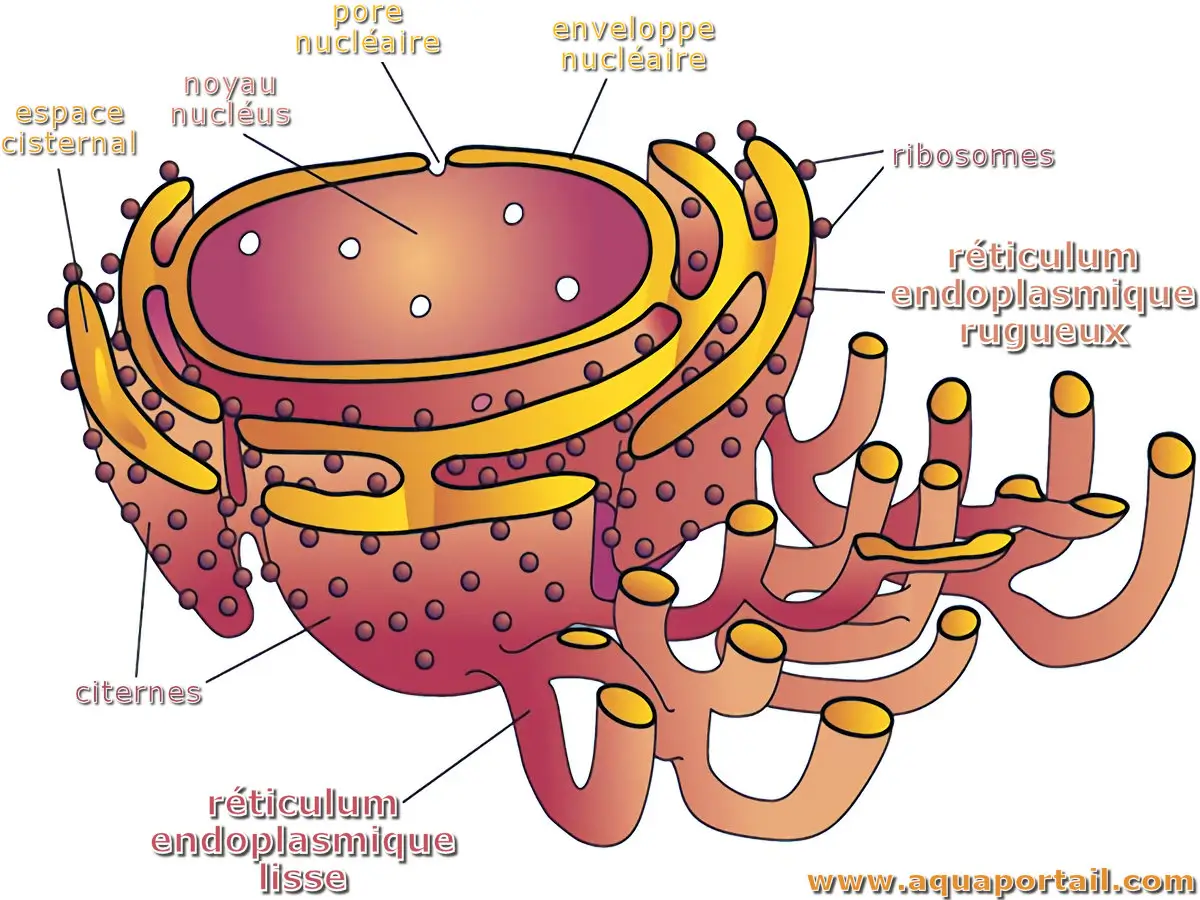
An endoplasmic reticulum is a cellular compartment with two distinct parts: a rough portion with ribosomes on its surface, cisternae, and cisternal spaces, and a smooth portion for specific subcellular exchanges.
Explanations
The endoplasmic reticulum (ER) is a membrane-bound reticulated system of cavities and tubules extending throughout the cytoplasm of eukaryotic cells; when it bears ribosomes on its outer surface, it is termed granular or rough, and otherwise it is termed smooth.
The endoplasmic reticulum is regarded as the transport system or "highway" of the cell due to its vital role in moving proteins and other molecules across the cytoplasm.
Two types
The endoplasmic reticulum is divided into smooth endoplasmic reticulum and rough endoplasmic reticulum. In muscle cells, the smooth reticulum is called the sarcoplasmic reticulum.
Difference between rough and smooth endoplasmic reticulum:

The diagram details the structural differences between rough endoplasmic reticulum and smooth endoplasmic reticulum.
With the exception of mature erythrocytes, the endoplasmic reticulum is found in all eukaryotic cells; depending on the cell type, it develops to varying degrees. In a eukaryotic cell, it is a membranous network formed of flattened sacs and tubules connecting the plasma membrane and the nuclear envelope.
Description
The endoplasmic reticulum contains dolichol phosphate, a lipid of the rough endoplasmic reticulum membrane formed of a chain of 15 to 20 isoprene units. It acts as a carrier for the 14-sugar oligosaccharide used to glycosylate proteins. The first carbohydrate is linked to dolichol phosphate via a pyrophosphate bond. The energy of this bond enables the transfer of the oligosaccharide to the -NH2 group of an asparagine side chain on the protein.
In haptophytes, the peripheral endoplasmic reticulum is an extension of the endoplasmic reticulum located beneath the plasma membrane around the entire cell periphery and extending inside the haptonema.
The rough ER (or granular ER, ergastoplasm) is an endoplasmic reticulum whose surface bears ribosomes, whereas the smooth ER (or agranular ER) lacks them.
Composition
The endoplasmic reticulum is an organelle distributed throughout the cytoplasm of a eukaryotic cell, represented as a complex system of membranes arranged as interconnected flattened sacs and tubules sharing a common internal lumen. Its membranes are continuous with the nuclear envelope and can extend close to the plasma membrane, accounting for more than half of a cell's membranes. Because the fatty acids composing them tend to be shorter and more unsaturated, they are thinner than other membranes.
The reticulum is involved in functions related to protein synthesis, lipid and steroid metabolism, and intracellular transport. It is present in animal and plant cells, but absent in prokaryotic cells.
The reticulum organizes its membranes into regions or domains that perform distinct functions. The two most readily distinguishable domains are the rough endoplasmic reticulum, with membranes forming relatively straight tubules, occasionally flattened cisternae, and numerous bound ribosomes, and the smooth endoplasmic reticulum, lacking bound ribosomes and featuring membranes arranged into curved, irregular tubules.
Simple structure of the endoplasmic reticulum:
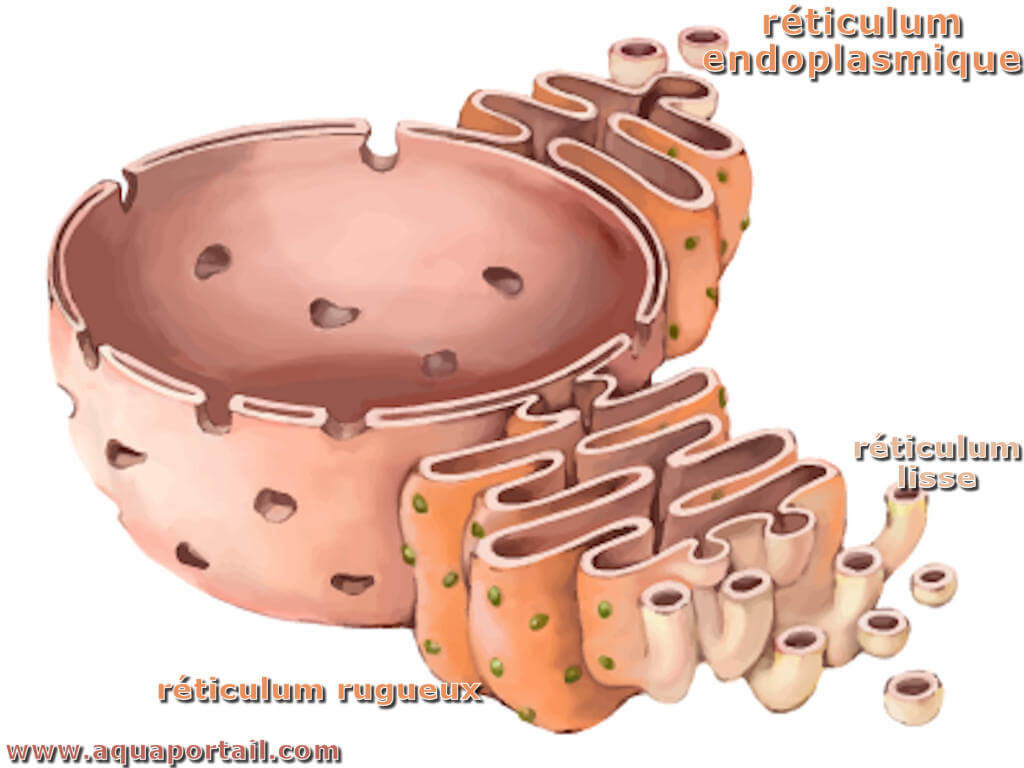
The endoplasmic reticulum surrounds the cell nucleus, composed of the rough reticulum and smooth reticulum.
The outer membrane of the nuclear envelope can be regarded as part of the endoplasmic reticulum since it is a physical continuation of it and bound ribosomes can be observed actively carrying out translation. Rough and smooth endoplasmic reticulum typically occupy distinct cellular spaces, as in hepatocytes, neurons, and steroid-synthesizing cells. However, in certain regions of the reticulum, there is no clear segregation between the two domains, and membrane zones with ribosomes are intermingled with ribosome-free zones. The spatial arrangement of the endoplasmic reticulum in animal cells depends on its interactions with microtubules, whereas in plants actin filaments are responsible.
Tasks and functions
A recent scientific study examined the process of protein secretion and also explained the existence of alternative mechanisms for exporting proteins synthesized in the endoplasmic reticulum, noting that this is known as the secretory pathway, a set of organelles responsible for transporting proteins from the endoplasmic reticulum to other destinations.
Protein translation and folding, protein quality control, post-translational modifications, and the transport of transmembrane and secretory proteins (see exocytosis) take place on and within the reticulum. Furthermore, the ER is the site where (for example after mitosis) new central membranes are formed and pinched off. The ER also serves as an intracellular calcium store, giving it a key role in signal transduction. In muscle cells (where the ER is called the sarcoplasmic reticulum, or SR for short), calcium release mediates contraction. The roles of the ER and SR are distinct.
Synonyms, antonyms
Spanish translation: retículo endoplasmático
4 synonyms (similar meaning) for "endoplasmic reticulum":
- dolichol phosphate
- rough endoplasmic reticulum
- sarcoplasmic reticulum
- smooth endoplasmic reticulum
0 antonyms (opposite meaning).
Related words and expressions to ENDOPLASMIC RETICULUM are directly connected by general or specific meaning.
The expression ENDOPLASMIC RETICULUM is listed on page 1 of words starting with E in the dictionary glossary.
Related to "endoplasmic reticulum"
organelle

An organelle is a subcellular structure that performs one or more specific functions within the cell, much like an organ in the body.
endophyte

An endophyte is a plant, fungal, or animal organism living inside a plant without necessarily being a parasite, though it is sometimes termed a plant...
operculum
An operculum is a structure characteristic of fish and larval amphibians that covers the gills, leaving only a posterior opening or gill slit.
retinaculum

Retinacula ensure smooth movement of the distal extremities by anchoring tendons close to joints.
Simple summary
The endoplasmic reticulum (ER) is a cellular organelle in eukaryotic cells that functions as a manufacturing and packaging system. There are two types: rough endoplasmic reticulum and smooth endoplasmic reticulum. Rough endoplasmic reticulum is studded with ribosomes, giving it a granular appearance, and is primarily involved in protein synthesis. Conversely, smooth endoplasmic reticulum lacks ribosomes and participates in lipid production, chemical detoxification, and ion storage. Both types maintain cellular function and facilitate communication within the cell.
