Telomere
noun (n.)
Definition
Telomeres are the ends of chromosomes. A telomere is a repetitive sequence, periodically elongated by a specialized enzyme, located at the end of eukaryotic chromosomes. It prevents the DNA strand from shortening with each replication cycle. See also telomerase.
Chromosomes with telomeres:
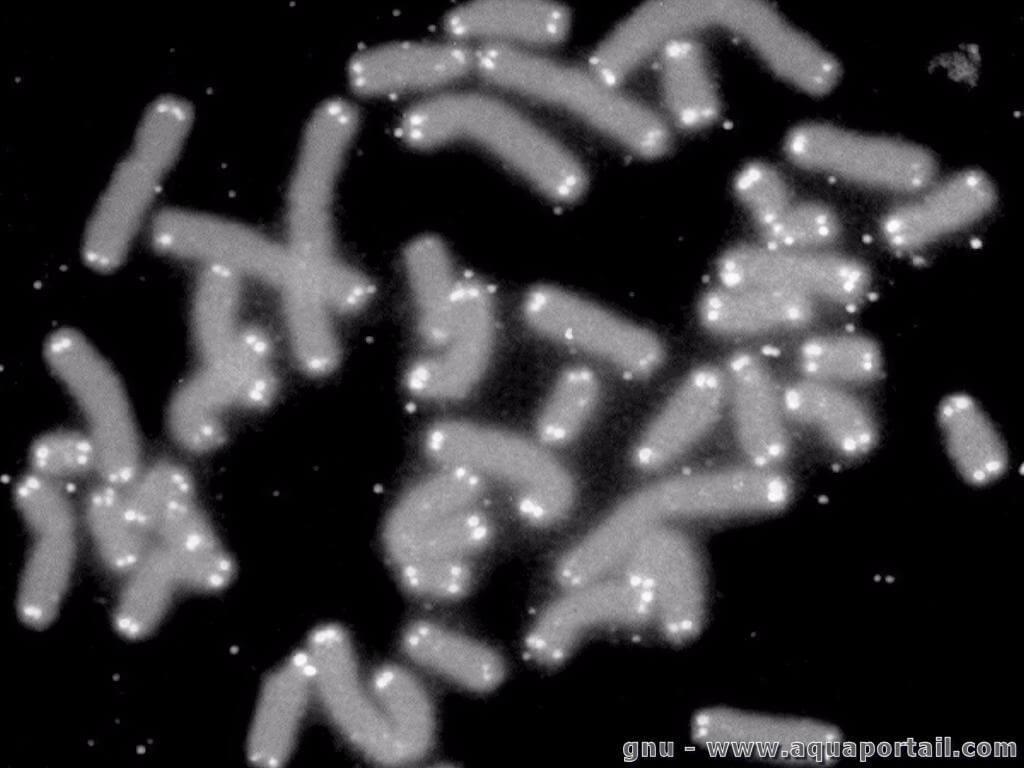
Telomeres (white) cap human chromosomes (gray).
Explanations
Telomeres are highly repetitive, non-coding DNA regions whose primary function is the structural stability of chromosomes in eukaryotic cells, cell division, and the lifespan of cell lineages. They are also implicated in major diseases such as cancer.
Indeed, replication of a DNA region requires the presence of DNA upstream of that region so that the RNA primer on which DNA polymerase binds can attach; this problem does not arise for bacterial chromosomes, which are circular, but occurs at the ends of linear eukaryotic chromosomes.
Prokaryotic organisms have circular chromosomes that lack telomeres. Certain prokaryotes have linear chromosomes with telomeric sequences whose sequence differs from that of eukaryotes.
A telomere is thus the end of the chromosomes of certain eukaryotes, consisting of repeated DNA sequences rich in guanosine. In humans, the sequence is the hexanucleotide TTAGGG (GGGTTA).
Discovery of telomeres
Telomeres were discovered by Hermann Joseph Muller during the 1930s, who, along with Barbara McClintock, received the Nobel Prize. Since then, considerable progress has been made in understanding telomeres through molecular genetics techniques. They proposed that telomeres, located at the ends of chromosomes, functioned to prevent chromosomes from fusing upon contact at their tips, which would have disastrous consequences for cells.
Scientists Elizabeth H. Blackburn, Carol W. Greider, and Jack W. Szostak were awarded the 2009 Nobel Prize in medicine for the molecular description of telomeres, the demonstration of their evolutionary conservation, and the discovery of telomerase, the central enzyme of the cellular machinery for telomere synthesis, having established a highly coherent model explaining the "end-replication problem" and the molecular mechanism protecting chromosome ends.
General considerations
Within a chromosome, there are two types of DNA: coding DNA, which makes up the genes, i.e., the parts of the chromosome containing information encoding proteins and ribosomal ribonucleic acids interspersed within a large amount of non-coding DNA. Among non-coding DNAs are those forming the centromere and telomeres of chromosomes. The centromere is an elongated region of DNA that allows the DNA molecule to attach to the mitotic spindle during M phase of the cell cycle.
On the other hand, telomeres play an important role in cell life by maintaining the integrity of chromosome ends, thereby preventing entanglement and fusion; they also assist homologous chromosome pairs in pairing during prophase of meiosis. Human and murine telomeres contain up to 2,000 repeats of the sequence 5'-TTAGGG-3'.
Aging and carcinogenesis
Certain theories of aging and carcinogenesis are based on the fact that telomeres act like cellular clocks or timers, marking the number of cell divisions until the cell dies. The foundations of these theories are:
- the DNA contained in telomeres is not fully replicated during DNA duplication, because DNA polymerase enzymes can only operate in the 5' to 3' direction. For one of the two strands (leading strand), this is not an issue, but to simultaneously duplicate the lagging strand (whose template strand runs in the 5' to 3' direction), Okazaki fragments must be formed. The start of each segment consists of an RNA primer. These are eventually replaced by DNA; however, the 5' end of the newly synthesized strand cannot be completed, as that would require synthesis in the 3' to 5' direction. Consequently, the telomere becomes shorter and shorter with each replication
- telomeres, in most animal, plant, and microorganism species, consist of short nucleotide subunits generally rich in thymine (T) and guanine (G). In humans, the sequence of each subunit is TTAGGG
- the number of repeats varies across different cells of the same individual; however, the average number of repeats is generally constant for each species. In humans, it is estimated to reach about 2,000 repeats
- telomerase is an enzyme formed by a protein-ribonucleic acid complex with reverse transcriptase activity (i.e., capable of synthesizing DNA from an RNA sequence) produced in embryonic germ cells
- telomerase is repressed in mature somatic cells after birth, causing the telomere to shorten after each cell division
- when telomere length reaches a certain threshold, mitosis halts, leaving cells in the G0 (G zero) stage of their cell cycle
- telomere attrition over cell cycles impairs its chromosome-protective function, leaving the chromosome unstable, fused, or lost. Cells exhibiting these defects are not only unable to divide, but are no longer viable, triggering apoptosis or programmed cell death
- many cancer cells reactivate telomerase activity, promoting proliferation of a malignant clone. Drugs are being investigated to inhibit telomerase and thereby halt the growth of malignant cells, representing a promising therapeutic target in cancer.
Specialists at the Spanish National Cancer Research Centre (CNIO) developed a gene therapy that, when administered to adult animals, safely extends average lifespan. Previously, such research required permanently modifying animal genes from the embryonic stage. However, the gene therapy developed by CNIO to combat aging was tested in one- and two-year-old adult mice and had a "rejuvenating" effect on them.
The procedure involves modifying the genetic payload of an engineered virus; its genes are replaced with one of the most important genes for aging in the treated species: the one encoding the enzyme telomerase. Telomerase slows this effect, rebuilds telomeres, and resets the cell's biological clock. The virus carrying the treated DNA inoculated into the animal acts as a vehicle delivering the telomerase gene into cells.
Resection of telomeric double-strand breaks
Linear chromosomes are packaged into specialized protective DNA complexes called telomeres. Telomeres are short tandem DNA repeats, and double-strand breaks (DSBs) have distinct properties such that telomeres prevent DNA repair activities. During telomeric DNA replication in the S/G2 and G1 phases of the cell cycle, the 3' strand leaves a short overhang called a G-tail. Telomeric DNA terminates in the 3' G-tail because the 3' strand extends beyond its complementary 5' C-strand. G-tails fulfill a major function in telomeric DNA by regulating telomere homeostasis.
In the G1 phase of the cell cycle, the telomere-associated proteins RIF1, RIF2, and RAP2 bind to telomeric DNA and block access to the MRX complex. This process in S. cerevisiae is negatively regulated by this activity. The MRX complex and the Ku complex bind simultaneously and independently to DSB ends. In the presence of telomere-associated proteins, MRX fails to bind to DSB ends whereas the Ku complex binds to DSB ends. The Ku complex bound to DSB ends protects telomeres from nucleolytic degradation by Exo1. This leads to inhibition of telomerase-mediated elongation at DSB ends and prevents further telomere action during the G1 phase of the cell cycle.
At the end of the S/G2 phase of the cell cycle, the telomere-associated proteins RIF1, RIF2, and RAP2 exert their inhibitory effect by binding to telomeric DNA. In late S/G2 phase, the cyclin-dependent protein kinase CDK1 promotes telomeric resection. This control is mediated by cyclin-dependent kinases, which phosphorylate components of the resection machinery. This process alleviates the inhibitory effect of telomere-associated proteins and allows Cdc13 (a single-stranded telomeric DNA-binding protein) to cap telomeric DNA. Binding of Cdc13 to DNA suppresses the DNA damage checkpoint and enables resection while allowing telomerase-mediated elongation at DSB ends.
Synonyms, antonyms
Spanish translation: telómero
0 synonyms (similar meaning) for "telomere".
0 antonyms (opposite meaning).
Related words and expressions to TELOMERE are directly connected by general or specific meaning.
The word TELOMERE is listed on page 1 of words starting with T in the dictionary glossary.
Related to "telomere"
tagma

A tagma is a group of fused segments formed by series of metameres differentiated from the rest of an arthropod's body.
tapeworm
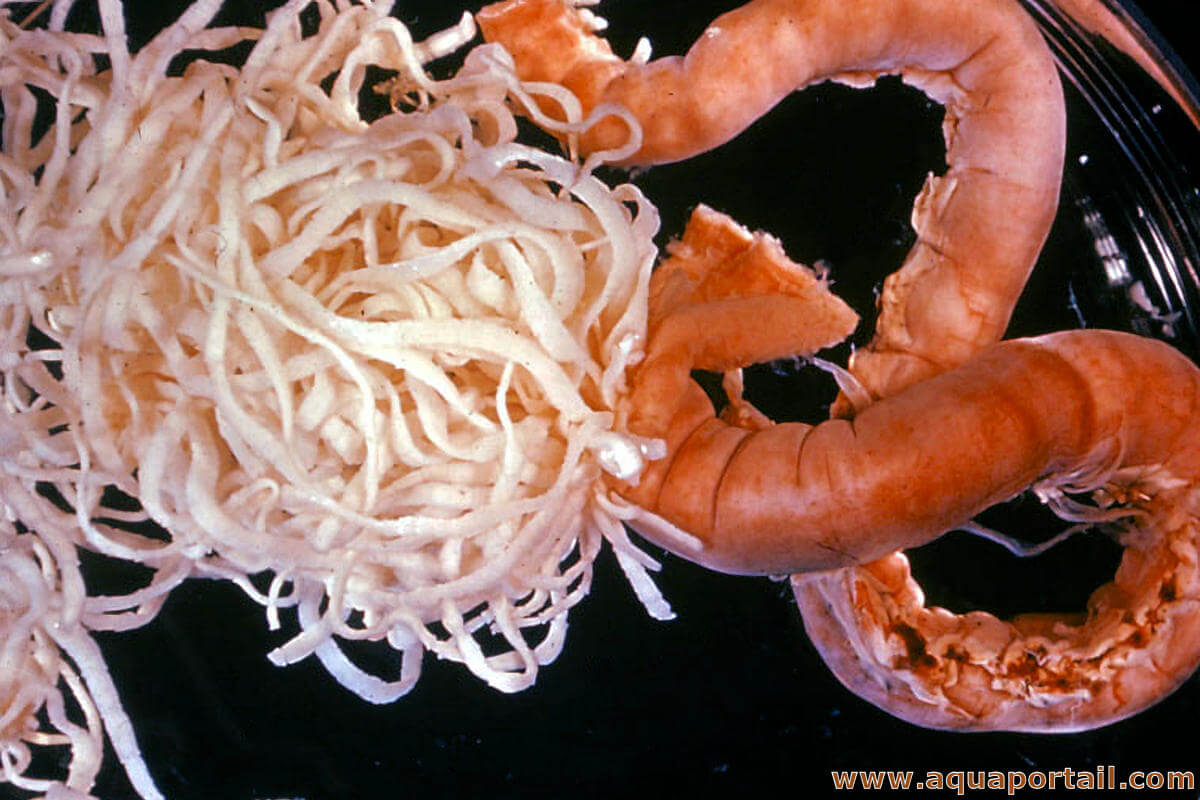
The tapeworm, or solitary worm, is a long, ribbon-like, segmented flatworm, a parasitic cestode of the genus Taenia.
taxon

In biology, a taxon is a taxonomic unit recognized by international codes within a given classification, or a systematic unit such as a family, genus...
tectonics

Tectonics is a branch of geology that studies the structure of the crust of a planetary body, such as Earth or the Moon, particularly the formation of folds...
