Homologous
noun and adjective (n. / adj.)
Definition
In biology, homologous describes traits or structures inherited from a common ancestor (resulting from homology). Structural or behavioral traits are termed homologous when their similarity is explained by descent from a shared ancestral form.
Comparison between homologous, duplicated, and recombined chromosomes:
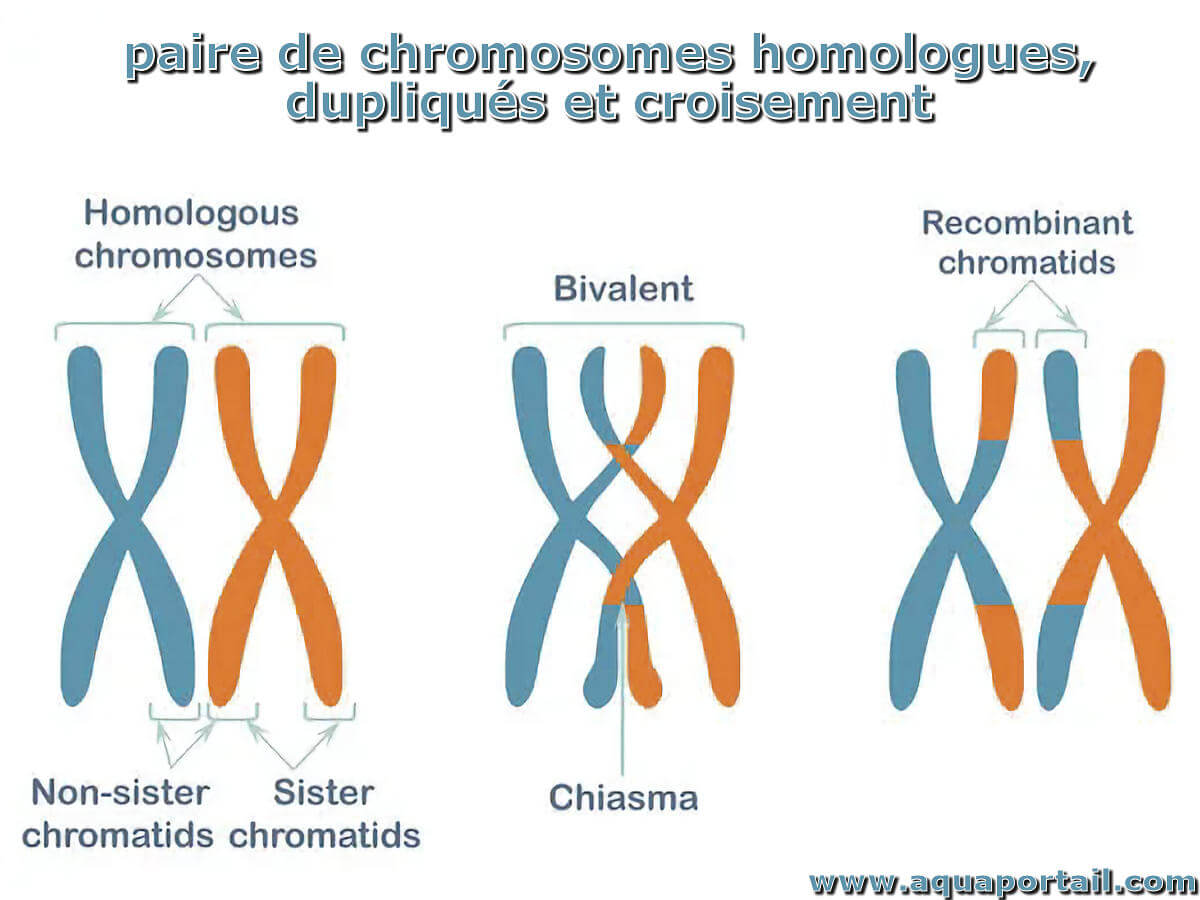
Homologous chromosomes are two DNA molecules within a diploid organism that carry the same genes, one inherited from each parent. In simpler terms, each parent contributes a complete haploid genome of 23 chromosomes encoding the corresponding set of genes.
Homologous in biology
A homologous limb or organ refers to an anatomical feature of one species that corresponds to that of another species in anatomical position and structural composition, with differences bridged by intermediate forms across related species or developmental stages.
Put another way, homologous structures denote organs in related species that need not share the same outward form or function, yet originate from the same embryonic primordia. Homologous contrasts with analogous and encompasses paralogous and orthologous relationships.
✅ See also homologous chromosomes and homeomerous organism.
Homologous in chemistry
In chemistry, a homolog (homologous compound) refers to one of two closely related molecules differing by a single functional group or repeating structural unit. For example, monolinuron bears a chlorine atom whereas metobromuron replaces chlorine with bromine, making the two molecules chemical homologs.
Differences between homologous and analogous in anatomy
Comparative anatomy is the study of similarities and differences in the structures of organisms, classifying physical traits as either homologous or analogous.
Homologous structures are anatomical features in organisms sharing a common ancestor that often perform entirely different functions. Classic examples include the forelimbs of humans, cats, whales, and bats: whether an arm, leg, flipper, or wing, all are built upon the same underlying skeletal plan.
homologies arise through divergent evolution—the process by which organisms descending from a common ancestor accumulate differences over time, often giving rise to new species in response to shifting abiotic or biotic environmental pressures.
At the opposite end of the spectrum, analogous structures are similar physical features in organisms that do not share a common ancestor, instead resembling one another because they perform the same function. A prime example is the wing of a bat and the wing of a bird: they possess completely different skeletal architectures, yet both serve the shared function of powered flight.
Analogies result from convergent evolution, the process whereby two unrelated lineages independently evolve similar traits because they inhabit comparable environments or experience similar selective pressures.
Synonyms, antonyms
Spanish translation: homólogo
2 synonyms (similar meaning) for "homologous":
3 antonyms (opposite meaning):
- analogous
- autologous
- heterologous
Related words and expressions to HOMOLOGOUS are directly connected by general or specific meaning.
The word HOMOLOGOUS is listed on page 1 of words starting with H in the dictionary glossary.
Related to "homologous"
homology

Homology consists in identifying a shared character—homologous across multiple living organisms—inherited from their common ancestor.
habitat

A habitat is the place or environment where an organism naturally lives and grows, its typical place of residence.
halitosis

Halitosis (bad breath) is primarily caused by sulfur-producing bacteria that normally live on the surface of the tongue and in the throat.
hallux

The hallux is the big toe (great toe) of a foot, homologous to the thumb of a hand. It is located on the medial (inner) side of the foot, whereas the little...
