Chlorine
noun (n.)
Definition
Chlorine is the halogen element with the chemical symbol Cl and atomic number 17. It occurs naturally as a diatomic gas Cl2, dichlorine, which has a pale greenish color and an irritating odor.Chlorine is known in its chloride ion form bonded with sodium to form table salt NaCl, or bonded with hydrogen to form hydrochloric acid HCl.
The element chlorine:
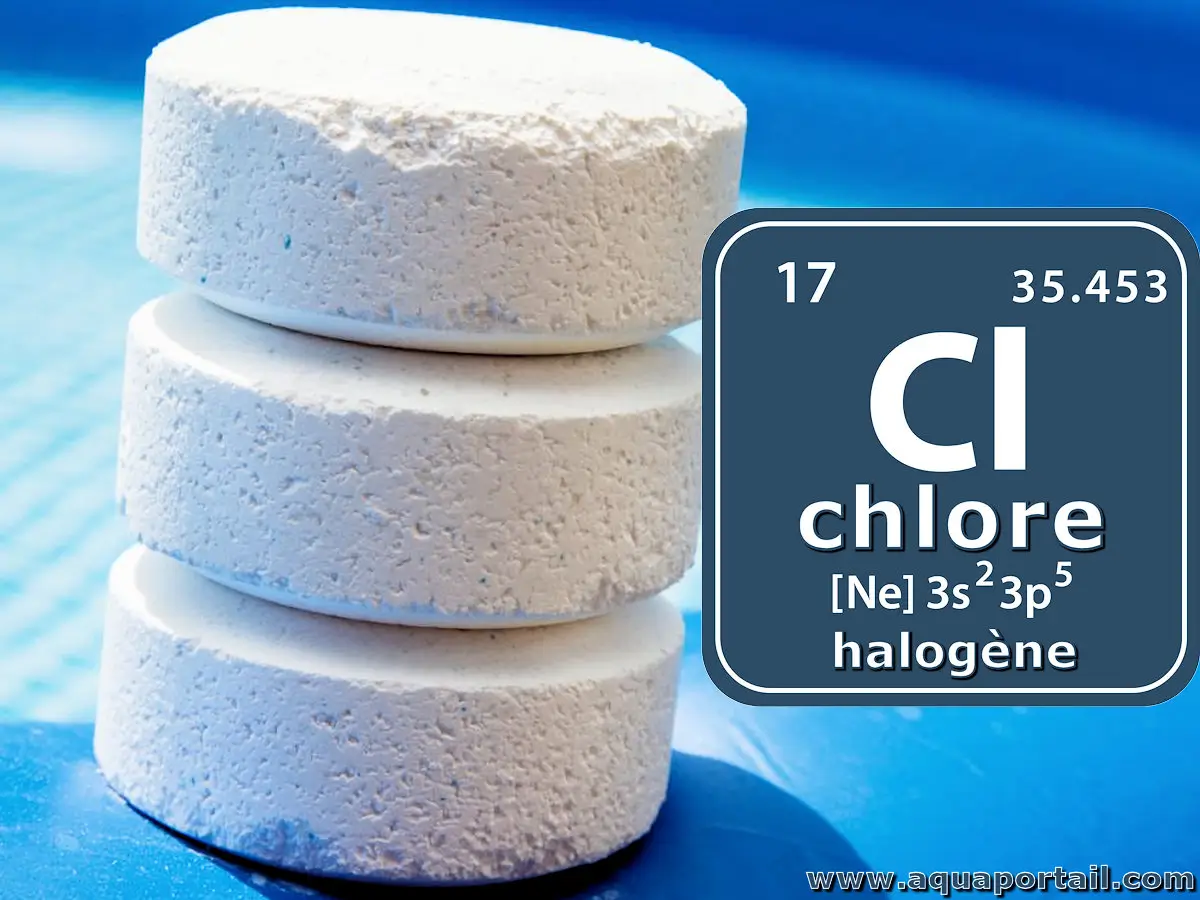
Chlorine has an atomic mass of 35.45 ± 0.01 g/mol. Its name is derived from the Greek "chloros", meaning "greenish-yellow".
Explanations
Chlorine Cl is widely used in various fields mixed with water such as bleach, but more generally as a bleaching agent, oxidizing agent, and microbicide.
Chlorine is not present in its pure state in nature. Halite (sodium chloride) is the main mineral mined to obtain chlorine. Chlorine is also present in the minerals carnallite (magnesium potassium chloride) and sylvite (potassium chloride).
In its dichlorine form, it is a dense gas that irritates the eyes and respiratory system. Moreover, this toxic gas was used as a chemical weapon during World War I.
Uses
Chlorine kills microbes (bactericidal and virucidal actions), acting as a general disinfectant. It is used to make tap water drinkable and to sanitize swimming pool water. About 20% of the chlorine produced worldwide is used in the manufacture of PVC.
Chlorine is also used in organic chemistry as an oxidizing agent and in substitution reactions. 85% of pharmaceuticals use chlorine or its compounds at one stage or another of their manufacture.
In the past, chlorine was commonly used to make chloroform (an anesthetic) and carbon tetrachloride (a dry-cleaning solvent). However, both of these chemicals are now strictly controlled because they can damage the liver.
Biological role
The chloride ion is essential to life because it is mainly present in cellular fluid as a negative ion to balance positive ions (primarily potassium). It is also present in extracellular fluid to balance positive ions (primarily sodium).
History
This gaseous element was first produced in 1774 by Carl Wilhelm Scheele in Uppsala, Sweden, by heating hydrochloric acid with pyrolusite, a natural mineral of manganese dioxide (MnO2). A dense, greenish-yellow gas was released, which he noted as having a suffocating odor and which, upon dissolving in water, yielded an acidic solution. He observed that it bleached litmus paper and decolorized leaves and flowers.
Humphry Davy studied it in 1807 and finally concluded not only that it was a simple substance, but that it was indeed an element. He announced it in 1810, though it took another ten years for some chemists to finally accept that chlorine was truly an element.
Synonyms, antonyms
Spanish translation: cloro
5 synonyms (similar meaning) for "chlorine":
- chlorate
- chloride
- chlorite
- dephlogisticated muriatic acid
- dichlorine
0 antonyms (opposite meaning).
Related words and expressions to CHLORINE are directly connected by general or specific meaning.
The word CHLORINE is listed on page 1 of words starting with C in the dictionary glossary.
Related to "chlorine"
chloramine
A chloramine is a chemical compound used in chloramination. Monochloramine has the chemical formula NH₂Cl and is typically used in dilute aqueous solution...
chlorobiont

A chlorobiont (Chlorobionta) is a green photosynthetic plant organism. The chlorobionts as a whole encompass terrestrial green plants (Embryophyta) as well...
cactus

A cactus is a thick, fleshy plant that grows in many hot, dry regions of the world. Cacti do not have leaves, and many are covered with spines.
caecilian

A caecilian (gymnophione) is a limbless, burrowing, worm-like amphibian whose legs are vestigial or absent.
