Chiton
noun (n.)
Definition
From the class Polyplacophora, a chiton, or sea cradle, is a marine mollusk belonging to an ancient group whose shell is formed of several segmented (generally eight), calcareous, articulated plates. These segmented, articulated plates distinguish them from "true" gastropods whose shell is "unsegmented." Chitons, just like gastropods, possess a rasping tongue called a radula, allowing them to graze on algae, including the toughest varieties.
Acanthopleura spinosa is a chiton:
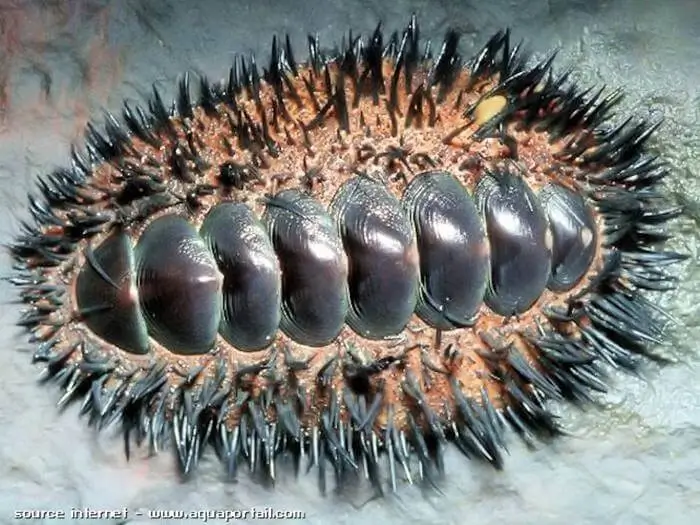
Chitons (here Acanthopleura spinosa) live on rocky coastal substrates, including the intertidal zone, in an environment similar to limpet ecology, though deeper down.
Explanations
Most chitons are herbivorous algae grazers. Marine species are well known, particularly in cold-temperate latitudes. Chitons are discreet, cryptic in coloration, and tend to remain motionless most of the time, clinging to a crevice in a rock. They are gregarious and nocturnal, with marked negative phototaxis, so they seek the underside of rocks. They have the ability to curl up into a ball to protect themselves.
A chiton (very colorful):
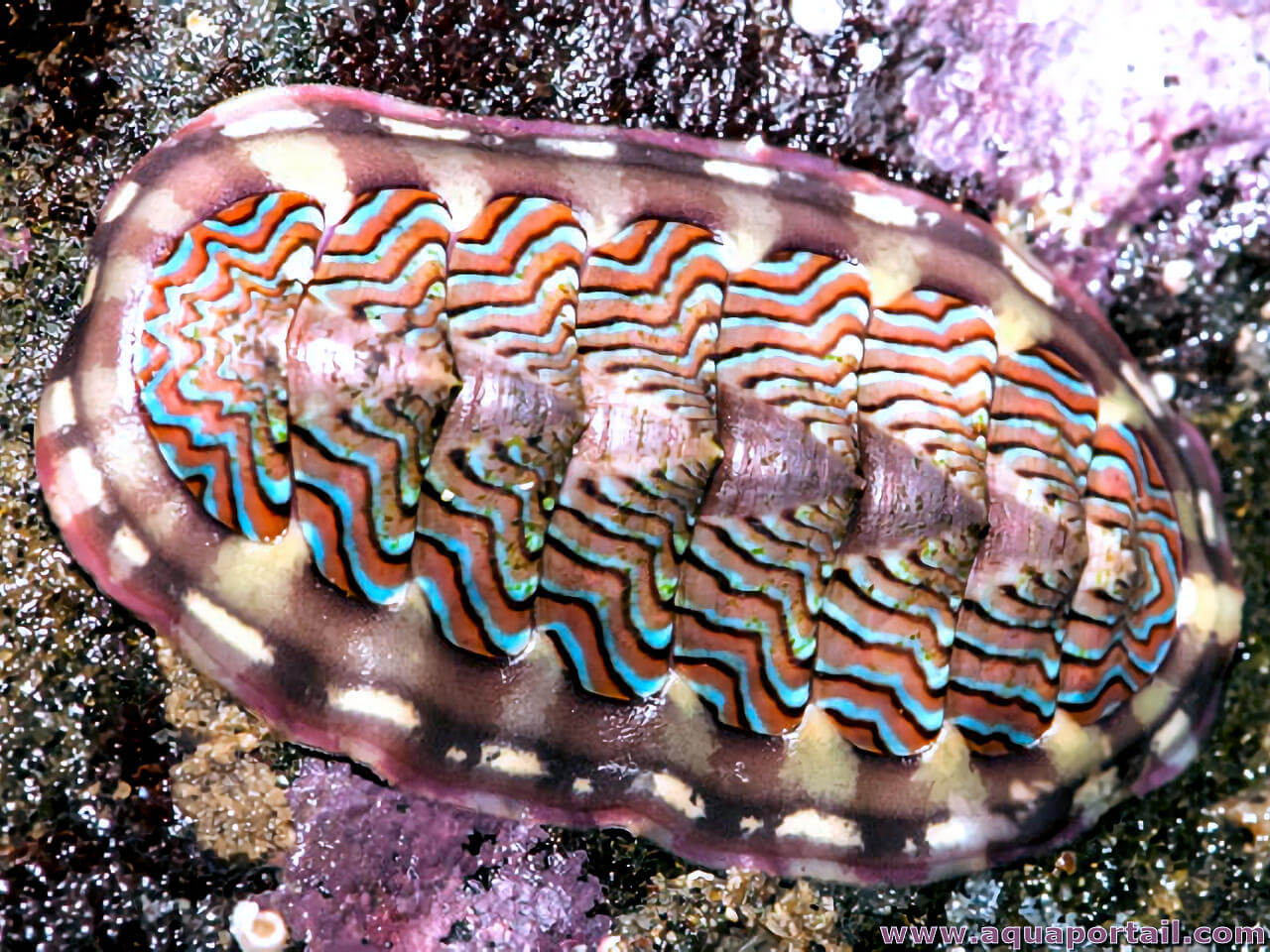
Chitons can see thanks to compound-like eyes.
Chitons have thousands of tiny lenses across their entire shell that can work together to form a compound eye. Yet, there are no visible eyes on the head or anywhere else on their body. These animals, restricted to marine environments, live encrusted on rock.
Chitons look somewhat like a cross between an armadillo and a slug. Like slugs and snails, they have a fleshy foot that holds tightly to rocks with an almost unbreakable grip. With eight overlapping shell plates on their back and a fleshy girdle encircling their body, chitons are not hard to recognize.
Early in life, chitons (larval stage) actually have eyespots in the head region as young larvae, which disappear within a month. Their way of seeing is unlike any other animal: they can actually see through the plates on their back!
All chitons have light-sensitive cells in their mantle - the tissue in all mollusks that secretes the shell. Unlike many other mollusks, chiton shells are translucent and their light-sensitive cells can detect changes in brightness. Some chitons go even further and have hundreds or thousands of tiny sand-grain-sized lenses, called ocelli, embedded in the shells above photoreceptor cells.
The hundreds of lenses act together as a kind of compound eye. Images are interpreted by a fairly simple nervous system resembling a ladder running down the back.
The visual acuity of these eyes was determined experimentally by Daniel Speiser and his colleagues. In their experiment, chitons in aquariums were allowed to feed under diffuse light. Without warning, they were then flashed with dark circles of varying sizes overhead. Chitons ignored smaller circles, yet clamped down onto the substrate almost instantaneously when larger circles appeared. They also conducted a test to see whether chitons reacted to the shapes themselves or to darkness. When overhead lights suddenly dimmed, chitons did not react.
They determined that chitons could only resolve objects at about 9 to 12° across; that is roughly equivalent to seeing a soccer-ball-sized object only 125 cm (49 in) from your eyes or closer! Not great for humans, yet good enough to spot a predator.
Speiser and colleagues also discovered that unlike most animal eyes, which have lenses made from protein, chiton lenses are made from a mineral called aragonite. Aragonite is a form of calcium carbonate and forms most mollusk shells. They also found that the lenses have two stacked layers. Because of the different ways light travels in air and water, the dual lenses are capable of focusing images onto the retina in both air and water and can therefore see at both high and low tide.
Because aragonite dissolves in acidic water, the ocelli erode over time. New ocelli are continuously created as the shells grow.
Remarkably, Eernisse (2007) notes that these ocelli appear to have evolved independently twice, in Chitonidae and Schizochitonidae. Curiously, no fossil chiton ocelli are found in rocks older than 10 million years. This makes the compound eye of chitons the most recently evolved eye of any animal group, most eyes being hundreds of millions of years old!
Further work is needed to determine how and why ocelli suddenly appeared in the fossil record. Speiser and colleagues note that there was no obvious ecological or climatic shift 10 million years ago, but suspect an unknown selective pressure was at work.
Synonyms, antonyms
Spanish translation: quitón
1 synonym (similar meaning) for "chiton":
0 antonyms (opposite meaning).
Related words and expressions to CHITON are directly connected by general or specific meaning.
The word CHITON is listed on page 1 of words starting with C in the dictionary glossary.
Related to "chiton"
cactus

A cactus is a thick, fleshy plant that grows in many hot, dry regions of the world. Cacti do not have leaves, and many are covered with spines.
caecilian

A caecilian (gymnophione) is a limbless, burrowing, worm-like amphibian whose legs are vestigial or absent.
cancer

Cancer is a disease in which certain cells of the body grow uncontrollably and spread to other parts of the body.
capsule

A hard capsule (gelcap) is a small, hollow, hard-shelled capsule made of two interlocking halves containing a medication, nutraceutical, or dietary...
