Holocene
proper noun
Definition
The Holocene is the most recent geological epoch of the Quaternary Period, spanning the past 11,700 years and representing the current epoch of Earth's history. It is an interglacial period—which, at an undetermined point in the future, could be followed by another glaciation—during which global temperatures warmed and continental ice sheets retreated or lost volume, causing global sea levels to rise.
A Holocene landscape:
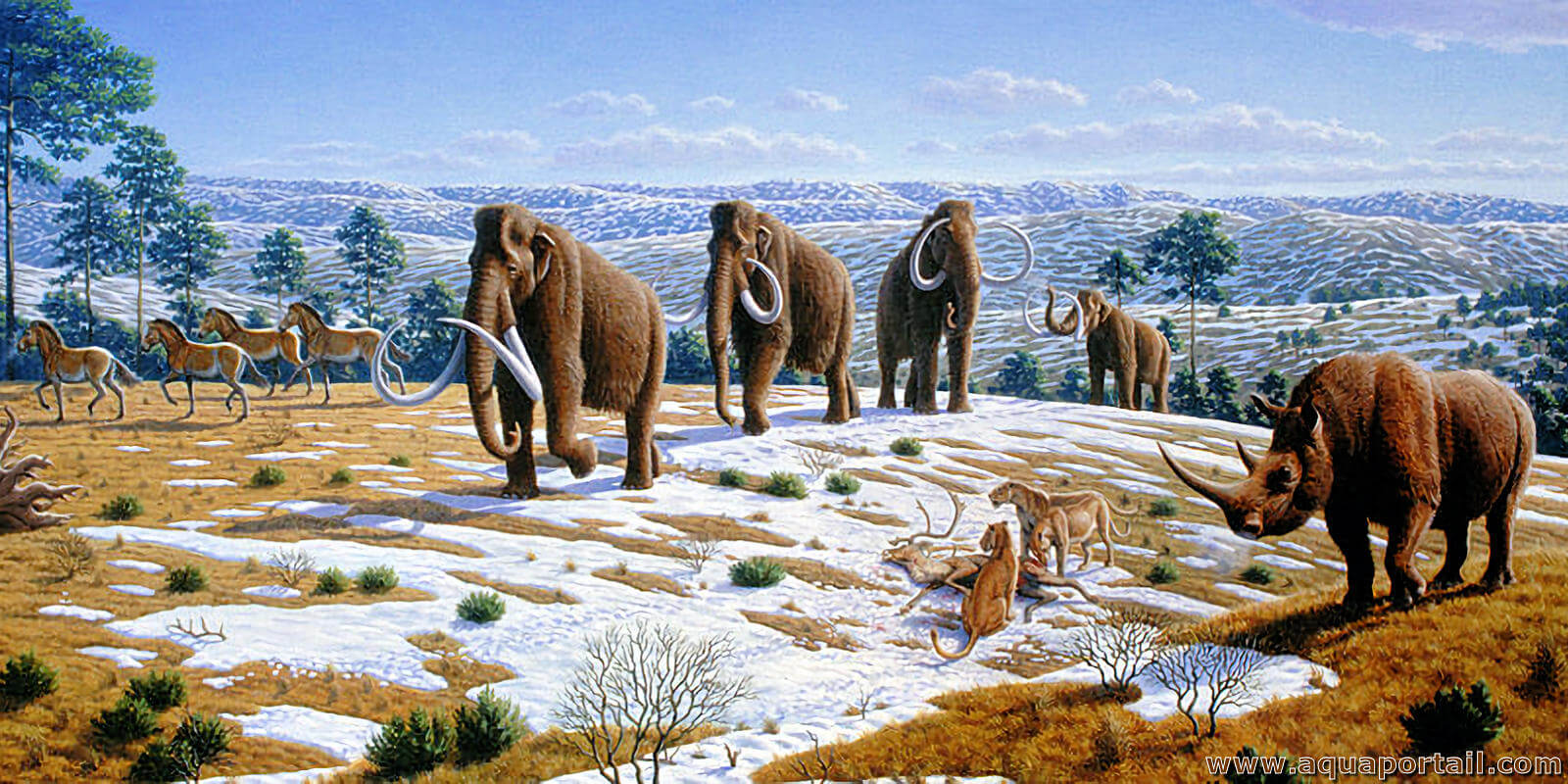
The Holocene epoch is the current geological epoch. Another term sometimes used is the Anthropocene epoch, reflecting global environmental changes driven by human activity; however, modern humans were already well established long before the epoch began. The Holocene began roughly 11,700 years ago at the end of the last glacial period and continues to the present day.
Explanations
During the Holocene epoch, rising seas separated Indonesia, Japan, and Taiwan from mainland Asia; Great Britain from continental Europe; and New Guinea and Tasmania from mainland Australia. In addition, flooding formed the Bering strait connecting the Arctic Ocean with the Pacific Ocean where a dry land bridge previously existed. In Africa, the most notable environmental shift was the progressive aridification of the region now occupied by the Sahara Desert.
The sole human species living during the Holocene has been Homo sapiens, which over recent millennia developed agriculture and complex civilizations, driving major environmental transformations. Because of this profound impact, some scientists have proposed designating the modern era as the Anthropocene.
The Holocene is sometimes informally called the "Anthropocene", or the "Age of Man". This label is somewhat misleading: anatomically modern humans, Homo sapiens, evolved and dispersed across the globe well before the onset of the Holocene. Nevertheless, the Holocene has witnessed all of recorded human history as well as the rise and fall of all human civilizations. Humanity has profoundly shaped the Holocene environment; while all organisms influence their surroundings to some degree, few have ever altered the planet as extensively or as rapidly as our species. The vast majority of scientists agree that human activity is driving "global warming", an observed rise in global average temperatures that continues today. habitat destruction, pollution, and other pressures are fueling an ongoing mass extinction of plant and animal species, with projections warning that a substantial fraction of Earth's biodiversity could vanish in the coming decades.
Chronostratigraphy of the Quaternary with the Holocene:
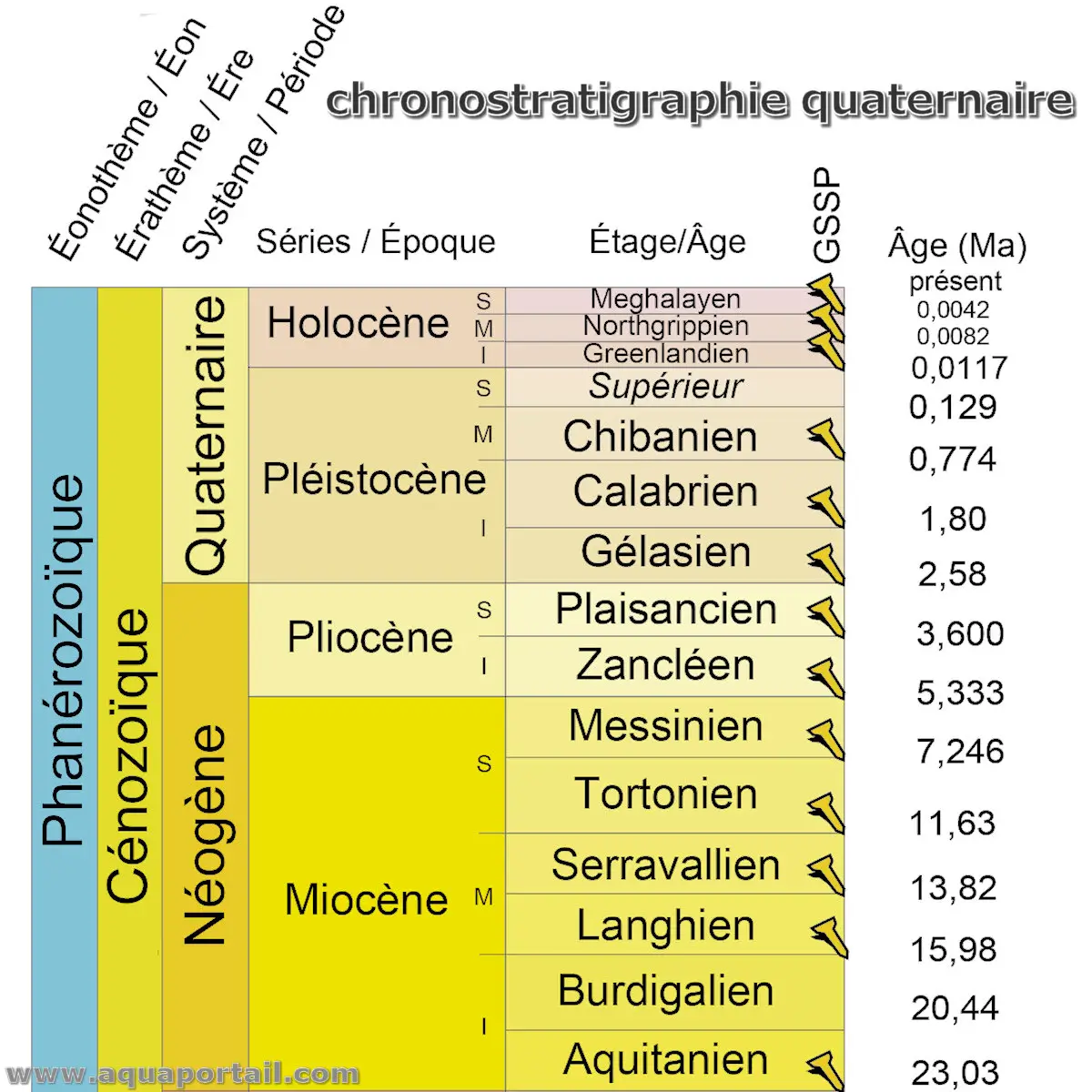
Stratigraphic chart of the Holocene within the Quaternary. The Holocene comprises 3 stratigraphic stages: the Meghalayan, Northgrippian, and Greenlandian.
The Holocene has also witnessed extraordinary growth in human knowledge and technology, which can be—and are being—applied to understand observed environmental shifts, predict their impacts, and halt or mitigate harm to Earth and humanity. Paleontologists contribute directly to this effort: because fossils preserve records of past climates and ecosystems, paleontological data help clarify how future environmental changes will affect life on Earth.
The Holocene began after the end of the Younger Dryas cold stadial, as global temperatures warmed. The Holocene Climatic Optimum was a warm interval occurring between roughly 9,000 and 5,000 years ago, when regional temperatures were 0.5 to 3 °C (0.9 to 5.4 °F) warmer than today.
However, warming was not uniform worldwide. This warm phase ended around 5,500 years ago, as early human civilizations in Asia and Africa began to flourish. Thereafter began the Neoglacial, during which temperatures gradually cooled toward the modern era through cyclic warming and cooling intervals, punctuated by notable warm anomalies such as the Roman Climatic Optimum (1st to 4th centuries) and the Medieval Warm Period (10th to 14th centuries).
The coldest culmination of this cooling trend was the Little Ice Age, marked by three temperature minima around 1650, 1770, and 1850.
The Holocene is an interglacial epoch, and there is no reason to assume it marks the permanent end of glacial cycles. However, current anthropogenic global warming could push Earth's climate warmer than during the previous interglacial period (the Eemian, between the Riss and Würm glaciations), which peaked around 125,000 years ago—a scenario sometimes termed a super-interglacial. Compared with glacial conditions, habitable zones expanded northward during the Holocene, reaching their northernmost extent during the Holocene Climatic Optimum, while increased moisture in high latitudes replaced boreal mammoth steppes with forests and tundra.
Synonyms, antonyms
Spanish translation: Holoceno
2 synonyms (similar meaning) for "holocene":
0 antonyms (opposite meaning).
Related words and expressions to HOLOCENE are directly connected by general or specific meaning.
The word HOLOCENE is listed on page 1 of words starting with H in the dictionary glossary.
Related to "Holocene"
Eocene
The Eocene epoch spans a geological time of the Cenozoic era, extending from 56 to 34 million years ago, belonging to the Paleogene period and system; within...
habitat

A habitat is the place or environment where an organism naturally lives and grows, its typical place of residence.
halitosis

Halitosis (bad breath) is primarily caused by sulfur-producing bacteria that normally live on the surface of the tongue and in the throat.
hallux

The hallux is the big toe (great toe) of a foot, homologous to the thumb of a hand. It is located on the medial (inner) side of the foot, whereas the little...
