Arctic
proper noun
Definition
The Arctic is the region around the Earth's North Pole, referring to the northern lands and waters within the Arctic Circle, a line of latitude located at approximately 66° 33′ 45.6″ north of the equator. Its geographical opposite in the south is Antarctica.
Map of the Arctic region:
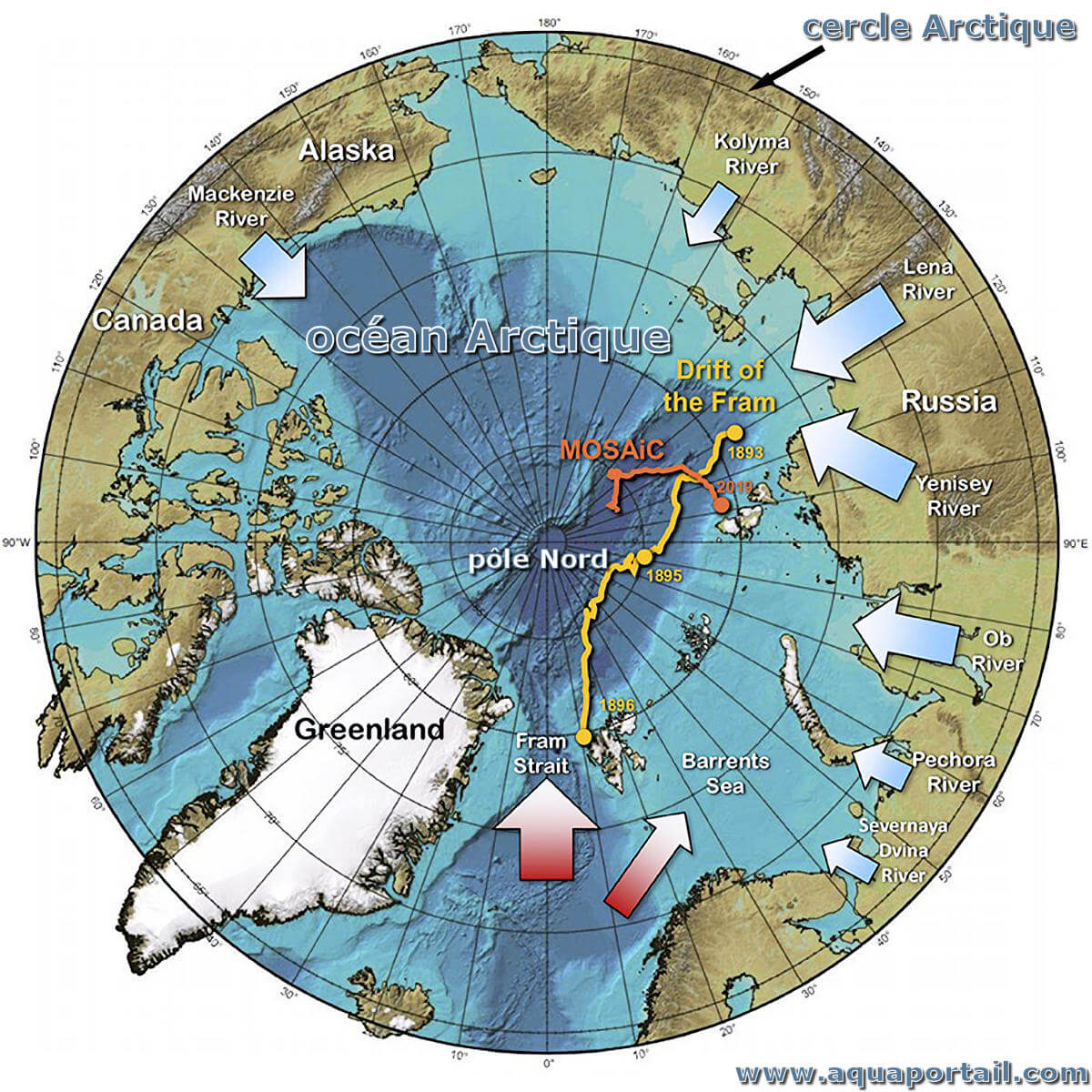
The Arctic is a vast region that includes the Arctic Ocean, which hosts many large marine mammals such as the beluga and the narwhal. The Arctic Circle (66° 33′ N) defines the Arctic in terms of solar radiation.
Explanations
The word "Arctic" comes from the Greek word arktos meaning "bear". The northern polar region is the sacred land of the polar bear, one of the largest terrestrial predators on the planet. Greek mariners called the Arctic region, into which they had likely first ventured around 325 BC, "the land under the constellation of the Great Bear".
Besides the abundant aquatic fauna of large marine mammals, there are only three species of large terrestrial mammals in the Arctic: the polar bear, the reindeer (caribou), and the Arctic fox. Yet, despite the high latitude, over 100 species of birds, such as guillemots, kittiwakes, and razorbills, thrive there.
The surface area of the Arctic is approximately 14.5 million km2 (5.6 million sq mi).
The Arctic is characterized by very marked seasons. In winter, it is extremely cold and there is very little light. In summer, it remains very cool and there is very little darkness. At least once a year, there is a polar night (a 24-hour period without sun) and a midnight sun (a 24-hour period of daylight without night). Terrestrial permafrost is permanent across a large part of the Arctic.
Areas located north of the imaginary line of the Arctic Circle do not experience temperatures above 10 °C (50 °F) during the warmest month of the year (July isotherm). The tree line roughly corresponds to the July isotherm and marks the transition between the forests of the subarctic region and the shrubs and grasses of the tundra.
The Arctic is today home to nearly four million people: Indigenous peoples (about 10% of the inhabitants), more recent arrivals (often urban dwellers), hunters, and herders (especially reindeer herders). The Arctic is a vast ice-covered ocean surrounded by frozen, treeless lands, often covered in snow and ice. The harshness of this hostile environment poses a challenge for living, working, and conducting research in the Arctic.
⭐ Even though there are no trees, the Arctic is not devoid of vegetation. Thus, roseroot (Rhodiola rosea), a flowering plant native to the Arctic regions of Asia and Europe, is used in traditional medicine to improve endurance and reduce fatigue. The glacier buttercup (Ranunculus glacialis) is the northernmost flowering plant in the world.
✅ Within this circle lie the Arctic ocean basin and the northern parts of Greenland (Denmark), Canada, Alaska (United States), Russia, and Scandinavia. The territories of Iceland, Sweden, Norway (with the exception of Spitsbergen), and Finland are considered subarctic rather than strictly Arctic.
Arctic vs. Antarctica
It is colder in Antarctica than in the Arctic. Because it is an ocean, the Arctic naturally sits at sea level. Conversely, the average elevation of the Antarctic continent is 2,300 m (7,546 ft), and it is well known that the higher one goes in altitude, the colder it gets.
The Arctic is an ocean covered by a thin layer of perennial sea ice and surrounded by land. "Perennial" refers to the oldest and thickest sea ice. Antarctica, on the other hand, is a continent covered by a very thick ice sheet and surrounded by a fringe of sea ice and the Southern Ocean.
The Arctic Circle is a line of latitude that separates the Arctic zone to the north from the northern temperate zone to the south. The Arctic Circle is the northernmost of the five major circles of latitude.
An ocean surrounded by continents
Unlike Antarctica, which is itself a continent, the Arctic is an ocean surrounded by continents. It is also one of the most pristine and biologically rich regions in the world.
When it comes to understanding the Arctic, it is important not to view it simply as a homogeneous part of the world entirely covered in ice and snow. In fact, its geography and wildlife are extremely diverse, with some areas remaining virtually ice-free all year round, while similar latitudes elsewhere are mostly covered in ice.
The UK Arctic Research Station is located at Ny-Ålesund, on the southern shore of a large sheltered fjord called Kongsfjord, on the remote archipelago of Svalbard, which is part of the Kingdom of Norway. High up in the Arctic Ocean, the archipelago covers an area slightly smaller than that of Ireland (63,000 km2 / 24,324 sq mi) and is dominated by Spitsbergen, which is the largest island. Not as cold or inaccessible as one might think, Spitsbergen offers a true Arctic experience at the edge of the habitable world.
The Svalbard archipelago stretches between 74° and 81° north, roughly halfway between Tromsø in Norway and the North Pole. It is the northernmost place in Europe and the furthest north you can travel by scheduled flight.
Synonyms, antonyms
Spanish translation: Ártico
2 synonyms (similar meaning) for "arctic":
1 antonym (opposite meaning):
Related words and expressions to ARCTIC are directly connected by general or specific meaning.
The word ARCTIC is listed on page 1 of words starting with A in the dictionary glossary.
Related to "Arctic"
North Pole

The geographic North Pole is the northernmost point on Earth and the center of the Northern Hemisphere.
Antarctica

Antarctica, at the geographical opposite of the Arctic, is the southernmost continent on Earth, surrounded by an ocean.
abiotic

In biology and ecology, abiotic refers to what is not biotic, that is, not part of living beings.
aboral

Aboral refers to what is situated away from or opposite the mouth in zoology, and especially in marine biology.
Simple summary
The Arctic refers to the region located at the northern extremity of the Earth, characterized by extremely cold temperatures, vast ice-covered marine expanses, and a highly specific ecosystem. This zone encompasses territories belonging to countries such as Canada, Russia, the United States (Alaska), Greenland, and Norway. It is home to diverse wildlife adapted to these harsh conditions, such as polar bears, seals, and various species of birds. The Arctic is also at the center of climate change debates, as the region's ice is diminishing due to global warming, affecting both the environment and the Indigenous communities living there.
