Plankton
noun (n.)
Definition
Plankton identifies aquatic organisms, mainly microscopic, that live in the water column, unable to swim against a current, floating in seawater or freshwater down to about 200 meters (656 ft) deep. It is composed of zooplankton (animal) and phytoplankton (plant).Plankton offers varied forms of small planktonic living organisms:

Plankton consists of all animal and plant organisms, generally small in size, that float more or less passively in marine or continental lake waters.
Explanations
Plankton is defined as all living organisms, including zooplankton for animals and phytoplankton for plants, drifting in open water. Plankton contains unicellular or multicellular organisms suspended in fresh or marine waters. The science studying plankton is planktology.
Planktology is the science that consists of studying plankton in order to define its species, groups, etc.
Differences between plankton, nekton, tripton, seston
By definition, plankton groups together all living aquatic organisms that cannot oppose currents, unlike nekton whose organisms can swim. Tripton (or pseudoplankton) groups dead (non-living) plankton, whereas seston groups all forms of particles unable to move in the water column.
There is a division between holoplankton, which is composed of organisms spending their entire life cycle within the plankton, and meroplankton, which is composed of organisms spending only part of their life in the planktonic community (coral larvae, fish larvae...).
By analogy with plankton, all invertebrates present in the air that serve as food for insectivorous birds such as swallows and bee-eaters are called aerial plankton.
Characteristics
Most plankton species are less than one millimeter (0.04 in) in size; others, however, are larger, such as siphonophores, ctenophores, and jellyfish. Most species are transparent with colored iridescence. Surface zooplankton species are bluish in color and others are reddish. Some organisms emit luminescence, such as the genus Noctiluca.
Plankton and nekton are the two components of pelagos. While plankton is capable of movement and more or less capable of swimming, it cannot exert sufficient force to fight against currents. Plankton movements are essentially vertical in the water mass, from top to bottom. Do not forget to also check neuston or pleuston.
Plankton is at the base of the trophic chain, the first link in the food chain, in hydrosystems, whether in freshwater, marine, or brackish environments. Phytoplankton is the first element of this food chain since it can be consumed by zooplankton.
Types of plankton
Several varieties and types of plankton are distinguished:
- according to nature:
- zooplankton, animal plankton
- phytoplankton, plant plankton
- bacterioplankton, bacterial plankton
- mycoplankton, plankton including fungi
- virioplankton
- protozooplankton
- metazooplankton
- according to living depth:
- aeroplankton is only a fraction of plankton carried by the wind, so it is airborne
- epiplankton in superficial epipelagic waters
- mesoplankton in mesopelagic waters
- bathyplankton in bathypelagic waters: the zone of existence is located at great depth, and always below 200 meters (656 ft) deep
- abyssoplankton in abyssal waters
- according to size:
- femtoplankton, smaller than 0.02 µm
- picoplankton smaller than 1 µm
- ultraplankton from 1 to 5 µm in diameter
- nanoplankton from 5 to 50 µm
- microplankton from 50 to 500 µm
- mesoplankton from 500 µm to 5 mm (0.2 in)
- macroplankton from 5 mm (0.2 in) to 5 cm (2 in)
- megaplankton larger than 5 cm (2 in) and up to about 20 cm (8 in) (zooplankton only)
- megaloplankton is a decimetric zooplankton more than 20 cm (8 in) in size
- according to biotope:
- limnoplankton is in stagnant freshwater
- cryoplankton distinguishes plankton of polar waters or lakes fed by snowmelt and glacier waters
- according to biogeographical distribution:
- neritic plankton lives in the neritic zone of oceans, near coasts or above the continental shelf
- oceanic plankton lives in the oceanic zone, further offshore, generally beyond the continental shelf
- according to diet:
- herbivorous (vegetarian) zooplankton consumes phytoplankton
- carnivorous zooplankton consumes other zooplanktonic organisms
A planktophyte designates and qualifies a planktonic plant, a plant of the plankton so to speak, associated with phytoplankton. Planktophytes can be consumed by planktophages (or planktivores). They are studied in planktology.
Vertical migration
Plant plankton always remains near the surface of the water, as it needs light to carry out photosynthesis. Conversely, zooplankton is continuously in motion, up and down, following a daily cycle over a distance of 100 to 500 meters (328 to 1,640 ft) or more. Zooplanktonic organisms are almost always near the surface at night to feed, but dive during the day to escape strong solar radiation, although this path may be reversed for certain groups.
Megaplankton
Megaplankton groups together zooplankton organisms, large plankton visible to the naked eye, measuring more than 5 cm (2 in) and up to a few tens of centimeters with some jellyfish, salp colonies... Megaplankton is larger than macroplankton but smaller than megaloplankton.
Megaloplankton
Megaloplankton is a decimetric zooplankton of great length, more than 20 cm (8 in), including large colonies of salps or large jellyfish for example.
Megaloplankton is the largest of all planktons, larger than megaplankton.
Meroplankton
Meroplankton is a form of plankton composed of larval ecophases. It lives in the meropelagic zone of the oceans. In a way, it contrasts with holoplankton.
Heleoplankton
Heleoplankton designates and qualifies the plankton of temporary pools, ponds, and microlakes, in shallow zones. It is a freshwater and stagnant water plankton, unlike potamoplankton which occupies running waters. It is assimilated to limnoplankton, the freshwater plankton of a body of water.
The presence of heleoplankton in a small body of water indicates good plant richness, including algae, diatoms, or cyanobacteria. Heloplankton (alternative spelling) complements telmatoplankton, eulimnoplankton, and crenoplankton among freshwater planktons. It is phytoplankton.
Ultraplankton
Ultraplankton is a part of plankton, of submicroscopic size between 1 and 5 µm in diameter, smaller than nanoplankton but larger than picoplankton. It consists of eukaryotic phytoplankton and heterotrophic prokaryotes, bacteria, and small flagellates.
Many of these organisms are generally extremophiles, resistant to hypersaline environments for example. It lives mainly at the bottom of the sea in soft sediments. Its overabundance is an indicator of eutrophication of the environment.
✅ Eukaryotic phytoplankton in the size range of ultraplankton (ultraphytoplankton) is recognized as an important member of the photosynthetic assemblage in the world's oceans.
The identification of ultraphytoplankton, whether in natural communities or clonal cultures, is often hampered by its size and the lack of taxonomically informative morphological characteristics. Moreover, most small planktonic cells are difficult to cultivate.
Taxonomic identification of small eukaryotic phytoplankton often relies on techniques such as electron microscopy, analysis of photosynthetic pigments by high-performance liquid chromatography, or immunological cross-reactivity.
Identification of individual cells at the class level is difficult at best and is rarely achieved with the ease and speed required to analyze large numbers of field samples.
Synonyms, antonyms
Spanish translation: plancton
2 synonyms (similar meaning) for "plankton":
1 antonym (opposite meaning):
Related words and expressions to PLANKTON are directly connected by general or specific meaning.
The word PLANKTON is listed on page 1 of words starting with P in the dictionary glossary.
Related to "plankton"
phytoplankton

Phytoplankton is the assemblage of microscopic algae dispersed in suspension in the euphotic layer of large bodies of water.
nanoplankton
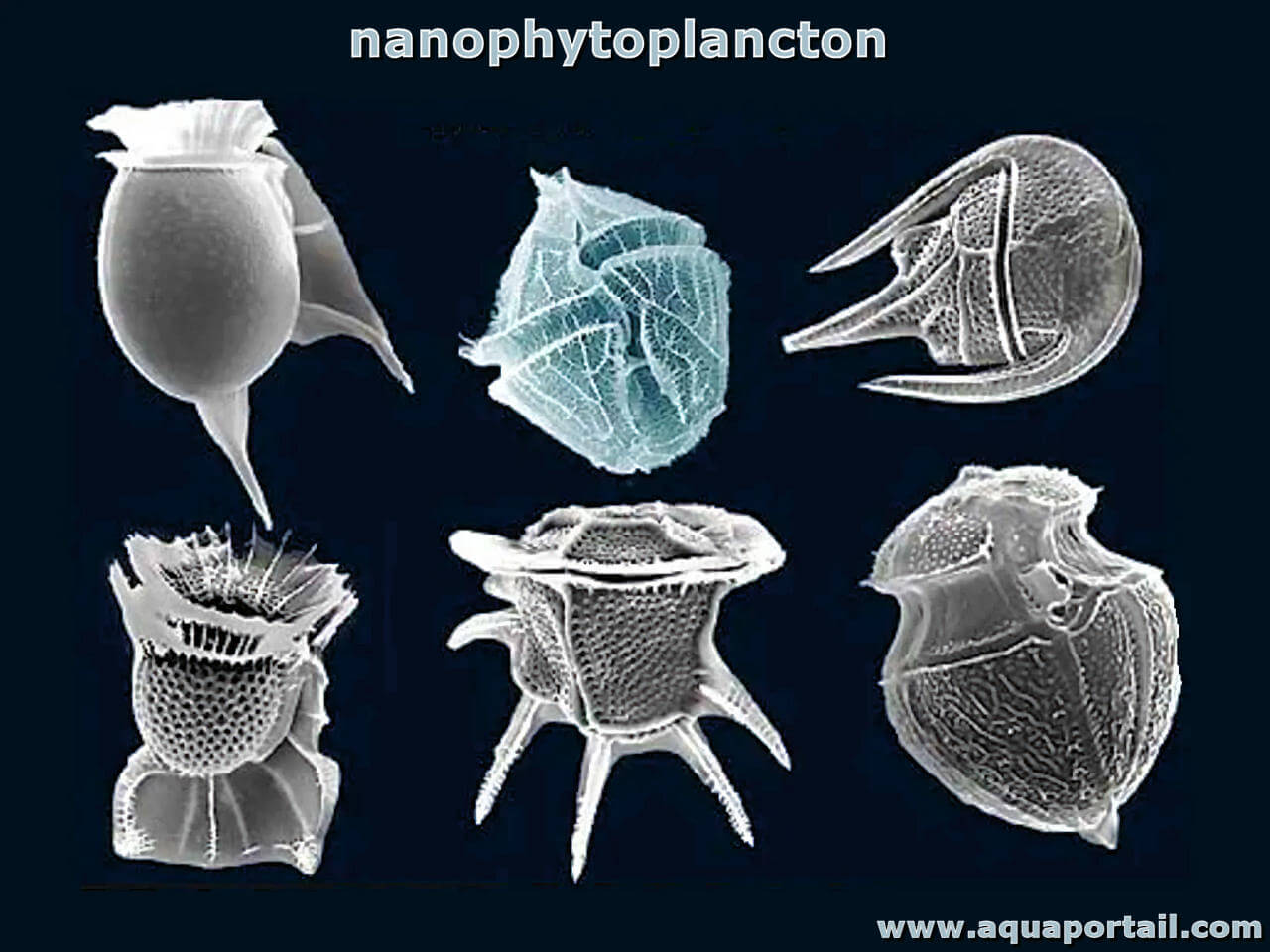
Nanoplankton is a fraction of plankton whose organism size ranges between 2 and 20 µm, below the naked-eye scale.
picoplankton
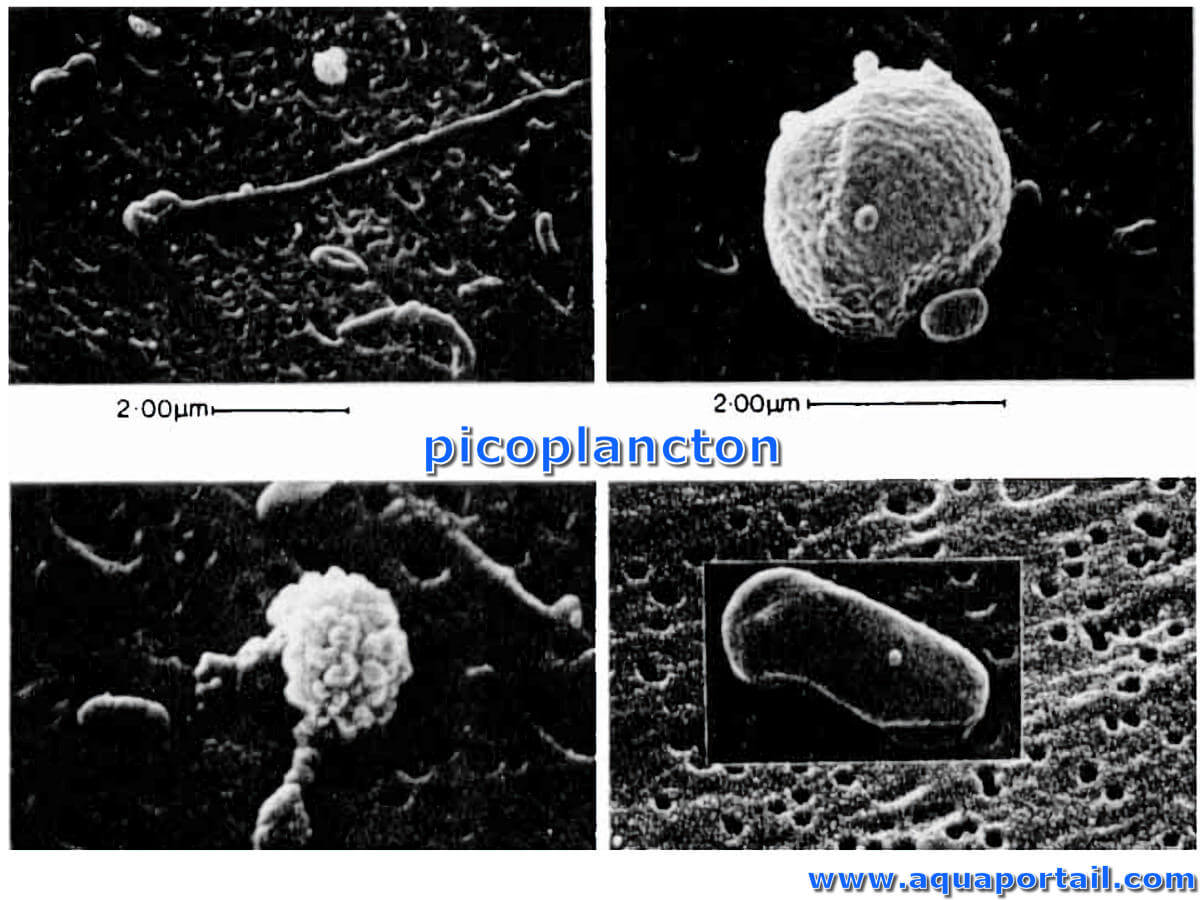
Picoplankton is a part of plankton consisting of organisms from 0. 2 to 2 µm. Picoplanktonic organisms form a microbial biomass in oligotrophic waters when...
nekton

Nekton encompasses all animal species capable of swimming actively and freely without drifting with currents : fish, squid, shrimp, cetaceans, and marine...
