Precambrian
noun and adjective (n. / adj.)
Definition
The Precambrian is the earliest geological division of Earth's history (from -4.56 billion years to -541 million years), during which the origin of life occurred. It comprises the Hadean, the Archean, and the Proterozoic eon. The Precambrian refers to the earliest eons of Earth's history, preceding the Cambrian period and the Phanerozoic eon.
70% of the dominant Precambrian flora and fauna perished during the first major Ediacaran extinctions. At the end of the Precambrian, more complex life forms began to appear. The fossil record of multicellular animals from the Precambrian includes three main groups that have persisted to the present day. These include sponges (Porifera), cnidarians (including sea anemones, corals, and jellyfish), and annelids (or segmented worms).
The Precambrian:

Chronostratigraphic time scale of Earth showing Precambrian eons, eras, and systems separated by Global Standard Stratigraphic Ages (GSSAs) and the single ratified Global Boundary Stratotype Section and Point (GSSP). Some of the oldest known geological records are also indicated on the time scale, which is presented in a solar system perspective and compared with the geological time scales of the Moon and Mars.
Explanations
The Precambrian encompasses the oldest geological ages, which are marked by different formations of sedimentary and metamorphic rocks. Deposited over millions of years, these rock layers contain a permanent record of Earth's past, including the fossilized remains of organisms buried during sediment formation. Some of the oldest rocks in the world (up to 3.5 to over 4 billion years old) are found in Precambrian shields. Examples include gneiss, granite, banded iron formations, schist, basalt, gabbro, and anorthosite.
✅ The Precambrian is the largest span of time in Earth's history prior to the current Phanerozoic eon (the largest formal division of geological time, comprising two or more eras) and constitutes a supereon divided into several eons of the geological time scale.
Precambrian is an informal term widely used in the scientific literature to describe a vast portion of the geological time scale, spanning from 4,560 to 541 million years ago. With boundaries marking respectively the origin of planet Earth and the appearance of fossils suitable for systematic biostratigraphic correlation, this interval corresponds to nearly 88% of Earth's existence. Although its exact origin is difficult to pinpoint, the term Precambrian has been applied informally since the mid-19th century, immediately following the establishment of the Cambrian period by the English geologist Adam Sedgwick in 1835.
Terms such as Protozoic, Azoic, and Cryptozoic have also been found in older literature as synonyms for Precambrian. However, as most of them were defined to describe an ancient rock record devoid of evidence of animal life or in which the existence of fossils was "cryptic", growing advances in Precambrian paleontology over the past century have rendered these terms inaccurate or obsolete. Although less common, the term pre-Phanerozoic can also be found in certain textbooks and scientific articles as an equivalent to Precambrian.
The Precambrian has been approached in different ways over recent decades. By dividing deep time into formal intervals that mark major globally recorded geological events and processes, the chronostratigraphic chart aims to synthesize and improve understanding of Earth system evolution, as well as create a common language for international scientific and non-scientific communication. Most of its subdivisions are defined based on global reference points established in the geological rock record, the Global Boundary Stratotype Sections and Points (GSSPs).
Although these points have been successfully established throughout the Phanerozoic eon at various levels, their recognition in the Precambrian rock record remains challenging. The main limitations stem from, among other factors, the relatively poor and scattered preservation of rock units and paleontological records, the long and polycyclic post-formation geological history, and the absence of index fossils in most Precambrian units. For these reasons, several classification schemes based on different criteria and contrasting geological records worldwide have been proposed for this time interval over recent decades.
Regardless of the ongoing and active debate over the appropriate criteria to use for subdividing the Precambrian in the chronostratigraphic chart, recent advances in geosciences and related subjects have enabled its division into comprehensive chronometric intervals. These intervals are currently organized at the level of eons (eonothems), eras (erathems), and periods (systems), which are mostly bounded by conventionally defined ages (Global Standard Stratigraphic Ages, GSSAs). While still requiring refinement, the current Precambrian classification scheme considers: (i) major tectonic, sedimentary, and magmatic cycles affecting the Earth system since its earliest evolutionary stages and (ii) late Neoproterozoic paleoclimatic and paleobiological events of global significance.
✅ The image above summarizes the currently established time intervals for the Precambrian, encompassing the Hadean (about 4,560–4,000 Ma), the formal Archean (4,000–2,500 Ma), and the Proterozoic (2,500–541 Ma), along with their lower-rank divisions (eras and periods). To facilitate translation into different languages, the available nomenclature is primarily derived from classical Greek.
See also the geological shields that emerged during the Precambrian.
Synonyms, antonyms
Spanish translation: Precámbrico
1 synonym (similar meaning) for "precambrian":
0 antonyms (opposite meaning).
Related words and expressions to PRECAMBRIAN are directly connected by general or specific meaning.
The word PRECAMBRIAN is listed on page 1 of words starting with P in the dictionary glossary.
Related to "Precambrian"
Cambrian
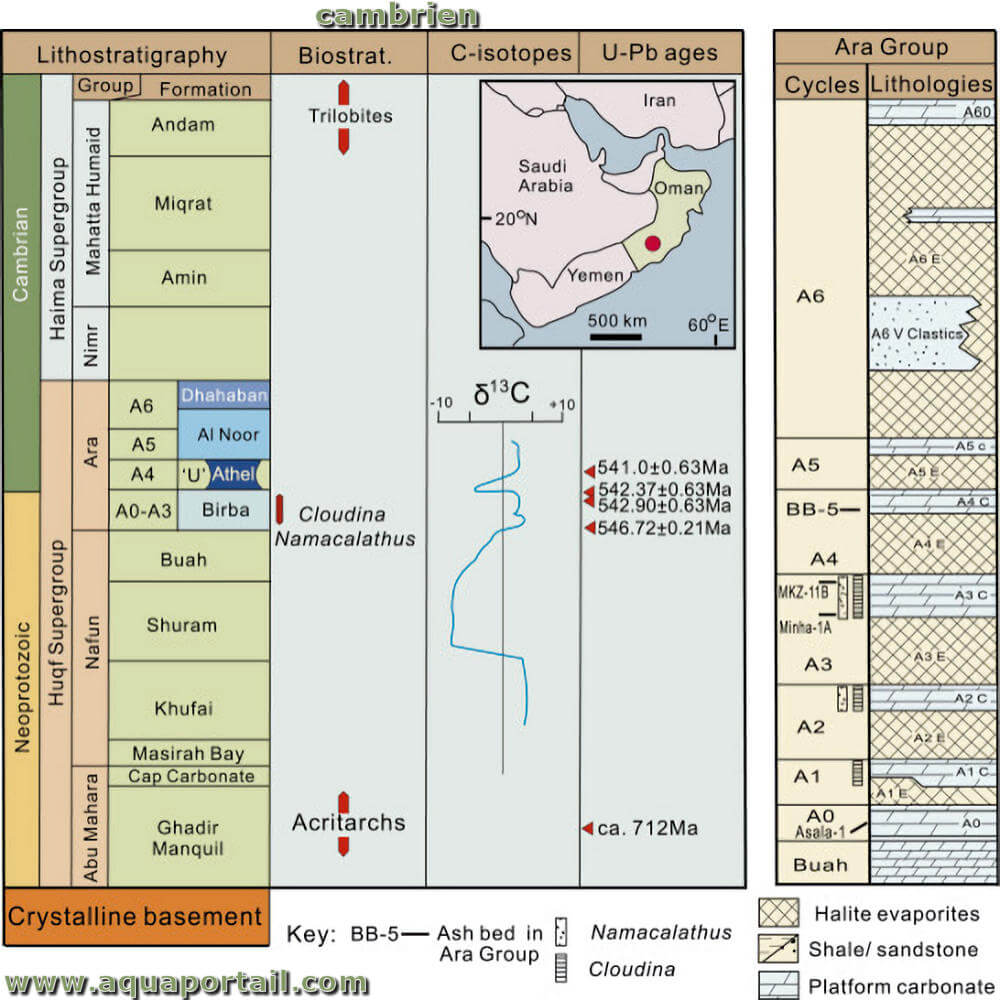
The Cambrian is the oldest period of the Paleozoic era (-541 to -252 Ma), spanning from approximately -541 to -485 Ma.
Cenozoic

The Cenozoic era, or Tertiary era (in the broad historical sense), is the geological era spanning from -66 Ma to the present day (we are still in this era).
Jurassic

The Jurassic is a geological period of the Mesozoic Era in Earth's history. The Jurassic began approximately 201. 3 million years ago and ended about...
Mesozoic

The Mesozoic is a geological era spanning from -252 to -66 Ma. This name given to the Secondary era groups together the Triassic, Jurassic, and Cretaceous...
