Cambrian
noun and adjective (n. / adj.)
Definition
The Cambrian is the oldest period of the Paleozoic era (-541 to -252 Ma), spanning from approximately -541 to -485 Ma. The Cambrian explosion of life corresponds to a major diversification of known fossils. Anomalocaridids are an iconic group of animals from the Cambrian explosion, also found fossilized up into sediments dating from the Ordovician in Morocco.
The defining temporal, geographic, and environmental attributes of the Cambrian relate to the most striking aspect of the Cambrian system: the diversification of abundant metazoan life.
The Cambrian:
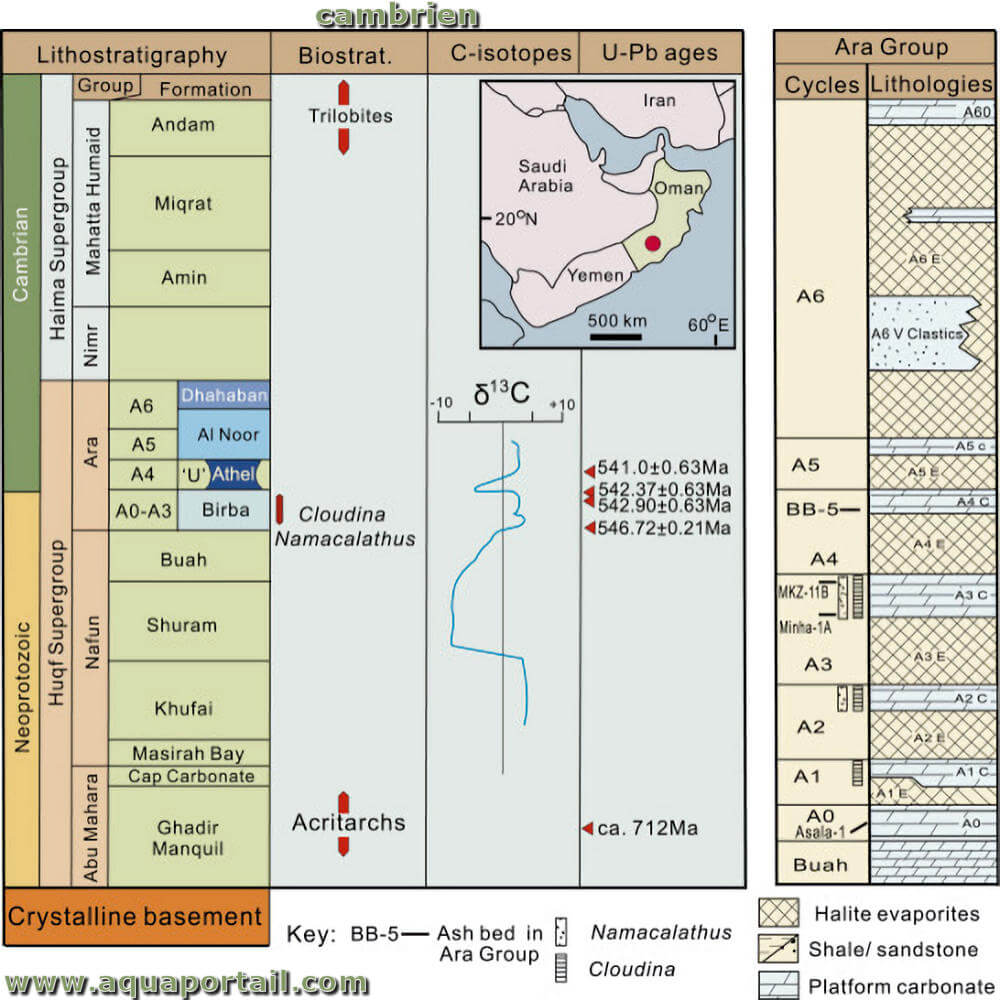
The inset map shows the location (red circle) of the subsurface basin in the Sultanate of Oman where U-Pb dates were obtained near the Ediacaran-Cambrian boundary. Chemostratigraphic and paleontological data indicate the near-simultaneous occurrence of an extinction of Ediacaran fossils (Namacalathus and Cloudinia) and the BACE δ13C excursion, a large-magnitude, short-lived negative excursion in carbon isotopes widely equated with the boundary.
Explanations
The Cambrian period, the oldest division of the Phanerozoic time scale, encompasses several major global environmental and evolutionary transitions. Recent advances in understanding Cambrian environments, faunas, and chronostratigraphy have all provided an enriched view of this critical interval in Earth's history (the period during which the direct impact of life on the rock record first became explicit).
The term Cambrian was first applied by Sedgwick in 1835 to a series of well-exposed sedimentary rocks in North Wales. The Cambrian system, as defined today, equates to only a portion of what Sedgwick originally considered the "Lower Cambrian". Cambrian deposits are widely distributed, and a basic stratigraphic and paleogeographic framework has been established for almost all regions. Nevertheless, much further research will be needed to fully understand the geological setting in which Cambrian events unfolded.
The base of the Cambrian period has received considerable attention from geochronologists, partly because of the major biotic changes that occurred during the late Ediacaran-Cambrian interval. For this reason, calibration of the lower boundary of the Cambrian, and hence of the Paleozoic era and the Phanerozoic eon, is relatively well constrained. Improving the calibration of the boundary likely depends more on advances in biostratigraphy than in geochronology, particularly the discovery of new stratigraphic sections and fossil occurrences that aid in defining and correlating the boundary.
The Cambrian period was a major transitional time in ecological and evolutionary history. Mineralized skeletons and skeletal elements, such as "small shelly fossils" and sponge spicules, appeared in the early Cambrian, though they did not spread and diversify widely until later in the Cambrian. A wide variety of soft-bodied fossils have been described from the exceptionally preserved early Cambrian Chengjiang biota in southern China, suggesting that non-mineralized metazoans formed a substantial component of early Cambrian benthic communities.
Biomineralizing organisms, equipped with skeletons resistant to predators and pressure, were able to occupy a wider range of niches than their soft-bodied counterparts, and this competitive advantage enabled populations of these organisms to thrive in a variety of marine environments. Alongside the trend toward widespread biomineralization among metazoans came the rapid diversification of metazoan body plans known as the Cambrian explosion. Metazoan body plans in the earliest Cambrian were generally simple and limited to a few types, whereas by the late Cambrian, most of the "biological architecture" regarded as characteristic of the major metazoan groups had already become established.
Rocks representing shallow marine environments of the early Cambrian below the intertidal zone typically show limited disturbance of sedimentary layers, reflecting a lack of vertically oriented bioturbation, and common microbially mediated sedimentary structures in siliciclastic facies. Microbially mediated sedimentary structures are thought to represent the effects of sediment binding by microbial mats, namely cohesive sediment behavior. Support for this interpretation comes from observations of modern microbial mats.
The surfaces of many of these modern mats bear a striking resemblance to distinctive features preserved in Lower Cambrian rocks, notably "wrinkle structures", "elephant skin", "domal structures", and "syneresis cracks".
Synonyms, antonyms
Spanish translation: Cámbrico
1 synonym (similar meaning) for "cambrian":
0 antonyms (opposite meaning).
Related words and expressions to CAMBRIAN are directly connected by general or specific meaning.
The word CAMBRIAN is listed on page 1 of words starting with C in the dictionary glossary.
Related to "Cambrian"
Cenozoic

The Cenozoic era, or Tertiary era (in the broad historical sense), is the geological era spanning from -66 Ma to the present day (we are still in this era).
Jurassic

The Jurassic is a geological period of the Mesozoic Era in Earth's history. The Jurassic began approximately 201. 3 million years ago and ended about...
Mesozoic

The Mesozoic is a geological era spanning from -252 to -66 Ma. This name given to the Secondary era groups together the Triassic, Jurassic, and Cretaceous...
Paleozoic
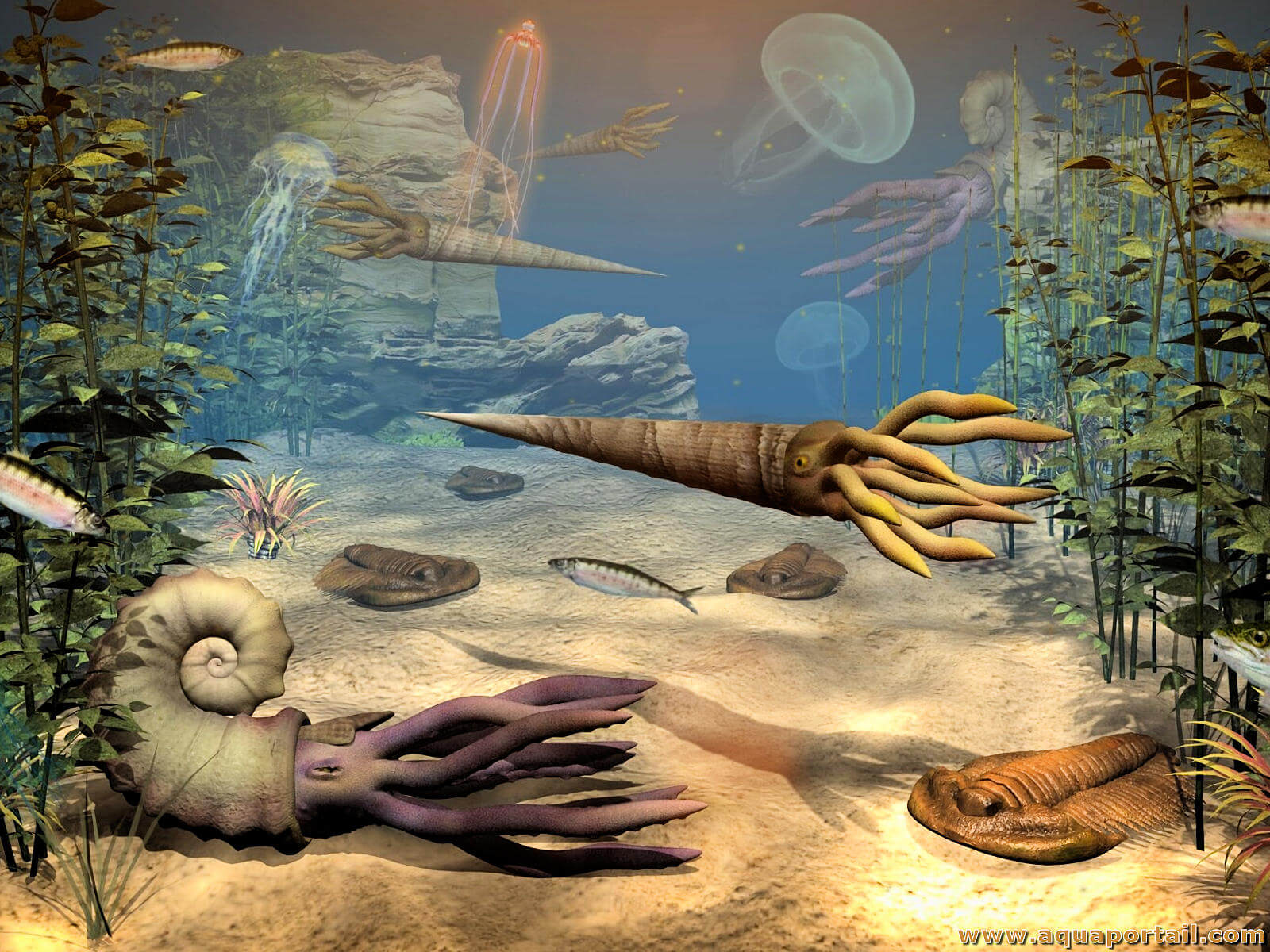
The Paleozoic is a geological era spanning from -541 to -251 Ma. This name, given to the primary era, groups 6 systems : Cambrian, Ordovician, Silurian...
