Polyploid
noun and adjective (n. / adj.)
Definition
A polyploid is an organism whose cells possess a multiple of n chromosomes. Polyploidy is the characteristic of a cell having more chromosomes than the usual diploid set (2n). When polyploidy occurs within the same species or individual, the plant is autopolyploid.
Polyploid combinations:
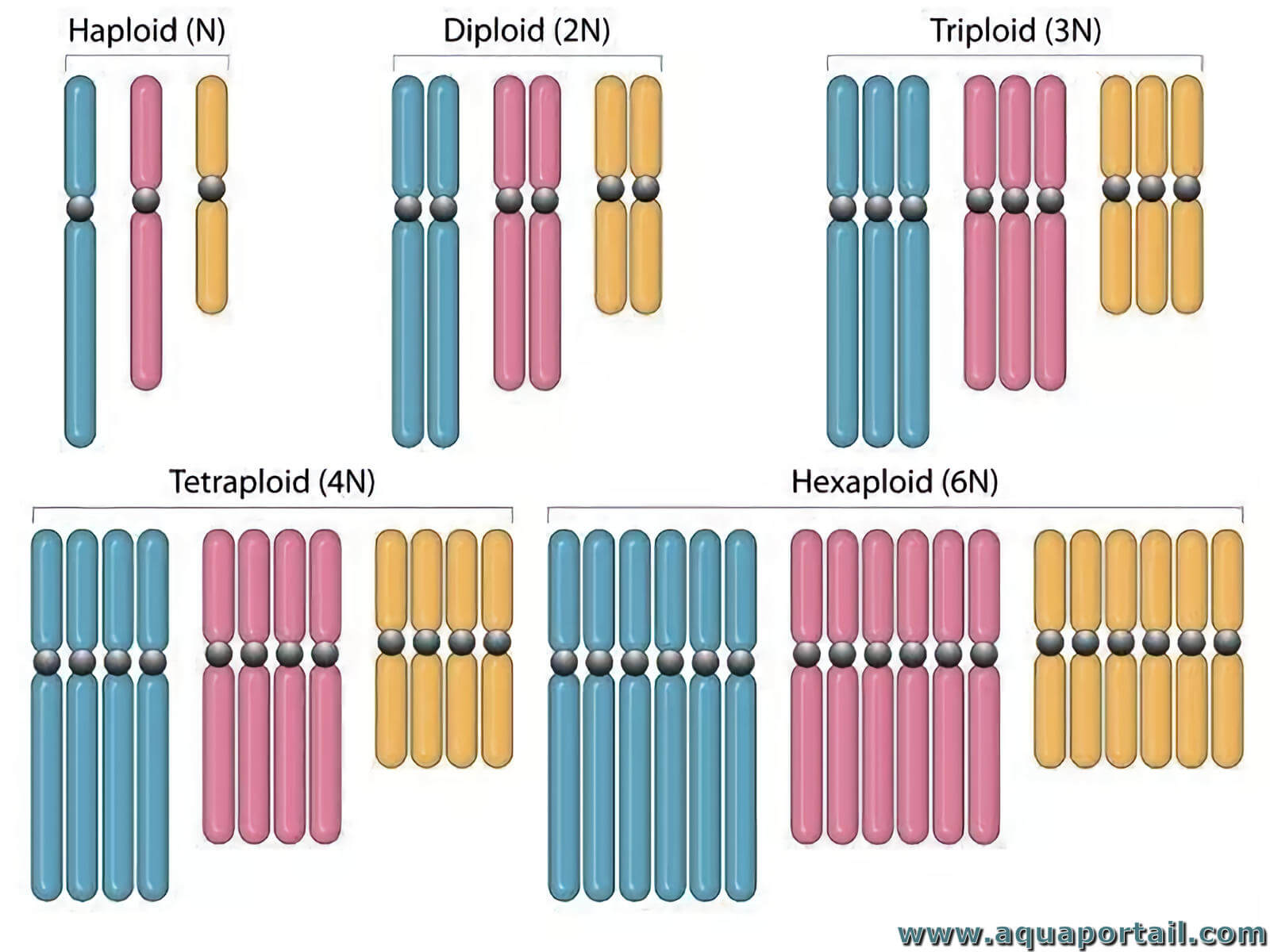
Polyploid combinations (diploid, triploid, tetraploid, and hexaploid) are ploidies referring to the number of chromosome sets.
Explanations
Polyploids, as opposed to haploids, are far more common in plants as well as in certain groups of fish and amphibians. For example, certain salamanders, frogs, and leeches belong to this category.
Polyploidy refers to the heritable condition characterized by possessing more than two complete sets of chromosomes. Many polyploid organisms exhibit morphology well adapted to their environment.
Recent genome studies reveal that many currently diploid species, including humans, likely descend from polyploid ancestors. These species, having undergone phases of genome duplication followed by genome reduction, are termed paleopolyploids.
Polyploids often arise following an accident during mitosis or meiosis, such as nondisjunction, leading to the formation of gametes containing a complete double set of chromosomes.
This process regularly leads to the production of diploid gametes. When one fuses with a haploid gamete, a triploid zygote forms. However, such zygotes are often unstable and frequently sterile. Conversely, if two diploid gametes fuse, they produce a tetraploid zygote that can be more stable.
A variety of polyploids exist in nature, notably including tetraploids (four chromosome sets), hexaploids (six sets), and other multiples.
Researchers generally distinguish polyploids according to their origin: those derived from a single species (autopolyploids) and those resulting from hybridization between different species (allopolyploids). Autopolyploids possess marked genetic homogeneity across all loci of the genome.
In contrast, allopolyploids may exhibit varying levels of heterozygosity, depending on the divergence between the parental genomes. This heterozygosity is visible in the gametes produced by polyploids. Moreover, allopolyploids tend to generate greater gametic diversity than autopolyploids.
Tolerance to polyploidy varies across species. For instance, in flowering plants, polyploids arise relatively frequently (1 individual in 100,000), demonstrating a strong adaptive capacity to this state. A similar phenomenon is observed in certain species of fish and amphibians. However, tolerance is lower in mammals, where approximately 10% of human spontaneous abortions appear attributable to polyploid zygotes.
It is also possible to artificially create polyploids using chemical agents such as colchicine or via the fusion of diploid nuclei.
✅ An organism is described as artioploid when it is polyploid and possesses an even number of chromosome sets. Contrasts with perissoploid.
Evolutionary potential of polyploid organisms
Regarding the evolutionary potential of polyploids, although their epigenetic modifications might seem detrimental due to disruptions of preexisting gene regulation patterns, they may on the contrary promote adaptation through increased diversity and plasticity.
A notable example is the rapid expansion of Sporobolus anglicus (common cordgrass, formerly Spartina anglica), an invasive allopolyploid. Yet it remains uncertain whether its success stems from a stabilized heterosis effect or from increased variability induced by epigenetic rearrangements.
Furthermore, in the case of allopolyploid Arctic floras, polyploidy appears to play an essential role in their rapid adaptation, likely through the combined effects of hybrid vigor and mitigation of inbreeding consequences.
However, for viable allopolyploids to form, it is often necessary to overcome interspecific fertility barriers. These barriers may be partly influenced by epigenetic mechanisms.
Synonyms, antonyms
Spanish translation: poliploide
3 synonyms (similar meaning) for "polyploid":
- artioploid
- autopolyploid
- paleopolyploid
2 antonyms (opposite meaning):
Related words and expressions to POLYPLOID are directly connected by general or specific meaning.
The word POLYPLOID is listed on page 1 of words starting with P in the dictionary glossary.
Related to "polyploid"
diploid
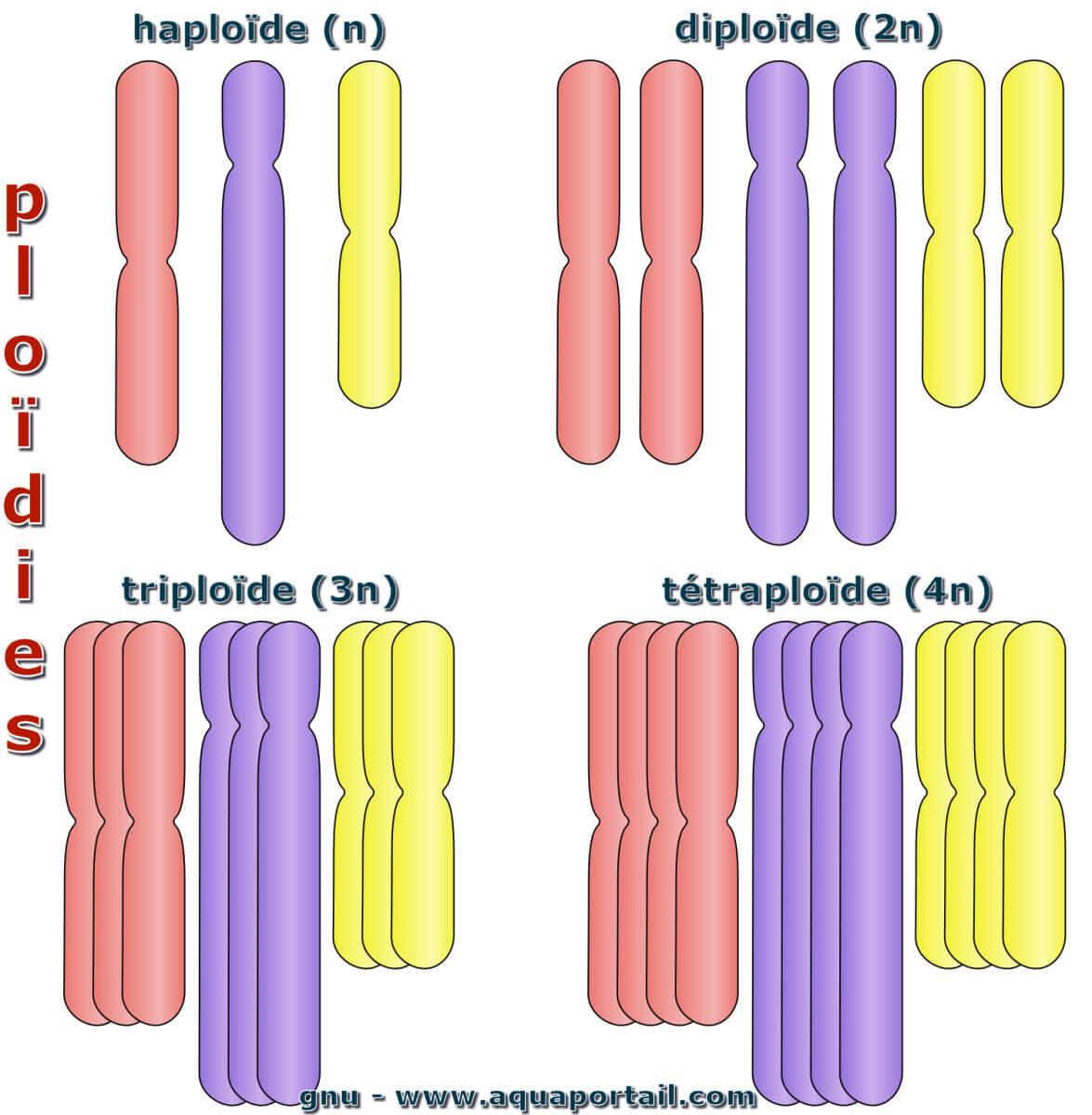
A diploid cell comes from an organism or tissue whose cells possess two sets of chromosomes, denoted 2n, as opposed to haploid with 1n chromosomes...
haplodiploidy

Haplodiploidy is a form of sex determination in which one sex carries only a single set of chromosomes (haploid) and the other sex carries a double...
haploid
A haploid organism has cells possessing 1n chromosomes (the basic minimal chromosome number).
tetraploid
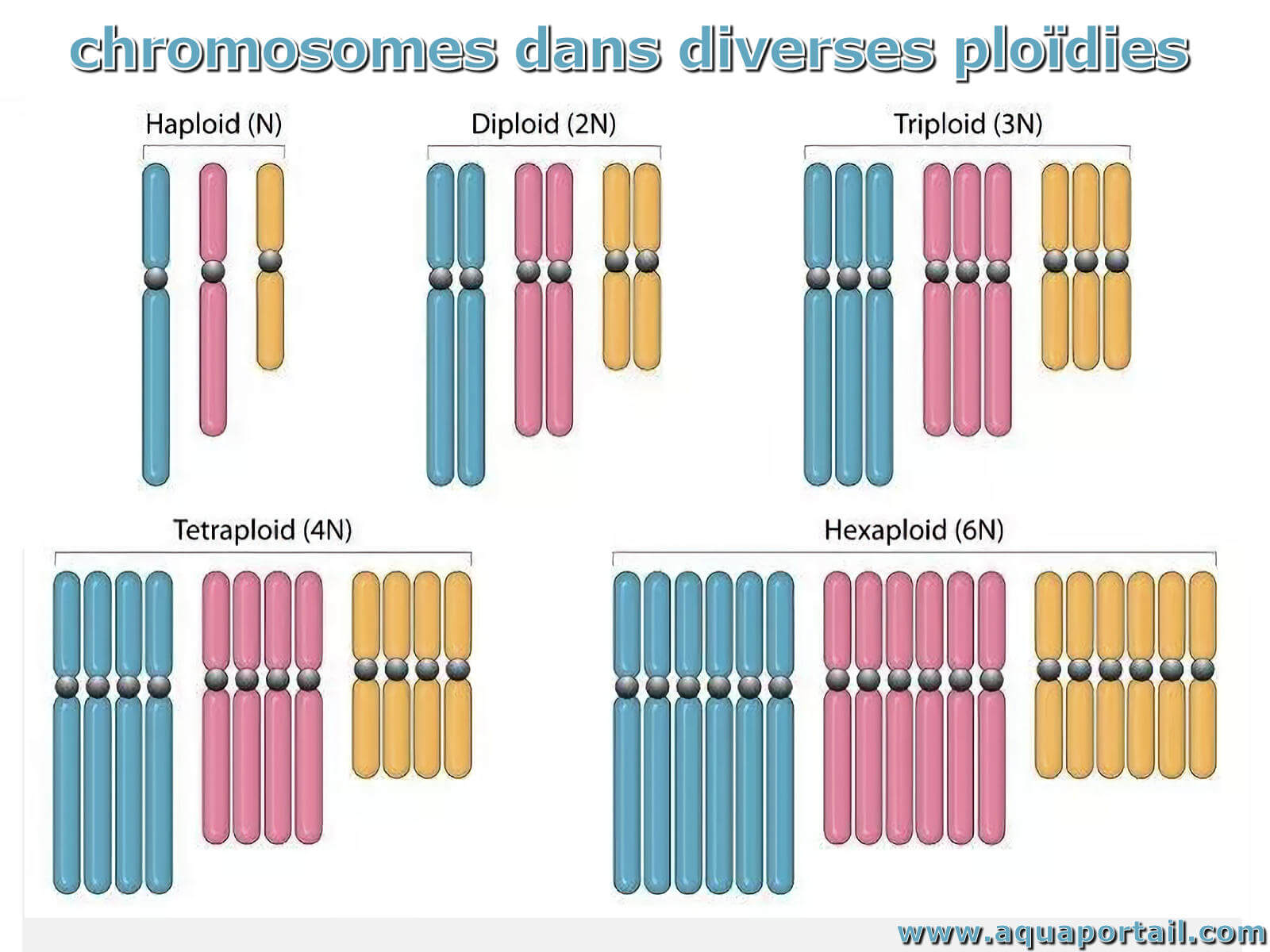
Tetraploid describes a polyploid organism or tissue whose cells possess 4n chromosomes, or put differently : an organism or cell in which each chromosome...
