Monogenetic
adjective (adj.)
Definition
In biology, monogenetic describes a life cycle of an organism involving only a single generation, generally with oogamous reproduction. The monogenetic life cycle has two main variants: haplontic and diplontic. It involves Mendelian inheritance (Mendelism) without alternation between haploid and diploid individuals.
A monogenetic life cycle:
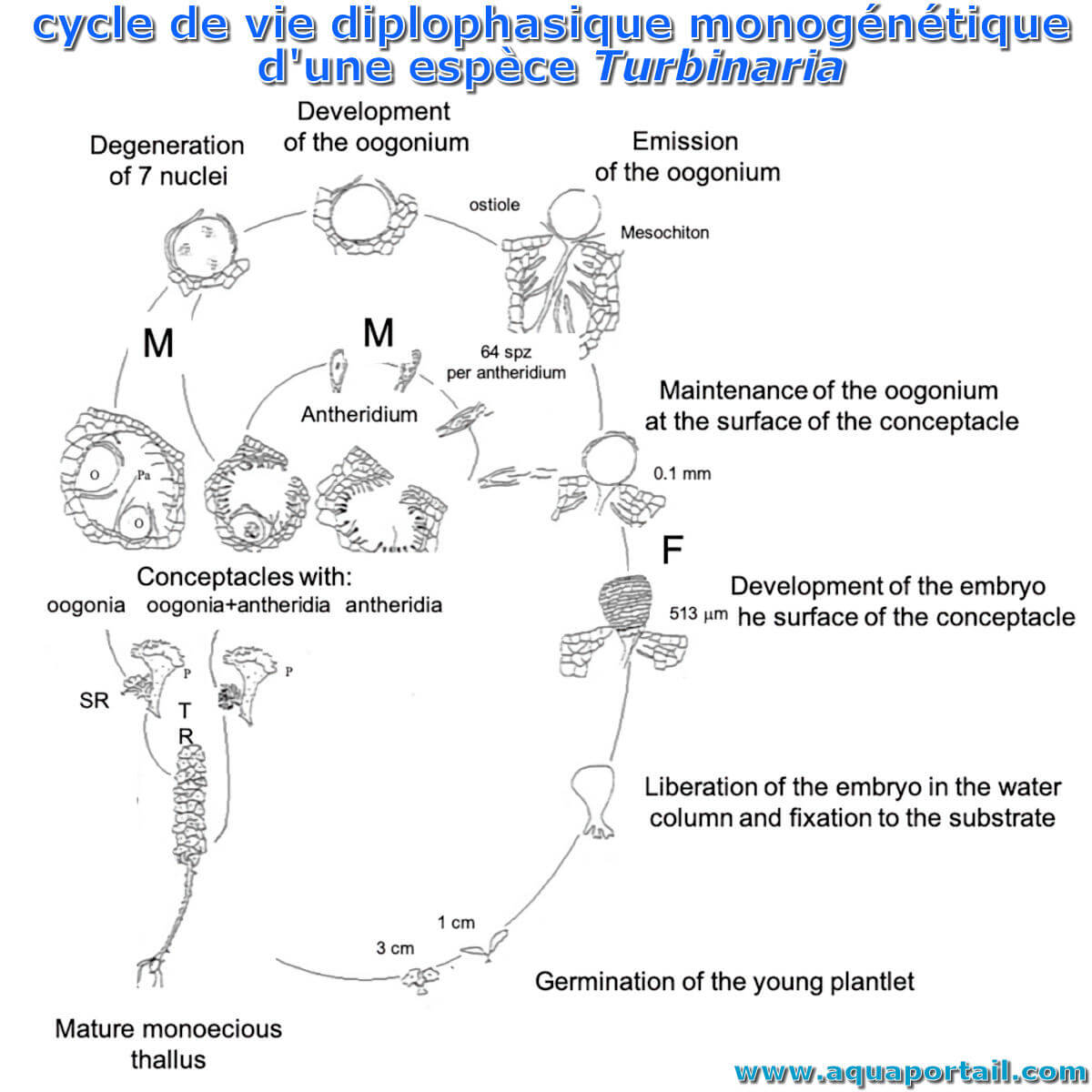
Diagram of the diplophasic monogenetic life cycle of Turbinaria species. Legend: O oogonium, Pa paraphysis, P pleuridium (blade), R receptacle, SR squat receptacle, TR conical receptacle, M meiosis, F fertilization. Turbinaria (J.V. Lamouroux) is a genus of brown algae in the family Sargassaceae (Fucales, Phaeophyceae) found in tropical, subtropical, and occasionally temperate marine regions.
In biology
The monogenetic cycle is a life cycle in which the gametophyte develops from the zygote, which (by definition) produces the gametes. There is only a single generation, the gametophyte. Here, it is therefore not really possible to speak of generational change. A distinction is made between the zygotic cycle and the gametic cycle.
A monogenetic cycle is a life cycle without generational change, involving only growth and development in the gametophyte phase or in the sporophyte phase. On the other hand, the digenetic cycle involves an alternation of two generations, the trigenetic cycle involves an alternation of three different generations, and the polygenetic cycle involves multiple origins.
See also the digenetic cycle, the trigenetic cycle, and the haplophasic cycle. ⛔ Do not confuse with monogenic and monogeneric. Monogenetic is sometimes improperly confused with monophasic.
In geology (volcanism)
In geology, a monogenetic volcanic field is a type of volcanic field consisting of a group of small monogenetic volcanoes, each of which erupts only once (single eruption), as opposed to polygenetic volcanoes, which erupt repeatedly over a period of time. Many monogenetic volcanoes are cinder cones, often with lava flows.
The cycle of a monogenetic volcano:
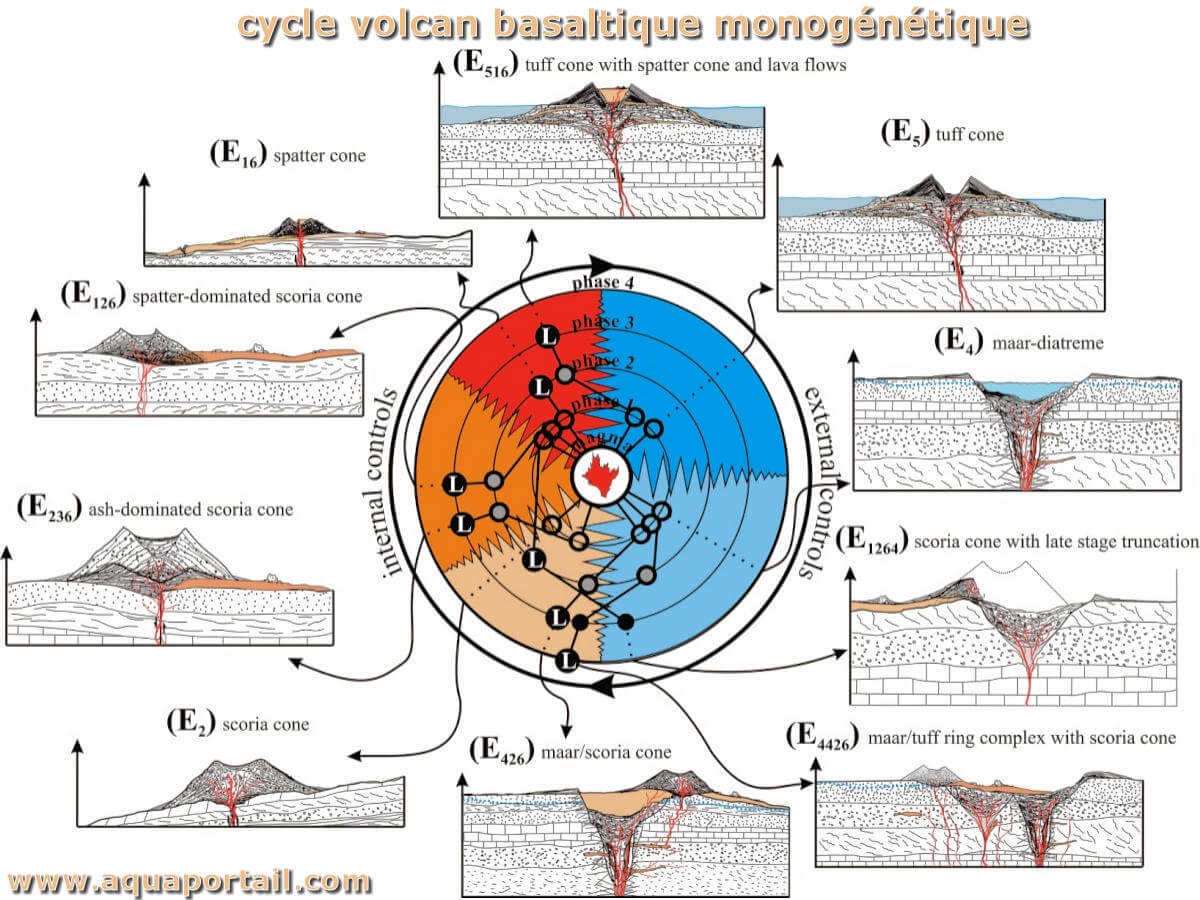
The cycle of a basaltic monogenetic volcano. Research on monogenetic volcanoes and volcanic fields focuses on their source-to-surface nature, meaning that once lava is extracted from the source, it tends to rise to the surface.
Hundreds of these volcanoes are often clustered into so-called monogenetic volcanic fields. A striking example is the cinder cone of Paricutín in Mexico, whose construction lasted nine years.
Intraplate volcanic systems are characterized by small-volume volcanoes with dispersed magmatic plumbing systems that primarily erupt basaltic magmas generally originating from the mantle with a residence time in the crust just sufficient to allow minor fractional crystallization or wall-rock assimilation.
However, there are a few examples of monogenetic eruptions that were fed by contaminated or stalled crustal magma originating from possibly shallower depths. The volumetric dimensions of such magmatic systems are often comparable to other focused, potentially smaller magmatic systems feeding polygenetic volcanoes. These volcanic fields occur in all known tectonic settings and also on other planetary bodies such as Mars.
Because of the abundance of monogenetic volcanic fields in every tectonic environment, this form of volcanism represents a localized and unpredictable volcanic hazard for growing human populations in cities located near these volcanic fields, such as Auckland in New Zealand or Mexico City in Mexico.
Synonyms, antonyms
Spanish translation: monogenético
1 synonym (similar meaning) for "monogenetic":
3 antonyms (opposite meaning):
Related words and expressions to MONOGENETIC are directly connected by general or specific meaning.
The word MONOGENETIC is listed on page 1 of words starting with M in the dictionary glossary.
Related to "monogenetic"
parthenogenetic
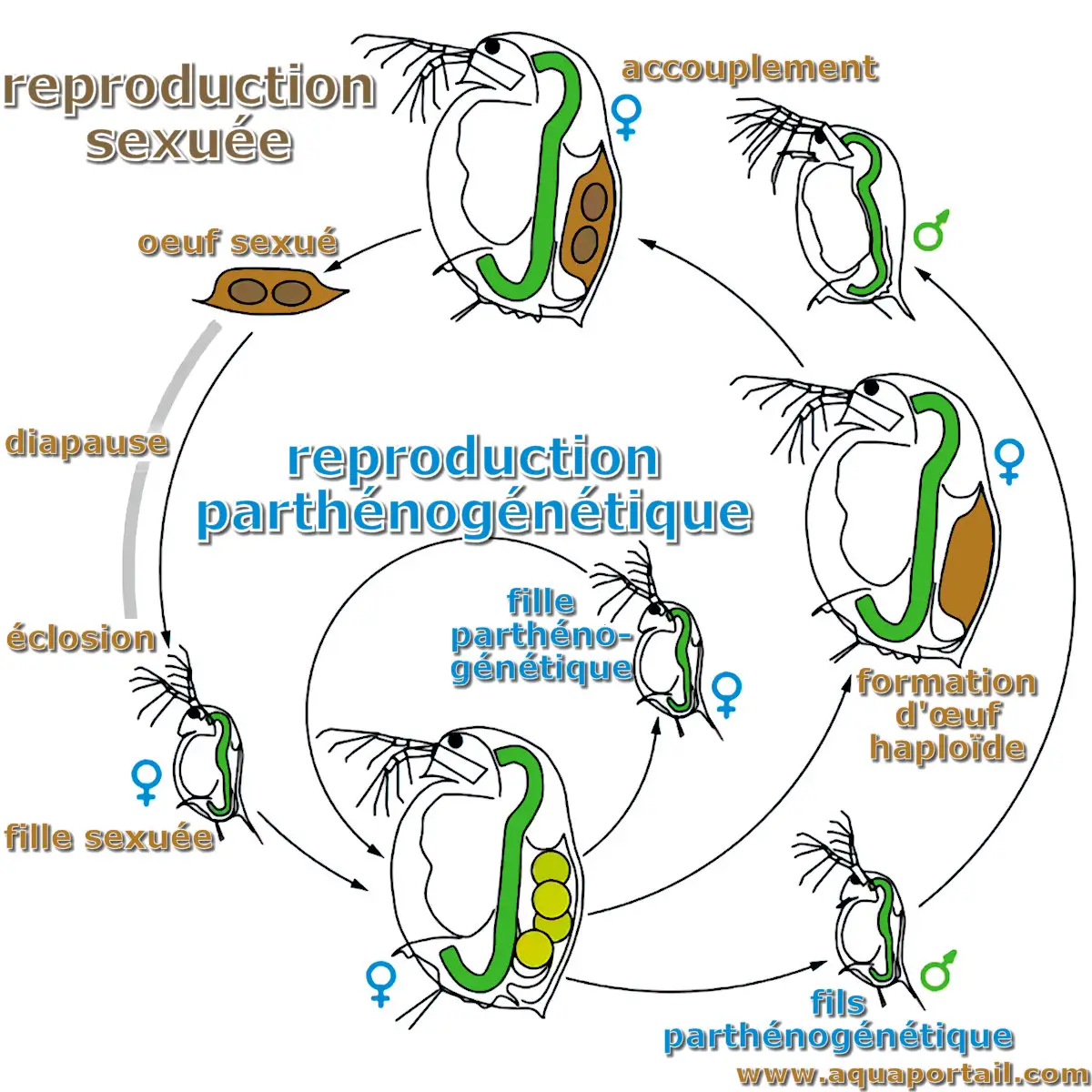
A parthenogenetic organism is an invertebrate (or occasionally vertebrate) animal capable of reproducing without fertilization, even though the species...
digenetic

A digenetic life cycle is the life cycle of an organism comprising two generations—a cycle in which, from one individual to an immediate descendant identical...
macro-organism

A macro-organism, unlike a microorganism, is a living organism visible to the naked eye, regardless of its classification in the animal or plant kingdom.
madrepore

A madrepore (Madrepora) is a marine animal of the group of scleractinian corals possessing an external skeleton, typically an acropora and encompassing...
