Megalodon
noun (n.)
Definition
The megalodon is a giant big-toothed shark, an extinct species that lived during the Cenozoic era more than 3 million years ago. Carcharodon megalodon is often regarded as a gigantic ancestor of the great white shark, one of the largest and most powerful predators in vertebrate history.
The megalodon is a giant predatory shark:
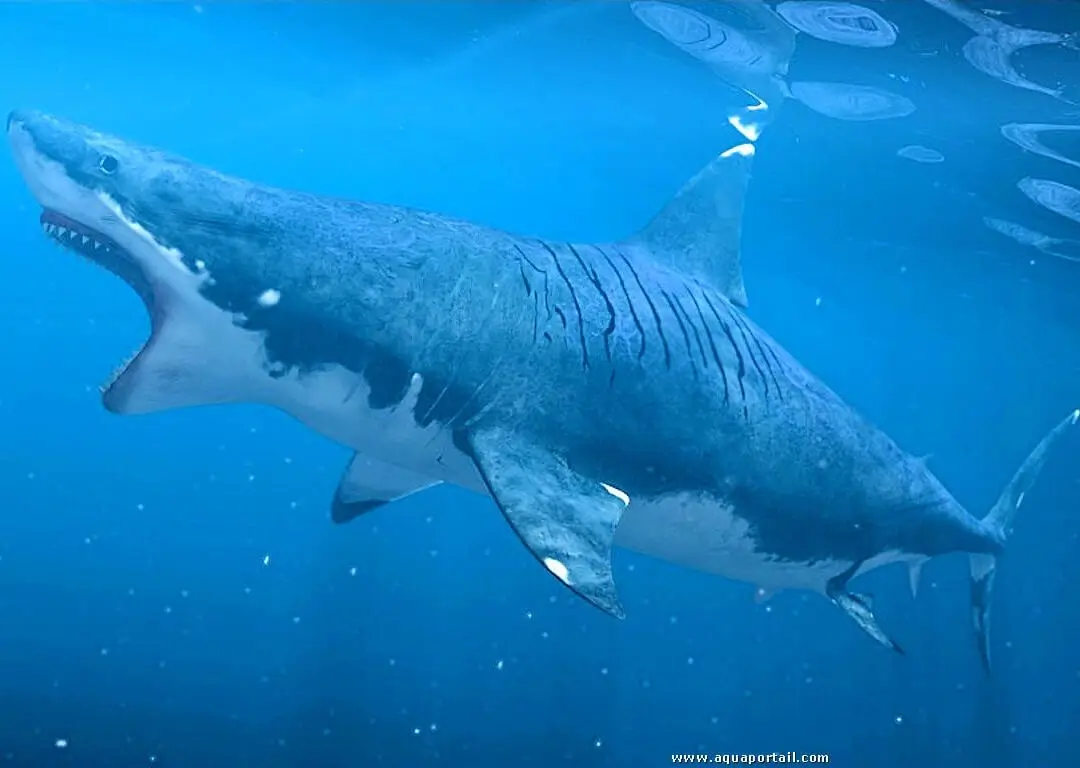
The apex predator Megalodon shark has been extinct for over 1.5 million years, though megalodons lived for a span of more than 25 million years during the Cenozoic era, from the late Oligocene to the early Pleistocene.
Explanations
The megalodon, or Megalodon, is a prehistoric shark closely related to the great white shark, a gigantic extinct fish of the fossil species Carcharodon megalodon. Megalodons are considered to have been among the largest and most powerful vertebrate predators in aquatic animal history, and likely had a profound impact on the structure of marine communities.
The megalodon certainly deserves respect and recognition today for its extraordinary dimensions.
Fossil remains of megalodons suggest that this giant shark reached a maximum length of 14 to 18 meters (46 to 59 ft) and had a cosmopolitan distribution. Scientists suggest that C. megalodon resembled a stockier version of the great white shark C. carcharias.
Historical information
The taxonomic assignment of C. megalodon has been debated for nearly a century and remains disputed. The two main interpretations place it as Carcharodon megalodon in the family Lamnidae or Carcharocles megalodon in the family Otodontidae. Consequently, the scientific name of this species is commonly abbreviated as C. megalodon in the literature to avoid taking a stance...
Drawing of a megalodon head:
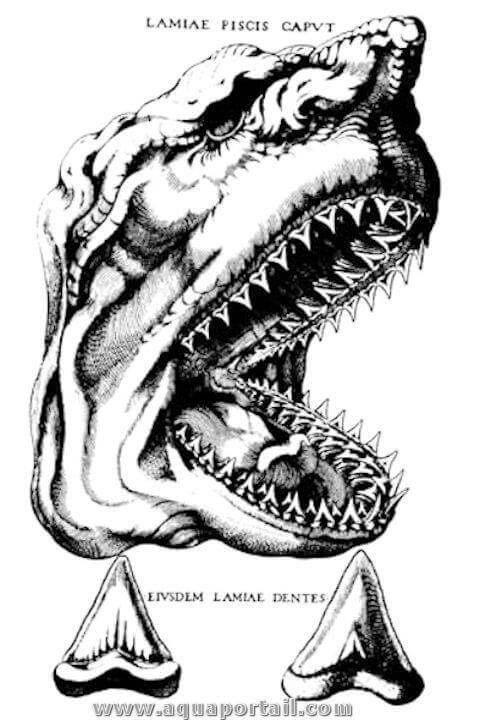
Depiction of a Megalodon head by Nicholas Steno in his work The Head of a Shark Dissected (Elementorum myologiae specimen) in 1667.
According to Renaissance accounts, gigantic triangular fossil teeth were frequently found embedded in rock formations and were sometimes believed to be the petrified tongues, or glossopetrae, of dragons and serpents! This interpretation was corrected in 1667 by the Danish naturalist Nicolas Steno (Niels Stensen or Nicholas Steno, 1638–1686), who recognized them as shark teeth and produced a famous illustration of a shark's head bearing such teeth. He described his findings in the book "The Head of a Shark Dissected," which also contains an illustration of a C. megalodon tooth. He also explained the role of the parotid duct, known as Steno's duct.
It was the Swiss naturalist Louis Agassiz who gave the shark its initial scientific name, Carcharodon megalodon, in 1835, in his research work "Recherches sur les poissons fossiles," completed in 1843, showing that Megalodon teeth are morphologically similar to those of the great white shark. Based on this observation, Agassiz assigned the megalodon to the genus Carcharodon. Although its scientific name is C. megalodon, it is sometimes nicknamed the "megatooth shark," the "giant white shark," or the "monster shark" in the literature.
Comparison of a Megalodon with a great white shark:

Size comparison of a Megalodon with a 6-meter-long (19.7 ft) great white shark C. carcharias, an estimate of the largest known adult size of C. megalodon between 16 and 20 m (52.5 to 65.6 ft) long, and a standing human.
C. megalodon is represented in the fossil record primarily by teeth and vertebral centra. Like all sharks, a Megalodon's skeleton was made of cartilage rather than bone: it is a cartilaginous fish, resulting in generally poorly preserved fossil specimens. The main preserved elements are glossopetrae, the shark's teeth. The retained meristic characters are: triangular shape, robust structure, large size, fine serrations, and a visible V-shaped root neck. Megalodon teeth can measure over 180 mm (7.1 in) (18 cm) in slant height or diagonal length, making them the largest teeth of any known shark species.
A few fossil vertebrae have been found. The most notable example is a partially preserved vertebral column from a single specimen unearthed in the Antwerp Basin in Belgium by M. Leriche in 1926. This cartilaginous vertebral column comprises 150 vertebral centra, with centra ranging from 55 millimeters (2.2 in) to 155 mm (6.1 in) in diameter. However, scientists have stated that much larger vertebrae can be expected. A partially preserved vertebral column from another megalodon specimen was excavated from clay at Gram in Denmark by Bendix-Almgreen in 1983. This specimen comprises 20 vertebral centra, with centra ranging from 100 millimeters (3.9 in) to 230 mm (9.1 in) in diameter.
Fossil remains of C. megalodon have been excavated in many parts of the world, including Europe, Africa, and North and South America, as well as Puerto Rico, Cuba, Jamaica, the Canary Islands, Australia, New Zealand, Japan, Malta, the Grenadines, and India. Megalodon teeth have been recovered from regions far removed from continental landmasses, in the open ocean, such as the Mariana Trench in the Pacific Ocean.
Comparison between a Megalodon glossopetra and that of a great white shark:

The fossilized Megalodon tooth measures about 17 cm (6.7 in), or 4 to 5 times larger than that of a great white.
The earliest "megalodontoid" remains have been reported from Oligocene strata, around 28 million years ago. Although fossils are often absent in strata extending beyond the Tertiary, they have been reported in subsequent Pleistocene layers. C. megalodon is thought to have gone extinct in the Pleistocene, probably around 1.5 million years ago.
Just like today's sharks, megalodon sharks were composed mainly of cartilage. Thus, even though these sharks were immense, most of their bodies did not fossilize; cartilage generally disintegrates too rapidly for the fossilization process to occur. Consequently, there are still many traits and characteristics of the megalodon about which we remain uncertain today. Fortunately, numerous teeth have been found and studied. For this reason, paleontologists have managed to uncover several well-established facts about these remarkable creatures, and even though many details remain debated, there are points on which most certainly agree.
Scientists have studied megalodon teeth found in Africa, North America, South America, India, Australia, Japan, and Europe. Based on the locations where these teeth were unearthed, there is firm consensus that megalodons thrived in the planet's warm waters. As mentioned earlier, scientists are still working to uncover details of this colossal prehistoric shark, including its diet. Since the great white shark is considered a relative of the "megatooth," one view holds that the great white shark's diet mirrors that of the megalodon. However, based on scratch marks found on the ancient shark's "mega"-teeth, it is believed they also fed on whales.
A possible reason for the Megalodon's extinction
Does the megalodon still exist? No! Indeed, the megalodon shark is extinct and is no longer alive today. Unfortunately, because little information is certain regarding these incredible creatures, the exact reason why they all died out at sea remains unknown. However, there are several theories that would explain the extinction of these animals. Two leading hypotheses agree with confidence that these sharks swam in warm waters. During the time these sharks were still alive, ocean temperatures began to drop. The steady decline toward colder ocean temperatures may very well be what killed off the megalodon shark. Another plausible hypothesis is that the ancient shark's preferred prey began migrating toward colder waters. Those low-temperature waters were likely too cold for the megalodon to survive. The species would have gone extinct from lack of food, though still driven by climate change.
Is the Megalodon still alive?
Curiously, many people refuse to believe that the megalodon shark has actually disappeared and is no longer alive. Skeptics feel that the megalodon shark might still live deep in the oceans. While it is true that we have not explored every inch of the planet's oceans, and it is likely that unknown species live in the abyssal and hadal depths of marine waters, the belief that the megalodon shark could still be alive today remains unproven. Sharks are known to shed hundreds of teeth on a regular basis; if the megalodon shark were still alive, more teeth from these sharks would likely be found. Every megalodon tooth ever found is ancient (fossilized). Until a "fresh" megalodon tooth is found, it is established that this ancient "megatooth" shark is almost certainly extinct.
However, another hypothesis exists, based on the average rate of manganese dioxide deposits around nuclei formed by fossil shark teeth: some have calculated that the Megalodon may have lived until relatively recently, just 11,000 years ago, rather than having died out 1.6 million years ago, as radiometric dating suggested. In geological terms, that is yesterday.
Taxonomy of the giant shark
Even after decades of research and scrutiny, controversy over the phylogeny of C. megalodon persists. Several ichthyologists specializing in sharks, such as J.E. Randall, A.P. Klimley, D.G. Ainley, M.D. Gottfried, L.J.V. Compagno, S.C. Bowman, and R.W. Purdy, maintain that C. megalodon is a close relative of the great white shark. However, others such as D.S. Jordan, H. Hannibal, E. Casier, C. DeMuizon, T.J. DeVries, D. Ward, and H. Cappetta, evolutionary specialists, cite homoplasy, an evolutionary convergence due to dental similarity. These proponents of the genus Carcharocles have gained notable support. Nonetheless, the original taxonomic assignment still enjoys wide acceptance.
The traditional view is that the Megalodon should be classified in the genus Carcharodon alongside the great white shark. The main reasons cited for this phylogeny are: an ontogenetic gradation, whereby teeth with coarse serrations in a juvenile evolve into fine serrations in adulthood, the latter resembling megalodon; the morphological similarity of juvenile megalodon teeth to those of C. carcharias; a symmetrical second anterior tooth; a large intermediate tooth that is mesially inclined; and upper anterior teeth featuring a chevron-shaped (V-shaped) neck area on the lingual face. Supporters of a close relationship with C. carcharias suggest that C. megalodon and C. carcharias share a common ancestor: Palaeocarcharodon orientalis.
Taxonomic hypotheses for the Megalodon:
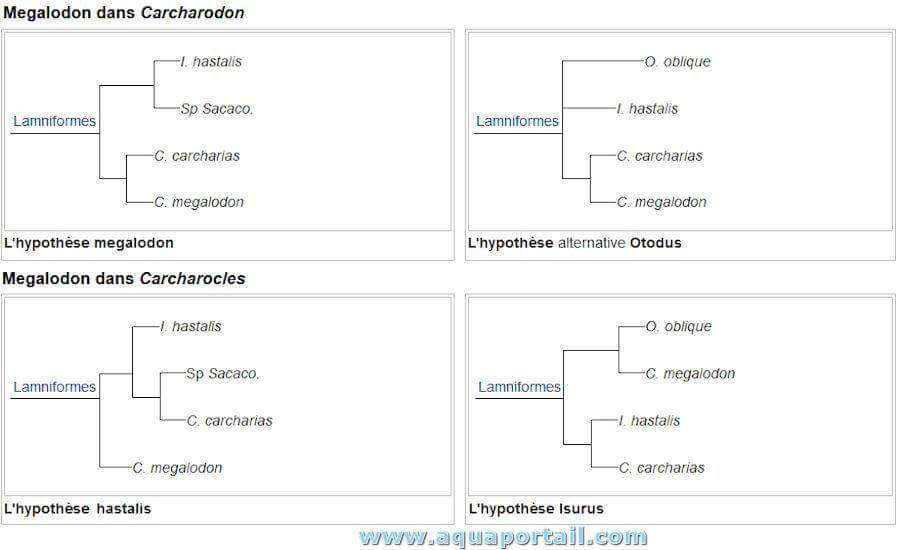
The 4 taxonomic hypotheses for the Megalodon: the Megalodon/Carcharias hypothesis, the Otodus hypothesis, the Hastalis hypothesis, and the Isurus hypothesis.
Around 1923, the genus Carcharocles was proposed by D.S. Jordan and H. Hannibal to classify the shark C. auriculatus. Later, proponents of Carcharocles assigned the megalodon to Carcharocles. Advocates of Carcharocles also suggest that the direct ancestor of sharks belonging to Carcharocles is an ancient giant shark called Otodus obliquus, which lived during the Paleocene and Eocene epochs. According to Carcharocles proponents, Otodus obliquus evolved into Otodus aksuaticus, which evolved into Carcharocles auriculatus, then into Carcharocles angustidens, then into Carcharocles chubutensis, and finally into the megalodon. Consequently, the immediate ancestor of C. megalodon is C. chubutensis, as it serves as the missing link between C. angustidens and C. megalodon and bridges the loss of the "lateral cusplets" that characterize megalodons.
Synonyms, antonyms
Spanish translation: megalodón
1 synonym (similar meaning) for "megalodon":
0 antonyms (opposite meaning).
Related words and expressions to MEGALODON are directly connected by general or specific meaning.
The word MEGALODON is listed on page 1 of words starting with M in the dictionary glossary.
Related to "megalodon"
Cenozoic

The Cenozoic era, or Tertiary era (in the broad historical sense), is the geological era spanning from -66 Ma to the present day (we are still in this era).
macro-organism

A macro-organism, unlike a microorganism, is a living organism visible to the naked eye, regardless of its classification in the animal or plant kingdom.
madrepore

A madrepore (Madrepora) is a marine animal of the group of scleractinian corals possessing an external skeleton, typically an acropora and encompassing...
mangrove

A mangrove is a coastal salt-marsh biotic zone comprising specific plants, mangrove trees, and plant associations that grow in the intertidal zone...
