Mesocyclone
noun (n.)
Definition
A mesocyclone is an updraft vortex within a convective storm with a diameter of 2 to 15 km (1.2 to 9.3 mi). Inside, air rises and rotates around a vertical axis, generally in the same direction as low-pressure systems. Mesocyclones are most often associated with a localized low-pressure region within a severe thunderstorm.
Such thunderstorms may be accompanied by strong surface winds and heavy hail. Mesocyclones often occur with updrafts in supercells, within which tornadoes may form through interaction with certain downdrafts.
Diagram of a mesocyclone:
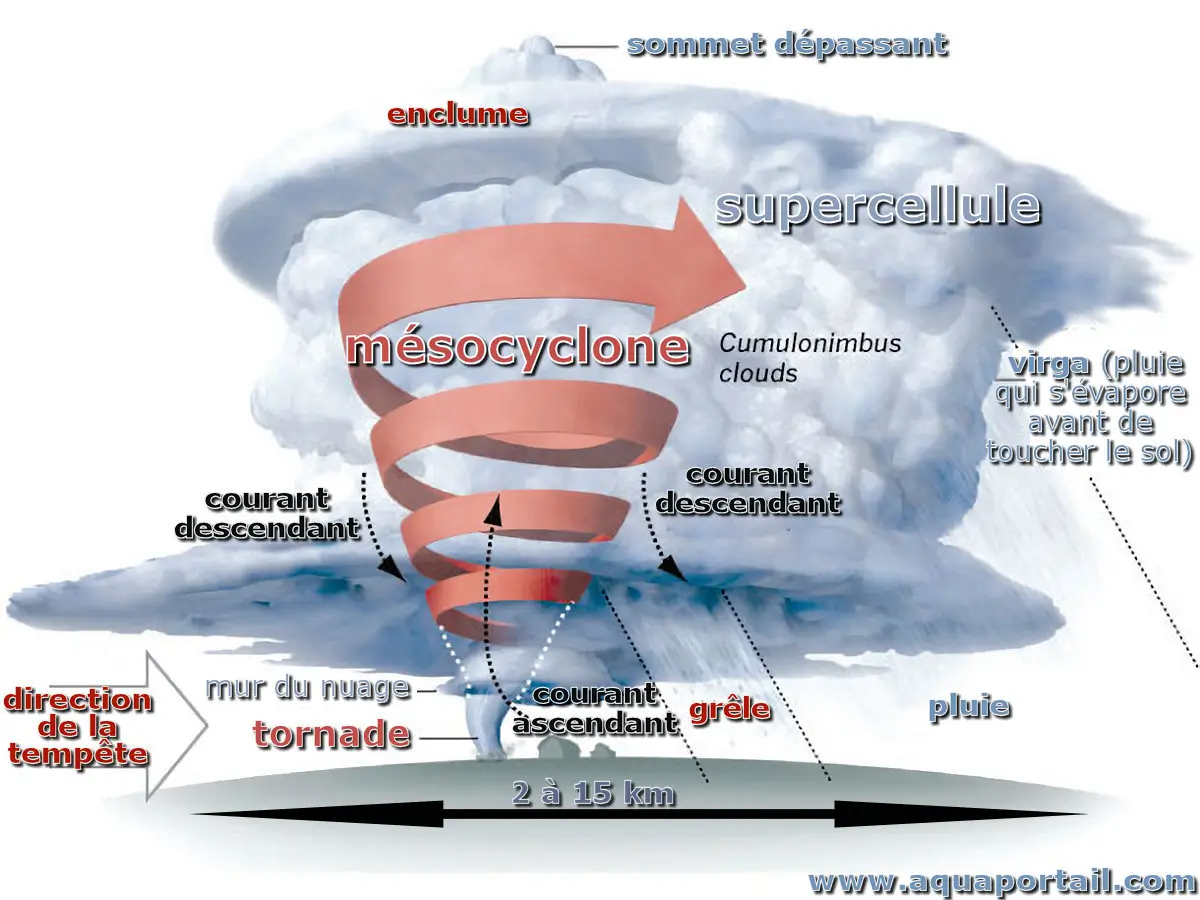
Operating diagram of a mesocyclone. Rotation begins horizontally, then with daytime heating, the rotation tilts upward by gaining energy through updraft heating.
Explanations
A mesocyclone is the rotation during a severe thunderstorm that occurs when an approaching low-pressure cold front from the ocean coast and a weakly moist wind field heading north meet. Thunderstorms containing persistent mesocyclones are supercell thunderstorms.
Mesocyclones occur at the "mesoscale", a more general term used in meteorology to designate organization on scales ranging from a few kilometers (miles) to hundreds of kilometers (hundreds of miles). Doppler radar is used to identify mesocyclones. A mesovortex is a similar, though generally smaller and weaker, rotational feature associated with squall lines.
A mesocyclone in the countryside:
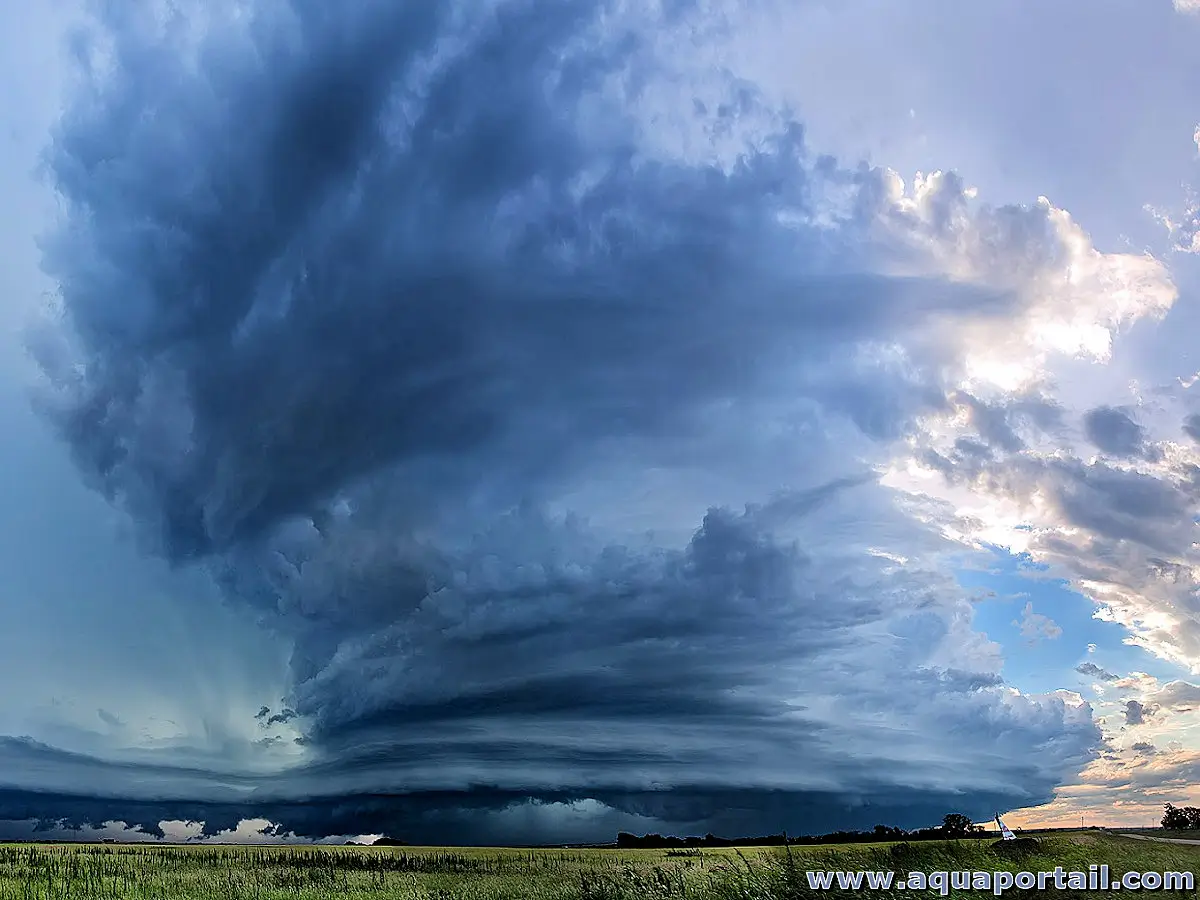
A mesocyclone is a rising, swirling air current within a convective storm. It is air rising and rotating around a vertical axis, generally in the same direction as low-pressure systems in a given hemisphere.
A mesocyclone is tilted and stretched due to pronounced directional and speed shear; its diameter decreases and its rotation increases. This resembles a figure skater pulling their arms closer to their body, accelerating their spin. Finally, as speed increases, pressure decreases toward the surface.
As a mesocyclone develops and intensifies, it can produce a wall cloud. A wall cloud hangs below the rain-free base or cloud base.
The wall cloud forms from rapid convergence of inflowing air. A funnel cloud will originate from the wall cloud. The funnel cloud will connect to the updrafts of the occluded front, where strong updrafts are present, where the cold front has overtaken the warm front and lifted it. This becomes a tornado once contact with the ground is established.
✅ The scale rates tornadoes from F0 to F5, with F0 being the least intense and F5 the most intense. F5 tornadoes are estimated to have maximum winds between 420 km/h and 512 km/h (261 mph and 318 mph).
Detection
Meteorologists rely on weather radars to provide information on the development of cyclonic storms. The National Weather Service strategically places Doppler radars across the country capable of detecting air movements toward or away from the radar. Early detection of increasing rotation aloft during a thunderstorm can allow life-saving warnings to be issued before the mesocyclone forms.
As these radar images are monitored, it becomes very clear that mesocyclonic rotation may be present. These radar readings are responsible for countless lives saved through advance warning. Below is an example of a possible mesocyclonic storm that will trigger a warning. On radar readings, the severe weather analyst will look for supercells to display a hook echo.
Mesocyclone vs. tornado
Mesocyclones and tornadoes exhibit several differences. First, a tornado is characterized by violent and destructive windstorms, whereas a mesocyclone is a rotating part of the atmosphere. Another difference is that mesocyclones are associated with supercells, whereas tornadoes are associated with severe thunderstorms.
Synonyms, antonyms
Spanish translation: mesociclón
2 synonyms (similar meaning) for "mesocyclone":
0 antonyms (opposite meaning).
Related words and expressions to MESOCYCLONE are directly connected by general or specific meaning.
The word MESOCYCLONE is listed on page 1 of words starting with M in the dictionary glossary.
Related to "mesocyclone"
macro-organism

A macro-organism, unlike a microorganism, is a living organism visible to the naked eye, regardless of its classification in the animal or plant kingdom.
madrepore

A madrepore (Madrepora) is a marine animal of the group of scleractinian corals possessing an external skeleton, typically an acropora and encompassing...
mangrove

A mangrove is a coastal salt-marsh biotic zone comprising specific plants, mangrove trees, and plant associations that grow in the intertidal zone...
manure

Manure is a mixture of animal droppings and plant bedding used to fertilize land. Manuring consists of applying manure to cultivated soil by spreading.
