Metal
noun (n.)
Definition
A metal is an element from a class of solid materials characterized by hardness, luster, malleability, fusibility, and ductility. Metals all possess good electrical and thermal conductivity.
Common metals include iron, gold, silver, copper, aluminum, magnesium, and tin, as well as their alloys, such as steel, brass, and bronze. For example, aluminum demonstrates its metallic properties by conducting heat efficiently.
Various metal bars:

A metal, derived from a metallic ore, is a chemical element as opposed to an alloy, which is a compound. They are workable because they are malleable. For example, nickel is used to strengthen stainless steel.
Explanations
Metals form cations by losing electrons and produce basic oxides and hydroxides. The atoms of metal ions are held together by metallic bonds. Certain properties of metals, such as ductility, conductivity, and hardness, help determine their optimal use for various applications.
Metals constitute a major component of the Earth's crust and occur naturally in the form of ores. These ores are often associated with one another as well as with various other elements. Moreover, they are found in rocks exposed to surface and groundwater flows, as well as in atmospheric dust particles.
Metals are inorganic substances naturally present beneath the Earth's surface. Most metals exhibit properties such as luster or a shiny appearance.
While many metals are hard, exceptions exist. For example, sodium and potassium are soft enough to be cut with a knife, and mercury remains unique in existing in liquid form at room temperature. By contrast, metals like iron exhibit a solid state under normal conditions.
More than 75% of elements are metals, which explains their large presence in the periodic table. Metals are located on the left side of the table. The two rows of elements positioned below the main body (the lanthanides and actinides) are metals. Metallic transactinides are superheavy metals.
Metals in the periodic table:
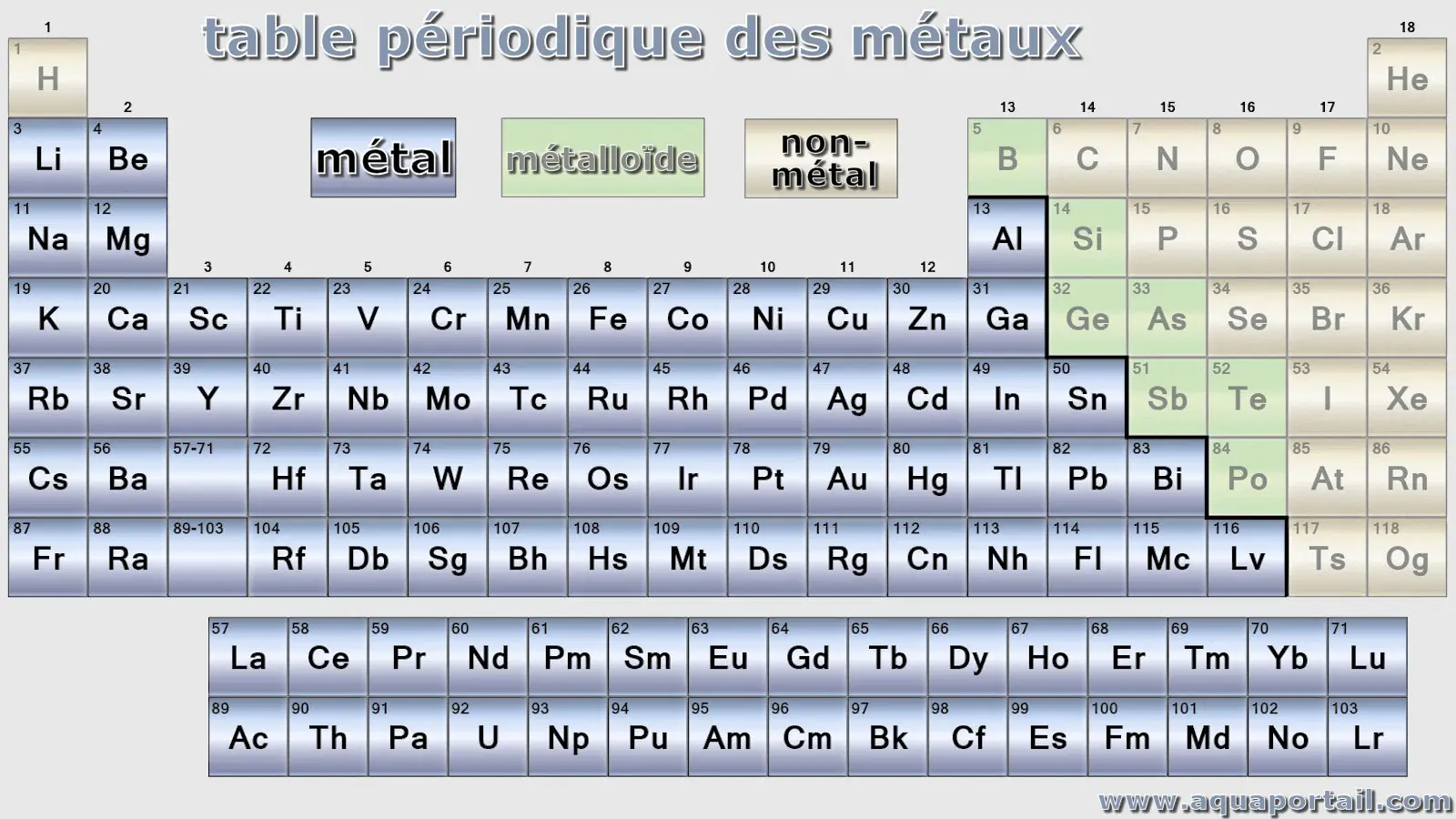
The majority of elements in the periodic table belong to the metal category. They are primarily concentrated from the center toward the left of the table. This vast group encompasses several subcategories, notably alkali metals, alkaline earth metals, transition metals, lanthanides, and actinides. Conversely, elements outside the metal classification include metalloids, nonmetals, halogens, and noble gases.
Metals are used in every aspect of life: structural components, containers, electrical wires and appliances, heat sinks, mirrors, coins, jewelry, and weapons. They are even found in food in the form of iron, copper, cobalt, nickel, zinc, and molybdenum.
Physical properties
Metals share several common properties, notably:
- they are solid at room temperature (except mercury)
- they are shiny, with a metallic luster
- with a few exceptions, most have a high melting point
- most are good conductors of heat
- most are good electrical conductors
- they have low ionization energies
- they have low electronegativity
- they are malleable (they can be hammered into sheets)
- they are ductile (they can be drawn into wires)
- they have high densities (exceptions: lithium, potassium, and sodium)
- most corrode in air or seawater
- metal atoms lose electrons during reactions and form cations.
✅ Under certain conditions, hydrogen can act as a metallic element. These conditions generally occur under extreme environments, such as high pressures or when the element is frozen.
Chemical properties
Reaction with water: only highly reactive metals have the ability to react with water, whereas many others do not. For example, sodium reacts with water and oxygen, releasing significant amounts of heat during the reaction. Due to its high reactivity, sodium is stored in kerosene to prevent any contact with moisture or atmospheric oxygen.
Reaction with acids: when metals react with acids, hydrogen gas is generally released. For example, the reaction between zinc and hydrochloric acid produces zinc chloride and hydrogen gas.
Reaction with bases: not all metals interact with bases, but those that do produce metal salts along with hydrogen gas. For example, zinc reacts with concentrated sodium hydroxide to produce sodium zincate and hydrogen gas.
Reaction with oxygen: in the presence of oxygen, metals form metal oxides, which are generally basic. For example, when magnesium burns in oxygen, magnesium oxide is formed. Subsequent dissolution of magnesium oxide in water leads to the formation of magnesium hydroxide.
List of metals
Metals constitute a large family of 92 chemical elements.
| Number | Symbol | Element |
| 3 | Li | Lithium |
| 4 | Be | Beryllium |
| 11 | Na | Sodium |
| 12 | Mg | Magnesium |
| 13 | Al | Aluminum |
| 19 | K | Potassium |
| 20 | Ca | Calcium |
| 21 | Sc | Scandium |
| 22 | Ti | Titanium |
| 23 | V | Vanadium |
| 24 | Cr | Chromium |
| 25 | Mn | Manganese |
| 26 | Fe | Iron |
| 27 | Co | Cobalt |
| 28 | Ni | Nickel |
| 29 | Cu | Copper |
| 30 | Zn | Zinc |
| 31 | Ga | Gallium |
| 37 | Rb | Rubidium |
| 38 | Sr | Strontium |
| 39 | Y | Yttrium |
| 40 | Zr | Zirconium |
| 41 | Nb | Niobium |
| 42 | Mo | Molybdenum |
| 43 | Tc | Technetium |
| 44 | Ru | Ruthenium |
| 45 | Rh | Rhodium |
| 46 | Pd | Palladium |
| 47 | Ag | Silver |
| 48 | Cd | Cadmium |
| 49 | In | Indium |
| 50 | Sn | Tin |
| 55 | Cs | Cesium |
| 56 | Ba | Barium |
| 57 | La | Lanthanum |
| 58 | Ce | Cerium |
| 59 | Pr | Praseodymium |
| 60 | Nd | Neodymium |
| 61 | Pm | Promethium |
| 62 | Sm | Samarium |
| 63 | Eu | Europium |
| 64 | Gd | Gadolinium |
| 65 | Tb | Terbium |
| 66 | Dy | Dysprosium |
| 67 | Ho | Holmium |
| 68 | Er | Erbium |
| 69 | Tm | Thulium |
| 70 | Yb | Ytterbium |
| 71 | Lu | Lutetium |
| 72 | Hf | Hafnium |
| 73 | Ta | Tantalum |
| 74 | W | Tungsten |
| 75 | Re | Rhenium |
| 76 | Os | Osmium |
| 77 | Ir | Iridium |
| 78 | Pt | Platinum |
| 79 | Au | Gold |
| 80 | Hg | Mercury |
| 81 | Tl | Thallium |
| 82 | Pb | Lead |
| 83 | Bi | Bismuth |
| 84 | Po | Polonium |
| 87 | Fr | Francium |
| 88 | Ra | Radium |
| 89 | Ac | Actinium |
| 90 | Th | Thorium |
| 91 | Pa | Protactinium |
| 92 | U | Uranium |
| 93 | Np | Neptunium |
| 94 | Pu | Plutonium |
| 95 | Am | Americium |
| 96 | Cm | Curium |
| 97 | Bk | Berkelium |
| 98 | Cf | Californium |
| 99 | Es | Einsteinium |
| 100 | Fm | Fermium |
| 101 | Md | Mendelevium |
| 102 | No | Nobelium |
| 103 | Lr | Lawrencium |
| 104 | Rf | Rutherfordium |
| 105 | Db | Dubnium |
| 106 | Sg | Seaborgium |
| 107 | Bh | Bohrium |
| 108 | Hs | Hassium |
| 109 | Mt | Meitnerium |
| 110 | Ds | Darmstadtium |
| 111 | Rg (Uuu) | Roentgenium (Unununium) |
| 112 | Cn (Uub) | Copernicium (Ununbium) |
| 113 | Nh (Uut) | Nihonium (Ununtrium) |
| 114 | Fl (Uuq) | Flerovium (Ununquadium) |
| 115 | Mc (Uup) | Moscovium (Ununpentium) |
| 116 | Lv (Uuh) | Livermorium (Ununhexium) |
Synonyms, antonyms
French translation:
métalSpanish translation: metal
6 synonyms (similar meaning) for "metal":
- actinide
- heavy metal
- lanthanide
- light metal
- metallic alloy
- transactinide
2 antonyms (opposite meaning):
Related words and expressions to METAL are directly connected by general or specific meaning.
The word METAL is listed on page 1 of words starting with M in the dictionary glossary.
Related to "metal"
noble gas

A noble gas, or rare gas, is a chemically inert gas because, being monatomic, it is very weakly reactive with any other compound.
macro-organism

A macro-organism, unlike a microorganism, is a living organism visible to the naked eye, regardless of its classification in the animal or plant kingdom.
madrepore

A madrepore (Madrepora) is a marine animal of the group of scleractinian corals possessing an external skeleton, typically an acropora and encompassing...
mangrove

A mangrove is a coastal salt-marsh biotic zone comprising specific plants, mangrove trees, and plant associations that grow in the intertidal zone...
Simple summary
A metal is a chemical element or alloy characterized by high electrical and thermal conductivity, malleability, ductility, and a shiny appearance. Metals are generally solid at room temperature (with the exception of mercury) and are known for their ability to form positive ions and metallic bonds.
