Adenine
noun (n.)
Definition
Adenine is one of the fundamental molecules of living organisms alongside nitrogen, as it is one of the five nucleobases making up the nucleic acids DNA and RNA. This nitrogenous base consists of a purine backbone with an amine group. In the genetic code, it is represented by the letter A.✅ The four other bases are guanine, cytosine, thymine, and uracil. Adenine always pairs with thymine in DNA and with uracil in RNA. See also adenosine.
Structure of adenine:
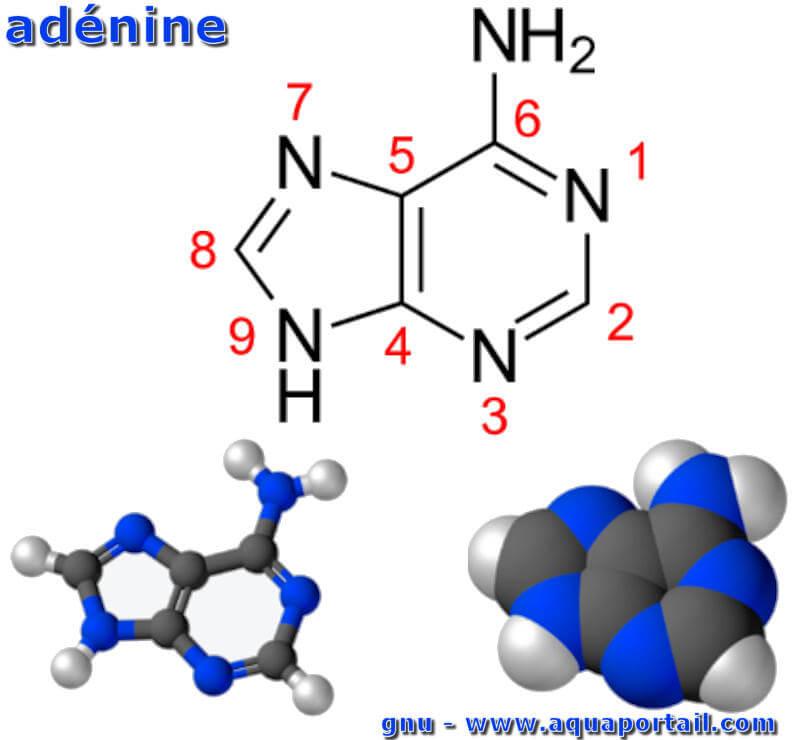
Adenine has the chemical formula: C5H5N5. It is a purine derivative (a purine base) in which a hydrogen atom has been replaced by an amino group (-NH2).
Adenine (or 6-aminopurine) is a purine nucleobase that enters into the composition of certain nucleotides and coenzymes. It is formed by an aminated purine ring (totaling 5 nitrogen atoms). It has two complementary bases: thymine in DNA and uracil in RNA.
Explanations
Adenine forms the nucleosides adenosine (Ado) and deoxyadenosine (dAdo), as well as the nucleotides adenylate (AMP) and deoxyadenylate (dAMP). In older literature, adenine was also regarded as a B vitamin, formerly called vitamin B4; however, today it is not considered a true vitamin.
Dimethyladenine is a tRNA nucleobase derivative carrying two methyl groups on carbon 6 of adenine. Linked to a ribose, it forms a nucleoside called dimethyladenosine; see also dimethylguanine.
Like guanine, cytosine, thymine, and uracil (all nucleobases), adenine is part of the nucleotides that make up long nucleic acid chains; each nucleotide consists of a phosphate group, a five-carbon sugar (ribose or deoxyribose), and one of the previously mentioned nucleobases. In the double-helix">helix structure shaped like a "twisted ladder" that characterizes deoxyribonucleic acid (DNA), each base is paired with a specific complementary base, forming the "rungs" of the ladder. Pairing of these bases occurs through chemical affinity (hydrogen bonds), so that in DNA, adenine always binds to thymine. In nucleotide sequences, adenine is represented by the letter "A".
Adenine is also a component of adenosine triphosphate, the primary cellular energy currency, and occurs in many natural substances such as beetroot, tea, and urine.
Adenine and thymine were discovered in 1885 by the German biochemist Albrecht Kossel.
Biosynthesis
Purine metabolism leads to the formation of adenine (A) and guanine (G). Both are derived from inosinic acid, which is synthesized on the precursor ribose-5-phosphate using atoms from the amino acids glycine, glutamine, and aspartic acid.
✅ In de novo purine nucleotide synthesis: in the first step, the rate-limiting step of this pathway, an amino group donated by glutamine attaches to C1 of phosphoribosyl pyrophosphate (PRPP). The resulting 5-phosphoribosylamine is highly unstable, and the purine ring is subsequently built upon this structure.
The second step involves incorporating three atoms from glycine, whose carboxyl group is activated at the expense of ATP. The amino group of the incorporated glycine is then formylated by N10-formyltetrahydrofolate, and a nitrogen atom donated by glutamine is incorporated, prior to dehydration and ring closure forming the five-membered imidazole ring of the purine core as 5-aminoimidazole ribonucleotide (AIR).
In higher eukaryotes, AIR is carboxylated to carboxyaminoimidazole ribonucleotide in a single step by AIR carboxylase (in two steps in bacteria and fungi). Aspartate donates its amino group in two steps: amide bond formation followed by elimination of its carbon skeleton.
The final carbon atom is donated by N10-formyltetrahydrofolate, and a second carboxylation completes the second fused ring of the purine core. The first intermediate with a complete purine ring is inosinate (IMP). Conversion of inosinate into adenylate requires incorporating an amino group from aspartate. Guanylate is formed by oxidation of inosinate at C2.
History
Previously, the literature sometimes referred to adenine as vitamin B4. It is no longer considered a true vitamin or part of the B-vitamin complex. However, two B vitamins, niacin and riboflavin, bind to adenine to form essential cofactors: nicotinamide adenine dinucleotide (NAD+) and flavin adenine dinucleotide (FAD), respectively. Hermann Emil Fischer was among the early scientists to study adenine.
Adenine was named in 1885 by Albrecht Kossel, referring to the pancreas (from Greek aden, gland) from which Kossel's sample originated. Experiments conducted in 1961 by the Catalan biochemist Joan Oró showed that a large amount of adenine could be synthesized by polymerizing ammonia with five molecules of hydrogen cyanide (HCN) in aqueous solution, carrying implications for the debate on the origin of life on Earth. In 1959, the Spanish biochemist Juan Oró had already synthesized adenine from hydrocyanic acid.
On August 8, 2011, a report based on NASA studies of meteorites found on Earth was published, suggesting that components of DNA and RNA could have originated from outer space.
Synonyms, antonyms
Spanish translation: adenina
2 synonyms (similar meaning) for "adenine":
0 antonyms (opposite meaning).
Related words and expressions to ADENINE are directly connected by general or specific meaning.
The word ADENINE is listed on page 1 of words starting with A in the dictionary glossary.
Related to "adenine"
abiotic

In biology and ecology, abiotic refers to what is not biotic, that is, not part of living beings.
aboral

Aboral refers to what is situated away from or opposite the mouth in zoology, and especially in marine biology.
absence

Absence refers to non-presence at an expected location, or the complete non-existence of something.
acetyltransferase
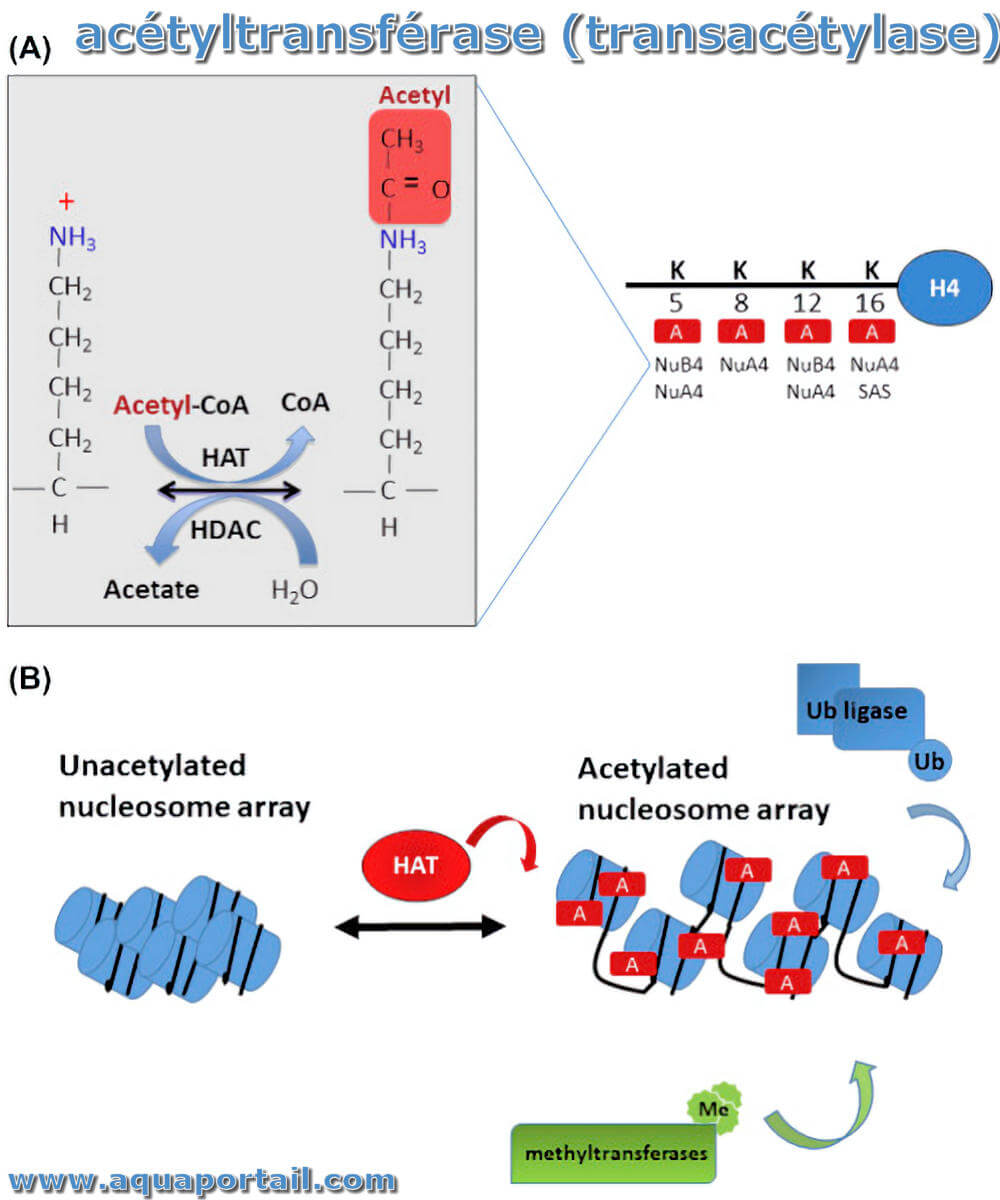
An acetyltransferase is an enzyme that transfers an acetyl group from acetyl-CoA to lysine amino acids.
