Action spectrum
noun phrase (n. phr.)
Definition
The action spectrum corresponds to the rate of photosynthesis carried out by a photosynthetic organism as a function of the wavelength of light it receives and the amount of energy carried by that wavelength.
Light absorption by plants, including aquatic plants in aquariology, unfortunately cannot be determined from the colorful graphs printed on aquarium lighting brochures, because those curves do not indicate the energy output across each wavelength band—so beyond looking attractive to hobbyists, they provide little practical utility.
⭐ See also absorption spectrum, emission spectrum, and light spectrum.
Action and absorption spectra of chlorophyll:
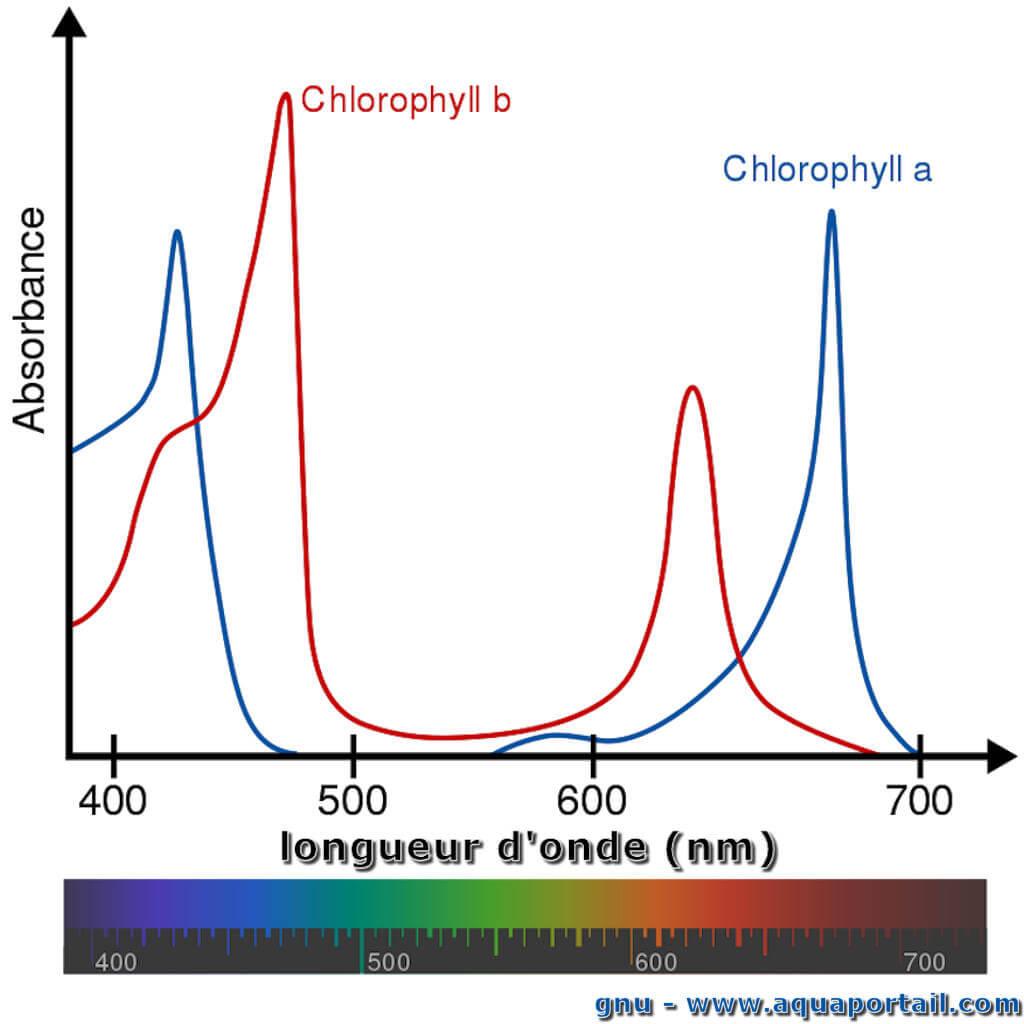
The absorption spectrum of free chlorophyll a (blue) and b (red) in a solvent reflects the action spectra of chlorophyll molecules, slightly shifted in vivo depending on specific pigment–protein interactions.
Explanations
An action spectrum, plotted as a graph, shows how effectively a light-dependent process (usually photochemical or photobiological) is driven by light of different wavelengths. Among other uses, an action spectrum can help identify the active light-absorbing chemical compound by comparison with known absorption spectra.
The action spectrum of human scotopic (twilight) vision, peaking at 503 nm, matches the absorption spectrum of rhodopsin, and the action spectrum of foliar photosynthesis closely resembles the absorption spectrum of chlorophyll.
Measuring the action spectrum for a specific developmental process in plants LED to the discovery of phytochrome, a widespread, abundant photoreceptor protein in plants with regulatory functions.
Certain reactants can utilize specific wavelengths of light more efficiently to drive their reactions. For instance, chlorophyll is far more efficient at using red and blue wavelengths to perform photosynthesis; consequently, the action spectrum graph shows distinct peaks in the red and blue wavelength bands.
The action spectrum of photosynthesis:

The action spectrum of photosynthesis depends on the absorption spectra of chlorophylls a and b and carotenoids.
The first action spectrum was created by T.W. Engelmann, who split white light into its component wavelengths using a prism and illuminated Cladophora in a suspension of aerobic bacteria. He discovered that the aerobic bacteria accumulated in the blue and red light regions of the dispersed spectrum, thereby demonstrating the effect of different wavelengths on photosynthesis and plotting the first photosynthetic action spectrum.
Summary
The action spectrum indicates the effectiveness of particular wavelengths of light in driving a physiological response, describing the relative quantum efficiency across wavelengths. The first photosynthetic action spectrum was discovered by T.W. Engelmann.
He used a prism to disperse light into its spectral components and illuminated a filament of Cladophora placed in a suspension of aerobic bacteria. Observing that the bacteria clustered predominantly in the red and blue regions of the spectrum, he concluded that photosynthesis varies with wavelength and plotted the first action spectrum of photosynthesis on a green alga.
It demonstrates that specific photochemical reactions require particular wavelengths of light, and that some reactions utilize certain wavelengths far more efficiently than others.
Synonyms, antonyms
Spanish translation: espectro de acción
0 synonyms (similar meaning) for "action spectrum".
0 antonyms (opposite meaning).
Related words and expressions to ACTION SPECTRUM are directly connected by general or specific meaning.
The expression ACTION SPECTRUM is listed on page 1 of words starting with A in the dictionary glossary.
Related to "action spectrum"
albedo
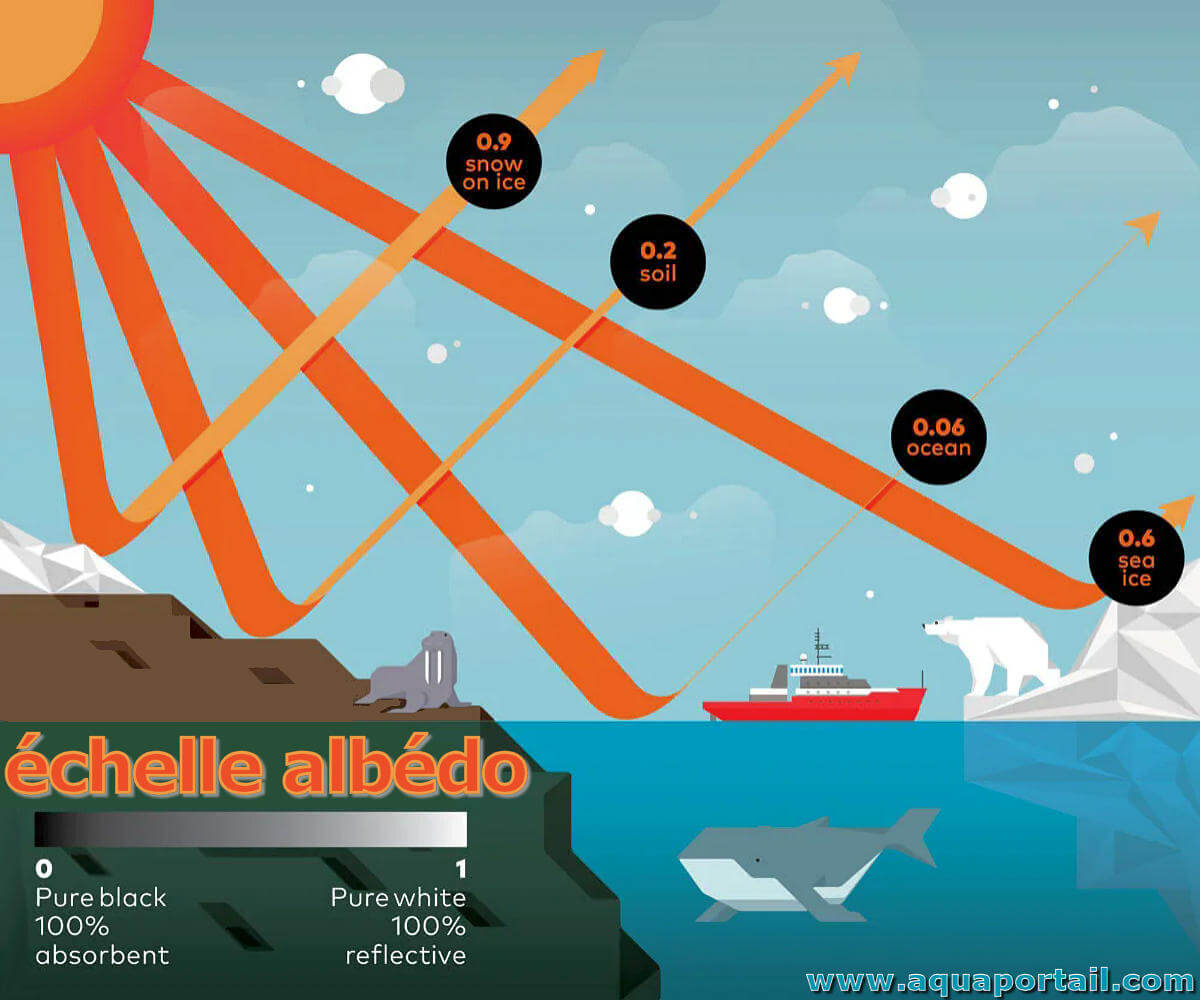
Albedo is the fraction of incident light reflected by a body (for example, clouds). Albedo thus corresponds to the ratio of reflected radiation to incident...
absorption spectrum
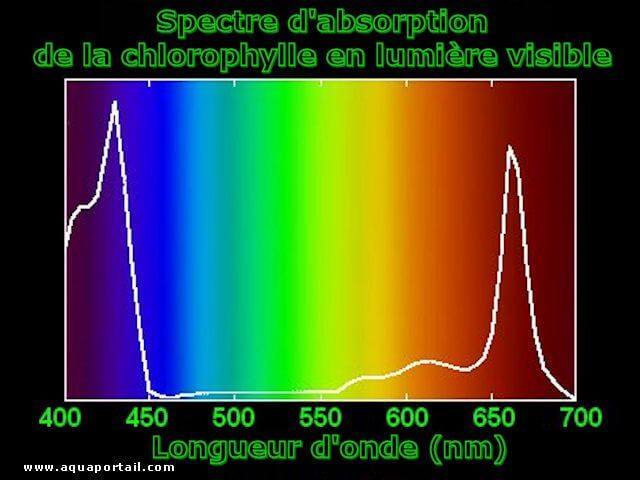
The absorption spectrum of a material is the fraction of incident radiation absorbed by the material across a range of frequencies.
contraction

A contraction is the process of becoming smaller. A contraction is the process by which a contractile muscle becomes or is shortened and tightened.
photosynthesis reaction centers

Photosynthesis reaction centers are specialized sites of photosynthesis where oxidation-reduction reactions take place.
