Absorption spectrum
noun phrase (n. phr.)
Definition
The absorption spectrum of a material is the fraction of incident radiation absorbed by the material across a range of frequencies. Different elements exhibit distinct spectra because they have different atomic compositions.
Here is the absorption spectrum of chlorophyll in visible light:
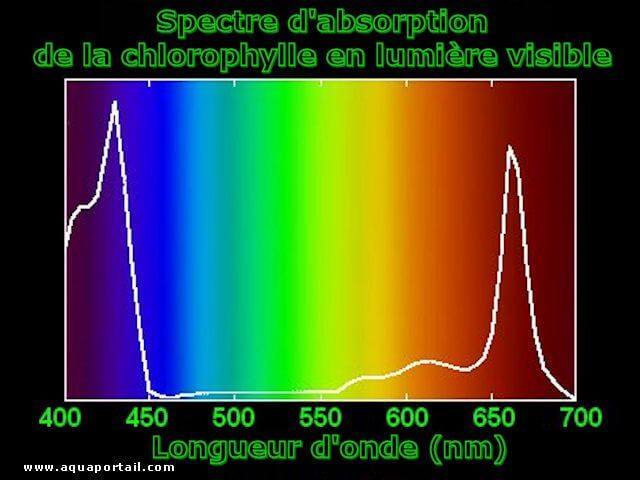
The absorption spectrum of chlorophyll in visible light exhibits two peaks. Chlorophyll "a" absorbs mainly in the blue (between 400 and 500 nm) and red (around 650 to 680 nm), whereas chlorophyll "b" absorbs primarily blue and yellow-orange light.
Explanations
The absorption spectrum of a material indicates the fraction of incident electromagnetic radiation absorbed within a given frequency range. In a sense, it is the opposite of an emission spectrum.
The absorption spectrum is determined by the amount of light absorbed by a compound as a function of wavelength (expressed in nanometers). Measurement is performed by spectroscopy, specifically absorption spectroscopy for spectroscopic analysis.
Properties
Each chemical element possesses its own absorption lines corresponding to specific wavelengths and relative energy differences between its atomic orbital levels.
For example, an object that absorbs blue, green, and yellow light will appear red when illuminated by white light, simplifying to primary colors. For this reason, absorption spectra can be used to identify elements present in a gas or liquid. This method is applied to infer the presence of elements in stars and other gaseous objects that cannot be measured directly.
⭐ See also light spectrum, visible spectrum, ultraviolet spectrum, emission spectrum, action spectrum, and infrared spectrum.
Absorption spectroscopy encompasses a set of spectroscopic techniques performed across the electromagnetic spectrum. These techniques rely on the absorption of electromagnetic radiation at different wavelengths by materials, producing a spectrum typically plotted against wavenumber and absorbance or transmittance. Absorption techniques include atomic absorption spectroscopy.
The absorption spectrum of a material is the fraction of incident radiation absorbed over a frequency range, determined primarily by the atomic and molecular composition of the material. Radiation is most readily absorbed at frequencies matching the energy difference between two quantum-mechanical states of the molecules. Absorption occurring due to a transition between two states is called an absorption line, and a spectrum typically comprises numerous lines.
Photosynthetic absorption with measurement of photosynthetic rate versus absorption spectrum:
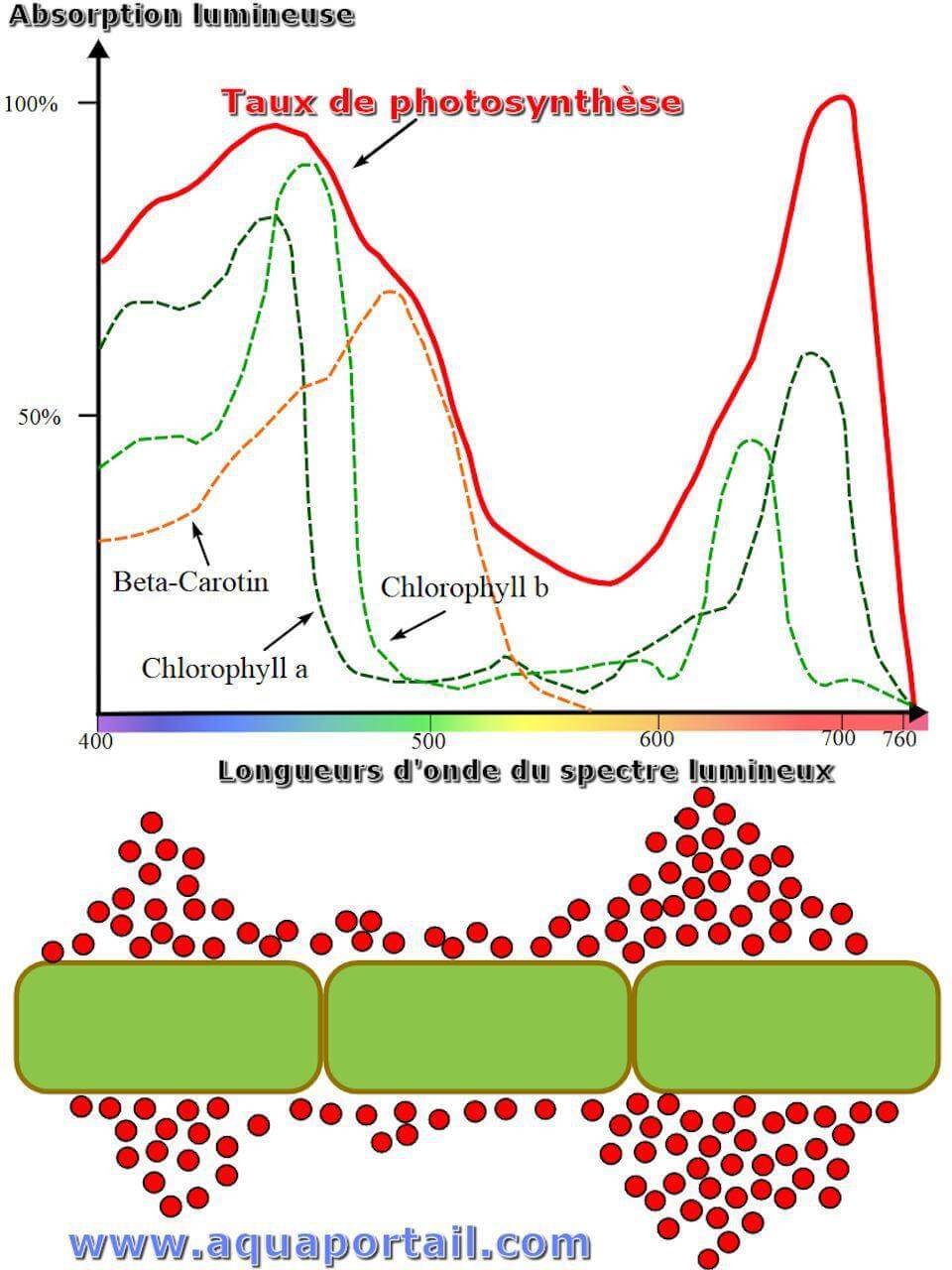
Profile of chlorophyll absorption during photosynthesis.
The frequencies at which absorption lines appear, as well as their relative intensities, depend primarily on the electronic and molecular structure of the sample. Frequencies also depend on interactions among molecules within the sample, crystal structure in solids, and environmental factors (such as temperature, pressure, and electromagnetic fields). Lines also exhibit a width and shape governed primarily by the spectral density or density of states of the system.
Relationship to emission spectrum
Emission is a process by which a substance releases energy in the form of electromagnetic radiation. Emission can occur at any absorption frequency, allowing absorption lines to be determined from an emission spectrum. An emission spectrum typically exhibits a quite different intensity profile from an absorption spectrum; however, the two are not identical.
The absorption spectrum can be calculated from the emission spectrum using appropriate theoretical models and additional information on quantum-mechanical states.
Relationship to transmission spectrum
Absorption and transmission spectra convey equivalent information, and one can be calculated from the other via mathematical transformation. A transmission spectrum reaches its maximum intensity at wavelengths where absorption is lowest, because more light passes through the sample, whereas an absorption spectrum peaks at wavelengths where absorption is strongest.
Relationship to scattering and reflection spectra
The scattering and reflection spectra of a material are influenced by both its refractive index and its absorption spectrum. In optics, the absorption spectrum is typically quantified by the extinction coefficient, and the extinction coefficient and refractive index are quantitatively linked through the Kramers–Kronig relation. Consequently, the absorption spectrum can be derived from a scattering or reflection spectrum, though this generally requires simplifying assumptions or models, making the derived absorption spectrum an approximation.
Chlorophyll absorption spectrum
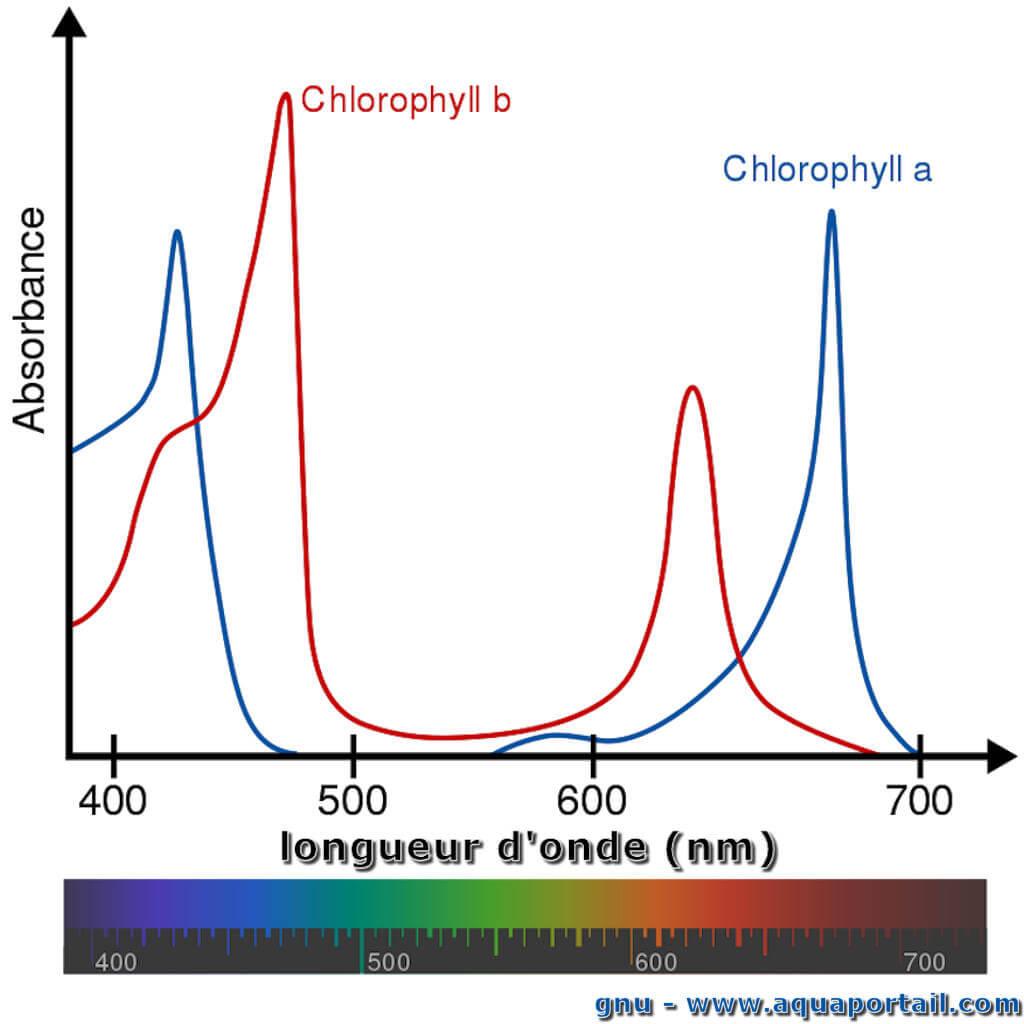
The absorption spectra of chlorophylls dissolved in solvents always display two distinct absorption maxima: one between 600 and 800 nm, called the Qy band, and another around 400 nm, called the Soret band. The figure on the right illustrates these absorption maxima for chlorophyll a and b. Additionally, the Qx band occurs around 580 nm, polarized perpendicular to Qy and generally absorbing very weakly.
Absorption depends on the solvent, so the positions of absorption maxima can shift by several nanometers depending on solvent type. Within the natural protein environment of chlorophylls, things behave differently, and the positions of absorption maxima depend on two factors:
- depending on the partial charges of surrounding amino acids and the bending of side groups on chlorophyll molecules, absorption maxima can occur at markedly different wavelengths
- within proteins, chlorophylls sit very close together and interact with one another (via dipole–dipole interactions and, at very short distances, exchange interactions), lowering energy levels and producing a redshift of absorption maxima; this is particularly striking in the LH2 light-harvesting antenna complex of purple bacteria, which consists of two concentric rings of bacteriochlorophyll molecules (the upper B850 ring containing 18 strongly coupled BChl molecules, and the lower B800 ring containing 9 more widely spaced, weakly coupled BChl molecules).
Strong coupling shifts BChl a absorption in the B850 ring into the red, with an absorption band at 850 nm, whereas weakly coupled BChl a in the B800 ring absorbs at 800 nm, in the same range as monomeric BChl a in organic solvents. In the absorption spectrum (right) of the LH2 complex, the absorption bands of the B800 and B850-BChl a molecules are clearly separated, and bands derived from carotenoid molecules are also visible even though they are not depicted in the structural model.
✅ Several types of chlorophyll exist that differ in the side groups attached to the porphyrin ring; they possess distinct absorption spectra and occur in different phototrophic organisms.
Hydrogen absorption spectrum
The absorption spectrum of hydrogen in the visible region occurs at wavelengths of 410 nm (violet), 434 nm (blue), 486 nm (blue-green), and 656 nm (red), with each absorption line corresponding to a specific electronic transition.
Specifically, when a hydrogen atom absorbs light, its electron jumps to a higher energy level (an "excited state"). It may jump one or several levels depending on the amount of energy absorbed, but the electron can only occupy discrete energy levels and cannot stop halfway between them. Furthermore, a very exact, discrete amount of energy—neither more nor less—is required to promote the electron from one specific level to another.
The energy required for an electron to jump to a given level corresponds to the wavelength of light it absorbs; in other words, electrons absorb only photons carrying the exact energy needed to bridge those energy levels, since photons carry quantized packets of energy corresponding to their wavelength.
Thus, the shortest-wavelength, highest-energy light (violet at 410 nm) promotes the electron across four levels, whereas the longest-wavelength, lowest-energy light (red at 656 nm) induces a jump of a single level.
Synonyms, antonyms
Spanish translation: espectro de absorción
1 synonym (similar meaning) for "absorption spectrum":
1 antonym (opposite meaning):
Related words and expressions to ABSORPTION SPECTRUM are directly connected by general or specific meaning.
The expression ABSORPTION SPECTRUM is listed on page 1 of words starting with A in the dictionary glossary.
Related to "absorption spectrum"
action spectrum
The action spectrum corresponds to the rate of photosynthesis carried out by a photosynthetic organism as a function of the wavelength of light it receives...
absorption

Absorption, when a body comes into contact with a fluid or energy, allows it to take in a portion of it.
abiotic

In biology and ecology, abiotic refers to what is not biotic, that is, not part of living beings.
aboral

Aboral refers to what is situated away from or opposite the mouth in zoology, and especially in marine biology.
