Phototrophic
noun and adjective (n. / adj.)
Definition
An organism is phototrophic when it derives its sustenance from photosynthesis. It is capable of producing organic matter from mineral nutrients through the use of light energy. A phototroph derives its main source of energy from light. Phototrophy is photosynthetic autotrophy.
The reaction with a purple phototroph:
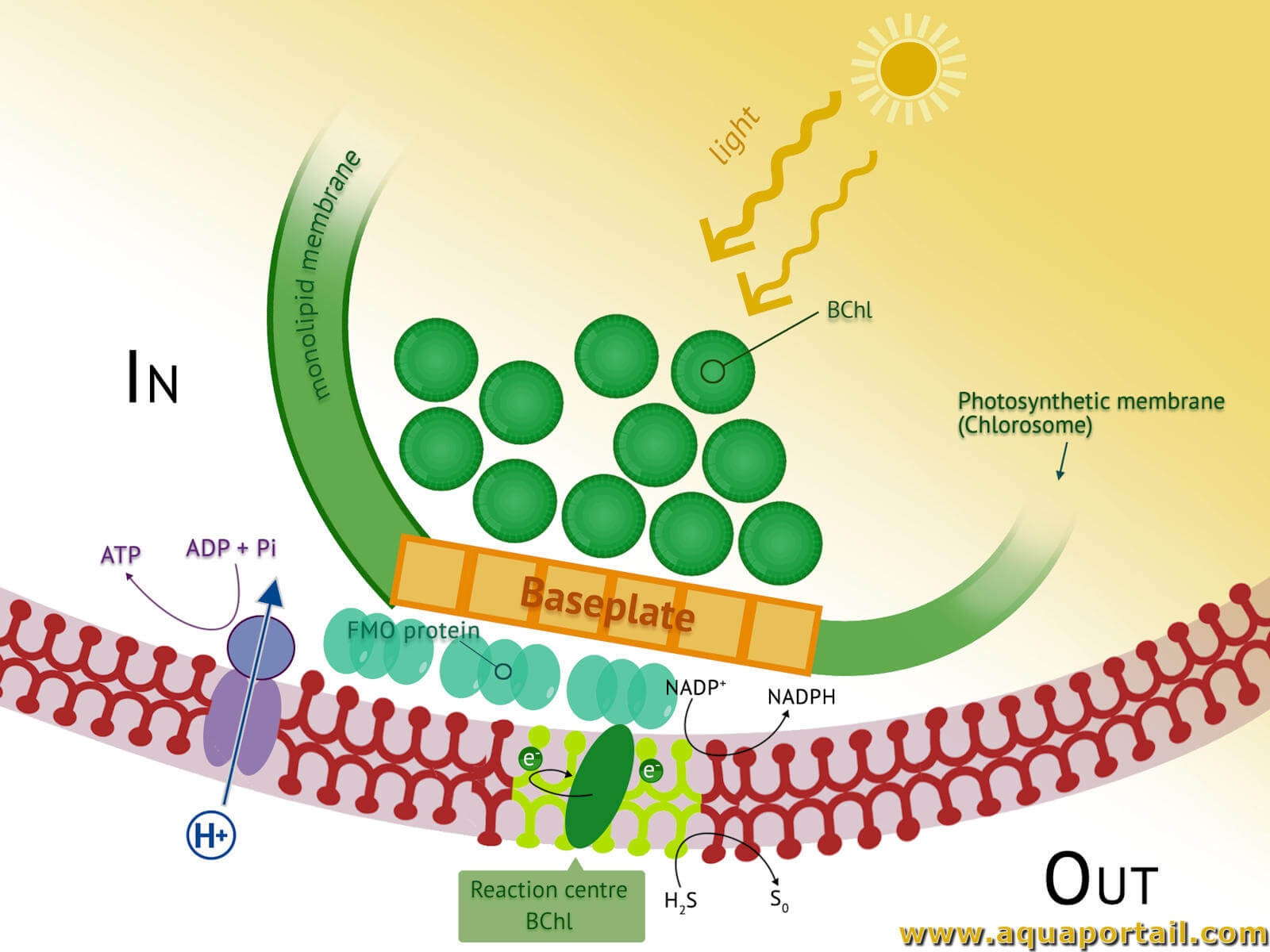
In purple phototrophs, the plasma membrane contains the purple photosystem and ATP synthase.
Explanations
Phototrophic organisms require light energy to carry out their organic matter syntheses. We distinguish:
- photoautotrophs whose carbon source is CO2
- photoheterotrophs whose carbon source is organic
- photolithotrophs whose proton and electron source is inorganic
- photoorganotrophs whose proton and electron source is organic.
Phototrophy
Phototrophy refers to the process by which energy from the Sun is captured and converted into chemical energy, in the form of ATP. The term photosynthesis is more specifically used to describe organisms that both convert sunlight into ATP (the "light reaction") and also use ATP to fix carbon dioxide into organic compounds.
These organisms are photoautotrophs and are the primary producers of global food webs. Although photosynthesis is most often associated with plants, microbial photosynthesis is also an important supplier of chemical energy to consumers in the food web.
Among bacteria and archaea, there are also photoheterotrophs, organisms that convert sunlight into ATP but use prefabricated organic compounds available in the environment. In the dark, these organisms generally grow as heterotrophs.
✅ The simplest, and perhaps oldest, form of phototrophy involves a light-activated proton pump in the plasma membrane of certain proteobacteria and halophilic archaea: these are the rhodopsin proteins (proteorhodopsin and bacteriorhodopsin, respectively). These proteins contain an associated retinal molecule related to that found in the eyes of vertebrates.
Amphitroph
An amphitrophic organism lives as a phototroph during the day and as a chemotroph at night. This is often the case for a hermatypic coral, capturing light during the day and taking advantage of chemical elements in the water at night.
Phototrophic biofilms
Phototrophic biofilms exist on light-exposed surfaces in various terrestrial and aquatic environments. oxygenic phototrophs such as diatoms, green algae, and cyanobacteria are the main primary producers that generate energy and reduce carbon dioxide, thereby supplying the system with organic substrates and oxygen.
Photosynthesis fuels processes and conversions in the entire biofilm community, including the metabolism of heterotrophic organisms.
A matrix of polymeric substances secreted by phototrophs and heterotrophs enhances the attachment of the biofilm community.
Current and potential applications of phototrophic biofilms include wastewater treatment, bioremediation, fish feed production, biohydrogen production, and soil improvement.
Light intensity decreases with depth, limiting phototrophic activity to the upper layer of the mat. oxygenic photosynthesis results in a steep oxygen gradient that restricts most anoxygenic phototrophs and anaerobic chemotrophs to the lower parts of the mat. However, recent studies have also shown examples of anaerobes thriving in the oxic zone of microbial mats. The use of CO2 during photosynthesis leads to a pH gradient.
Synonyms, antonyms
Spanish translation: fotótrofo
2 synonyms (similar meaning) for "phototrophic":
- amphitrophic
- photosynthetic autotroph
0 antonyms (opposite meaning).
Related words and expressions to PHOTOTROPHIC are directly connected by general or specific meaning.
The word PHOTOTROPHIC is listed on page 1 of words starting with P in the dictionary glossary.
Related to "phototrophic"
autotroph

An autotroph is an organism that synthesizes organic matter from inorganic matter using minerals, light energy, or chemical energy.
autotrophy

Autotrophy is the trophic mode of an organism capable of synthesizing organic matter from inorganic matter.
lithoautotroph

A lithoautotroph is a microorganism capable of generating the energy it needs from reduced inorganic compounds of mineral origin.
phototactic

Phototactic refers to a cell or a multicellular organism that exhibits an orientation reaction to light.
