Frustule
noun (n.)
Definition
A frustule is a bivalve siliceous structure enclosing a diatom cell, forming the silicified portion of a diatom cell wall. The frustule is a protective siliceous shell of Bacillariophyceae (diatoms), consisting of two overlapping valves: the upper valve (epivalve or epitheca) and the lower valve (hypovalve or hypotheca).
Different frustules:
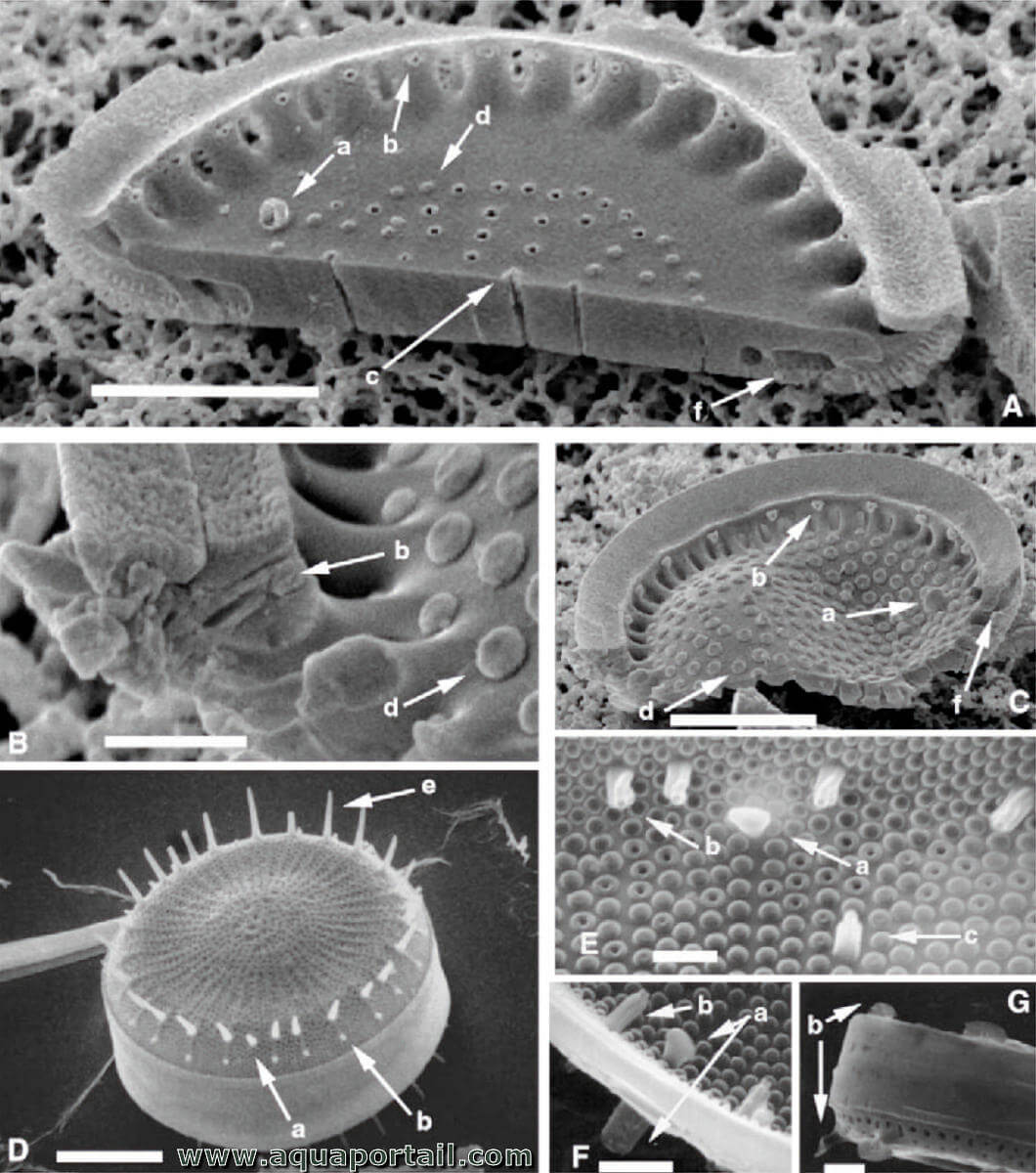
Main morphological structures in centric diatoms, showing frustules in D and G. A frustule is the siliceous portion of a diatom cell wall.
Explanations
A frustule consists of two halves, each called a theca. Each theca comprises a valve and, in most taxa, its associated girdle band (cingulum). The larger epitheca overlaps the smaller hypotheca via a girdle system, much like the two halves of a pillbox or Petri dish.
In Latin, frustulus means a small piece. See also valve view and girdle view.
Development
Frustules of centric diatoms develop inside a silica deposition vesicle (SDV), apparently derived from the Golgi apparatus, similar to other diatoms. While valve morphogenesis varies in detail across groups, SDV development and subsequent silicification always proceed outward from a central pattern center. In most freshwater diatoms, silicification appears to initiate from a basal siliceous layer, though this remains unverified in many taxa. Most thoroughly studied centric diatoms possess at least one labiate process (rimoportula). The exact function of this near-universal morphological feature is not known with certainty, though it may serve as an anchoring site during valve morphogenesis and possibly participate in retrieving organic structures left outside newly formed valves.
In certain cnidarians, a detached tissue fragment that buds off from a colony is also termed a frustule; carried by water currents, it can settle and develop into a primary polyp and new colony upon encountering a suitable substrate.
Construction of new siliceous cell wall components takes place within silica deposition vesicles (SDVs) adjacent to the plasma membrane. Dissolved silicic acid is actively taken up from water and concentrated in the cytoplasm well above the threshold at which silica normally polymerizes. intracellular precipitation is prevented because silicic acid transport proteins bind silica and guide it through the cytoplasm into the SDV. Additional classes of peptides—including silaffins, silacidins, and long-chain polyamines—are synthesized in the endoplasmic reticulum, trafficked in vesicles to the Golgi apparatus for modification and activation, and delivered to the SDV, where they form an organic matrix upon which supersaturated silica precipitates in amorphous form.
During vegetative cell division, new thecae are deposited so that the cell remains completely enclosed by siliceous wall elements throughout division. Newly formed thecae must therefore assemble within the confines of the parent thecae. The daughter cell inheriting the parental epitheca (the larger half of the frustule) synthesizes a new hypotheca of the same size as the parent's, retaining the original cell dimensions.
Conversely, the daughter cell inheriting the parental hypotheca (the smaller half of the frustule) uses it as an epitheca inside which a new, smaller hypotheca forms; consequently, this daughter cell is slightly smaller than its parent. As a result, mean cell diameter progressively decreases with ongoing mitotic divisions (the MacDonald–Pfitzer rule), and the sole escape from this continuous miniaturization is sexual reproduction.
The new frustule elements of the resulting vegetative cell are formed inside the wall of the auxospore, and once complete, the full-sized cell emerges from the auxospore.
Composition
The diatom frustule is composed of two overlapping thecae (the larger epitheca and smaller hypotheca), each consisting of a valve and a series of girdle bands (valvocopula and copulae). These frustule elements bear rows of pores, called interstriae, separated by solid silica ribs called striae. Pores within the interstriae serve as the primary conduits for nutrient uptake and metabolite exudation. Girdle bands are architecturally simple and always single-layered, whereas valves are more elaborate, featuring a flat central region (the valve face) and a downturned rim (the mantle).
Valves may be single-layered (laminar) or double-layered (loculate). In double-layered valves, the inner layer has larger pores and both layers are linked by perpendicular cross-walls arranged in a rectangular or honeycomb pattern, forming chambered valves.
Characteristics of diatoms
Perhaps the defining trait separating diatoms from most other physiological groups of algae is their obligate requirement for silicon to complete cell division and frustule formation.
This requirement is particularly stringent for euplanktonic species, which spend most of their lives far from concentrated silicon sources such as bottom sediments. In lakes with long water residence times, dissolved silicon can become depleted by diatom growth and subsequent sinking of frustules into sediments, giving a selective advantage to algal groups that do not require silicon.
Silicon limitation also strongly shapes seasonal diatom succession, favoring species that thrive during cold-season mixing in temperate and boreal lakes while reducing or eliminating those adapted to summer growth in the epilimnion or deep chlorophyll maximum. Because silicon so frequently limits planktonic diatom growth, many planktonic species have evolved remarkable morphological plasticity, producing heavily silicified frustules when silicon is abundant and markedly thinner cell walls when silicon becomes scarce.
In general, species capable of thriving in naturally or artificially eutrophic habitats display high morphological plasticity, whereas species inhabiting oligotrophic waters tend to be less morphologically plastic and more heavily silicified.
Hypovalve
The hypovalve is the lower valve of a diatom frustule. If the frustule is compared to a box and its lid, the hypovalve is the box. The lower half of a diatom frustule consists of the hypovalve and the hypocingulum, while the upper half is called the epivalve.
The epivalve and hypovalve of a diatom frustule:
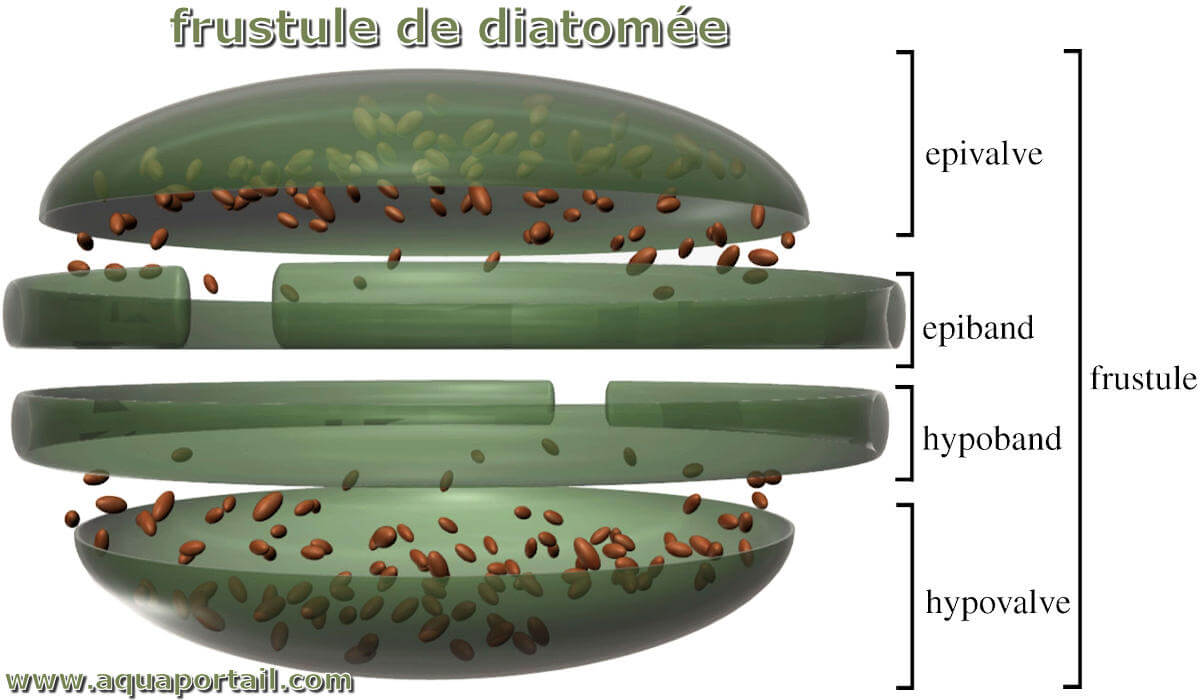
Exploded side-view diagram of the frustule of Coscinodiscus granii showing its indivisible components: two valves and two girdle bands. In this species, each girdle band is associated with a larger valve (epivalve) and a smaller valve (hypovalve). The chloroplasts, shown in brown due to their distinctive light-absorption properties, form components of a complex optical system in living cells.
The siliceous covering of a diatom cell consists of two valves—an epivalve (top) and a hypovalve (bottom)—together with their associated cingulum elements. Hypovalve and epivalve form the two halves of the shell in a diatom (and by analogy in the theca of certain dinoflagellates).
By extension, hypovalve also refers to the lower (hypothecal) half of a dinoflagellate theca, whereas epivalve refers to the upper (epithecal) half.
Epivalve
The epivalve is the upper valve of a diatom frustule. If the frustule is compared to a box with its lid, the epivalve is the lid, corresponding to the apical (upper) valve of a diatom that complements the hypovalve to form the complete frustule.
By extension, epivalve also denotes the apical (upper) half of the theca in certain dinoflagellates.
The diatom frustule is frequently likened to a pillbox or Petri dish with an epivalve (or epitheca, upper part) and a hypovalve (hypotheca, lower part). The vertical rim or margin of the epitheca is called the epicingulum, which overlaps the hypocingulum of the hypotheca.
Generally, the epivalve is the larger of the two overlapping valves in diatoms.
Synonyms, antonyms
Spanish translation: frústulo
1 synonym (similar meaning) for "frustule":
0 antonyms (opposite meaning).
Related words and expressions to FRUSTULE are directly connected by general or specific meaning.
The word FRUSTULE is listed on page 1 of words starting with F in the dictionary glossary.
Related to "frustule"
diatomite
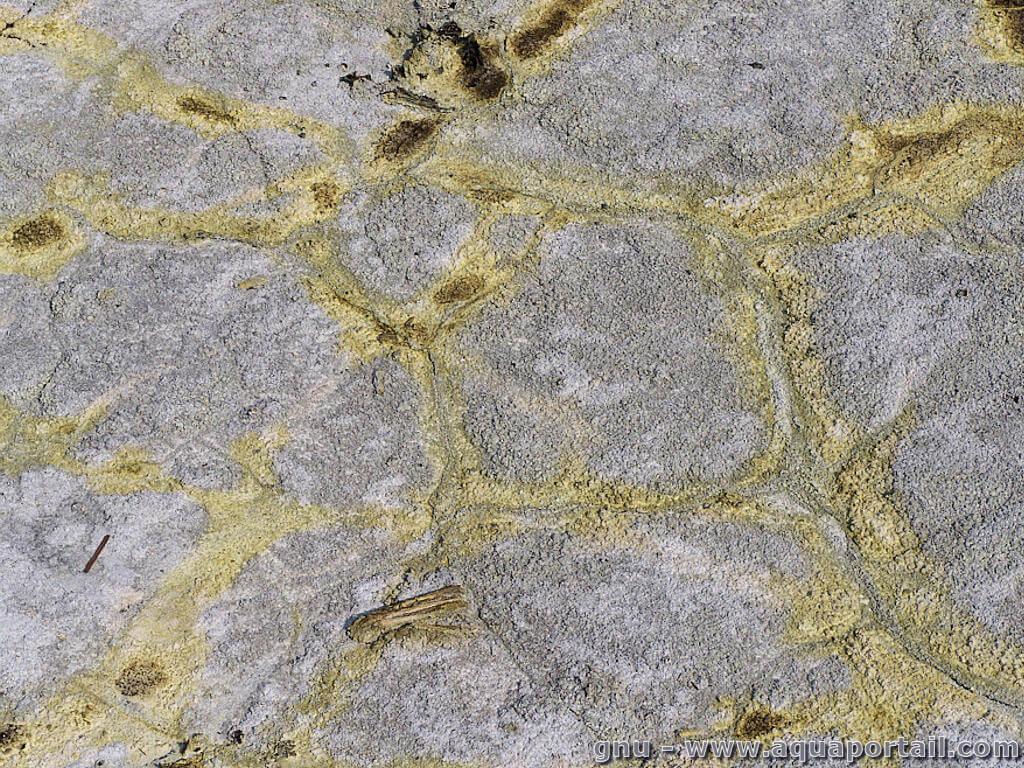
Diatomite is a siliceous sediment resulting from the accumulation of fossil diatom frustules.
epitheca

In biology, an epitheca is the outer part of a theca. The epitheca refers to the external covering of the theca, an outer calcareous layer investing the lower...
theca

In botany, a theca is either of the two halves into which an anther is typically divided. Normally, each theca contains two pollen sacs. More generally...
fabrication
Fabrication is the act or process of making, constructing, or inventing something. The manufacturing or fabrication process, whether artisanal or industrial...
Simple summary
A frustule is the specific name for the rigid, porous cell wall composed of silica that encloses a diatom (within the Stramenopiles). This siliceous shell persists in diatomite, a fossilized powdery sediment formed from the remains of dead diatoms.
