Axon
noun (n.)
Definition
An axon is the long filament, which can reach several tens of centimeters in length, of a neuron's nerve fiber that conducts nerve impulses. It is located at one end of the cell body and extends toward synaptic terminals, which are sites for the storage and release of neurotransmitters.
The axon of a neuron:

Axons, specialized cylindrical extensions of neurons, enable the transmission of electrical and chemical signals to other neurons. Neurons receive these signals via their dendrites, root-like structures. They conduct nerve impulses from the cell body (soma) toward another cell. The axon originates from the neuron's soma at the axon hillock.
Explanations
An axon (neurite or axis cylinder) is a fibrous extension of the neuron that transmits nerve signals from that neuron to other cells. The axon conducts nerve impulses along its own extension, which is very long (up to 1 m / 3.3 ft) and emerges from the neuron's cell body. Its tip divides into branches, forming the neuromuscular junction of a fiber.
The axon connects to other neurons through a specialized structure: the synapse. It transmits messages in the form of electrical signals and is surrounded and protected from its immediate surroundings by the axolemma. Thus, this single cytoplasmic extension of neurons conducts nerve impulses from the cell body to the synaptic boutons.
Structure
The axon is a long, slender extension of neurons that arises from a specialized region called the axon hillock, from the soma, or sometimes from a dendrite. The axon has a conical shape that tapers toward the periphery. Along its surface, periodic circular constrictions called nodes of Ranvier are observed. The cell membrane of the axon is called the axolemma.
The axoplasm is the cytoplasm contained within the axon and the axon hillock. It is a viscous fluid containing neurotubules, neurofilaments, mitochondria, granules, and vesicles, differing from the cytoplasm of the soma and proximal dendrites because it lacks rough endoplasmic reticulum, free ribosomes, and the Golgi apparatus.
Axons may or may not be covered by a sheath, called the myelin sheath. In the peripheral nervous system, axons are always associated with Schwann cells, which wrap around the axon with a multilayered covering formed from their plasma membrane to constitute the myelin sheath. Neurons in the peripheral nervous system that are not surrounded by a myelin sheath are embedded within Schwann cells, forming Remak bundles. In the central nervous system, myelinated axons are covered by oligodendrocytes, glial cells that form the myelin sheath (Schwann cells being specific to the peripheral nervous system).
Most neuronal axons measure no more than a few millimeters in length, whereas those extending from the spinal cord to the feet can reach up to one meter (3.3 ft) in length.
Functions
The functions of the axon are the transport of organelles and substances, and the conduction of nerve impulses. The transport of organelles, enzymes, macromolecules, and metabolites is a function of the axoplasm in which microtubules are directly involved. Axoplasmic transport is necessary for maintaining the axon and its associated cells, and for allowing regulatory factors that govern its function to reach the perikaryon.
Axons make up nerve fibers as the long efferent branch that transmits action potentials, either excitatory or inhibitory, through one or more synapses. Axons can also receive inputs via axoaxonic synapses formed between two axons, although axonal output functions predominate.
Nerve impulse conduction is the propagation of the action potential generated by changes in ion permeability along the axolemma (axonal membrane) of nerve fibers, assisted by the supporting cells that surround the axon like a sheath.
In the central nervous system, axons are surrounded by myelin from oligodendrocytes, whereas in the peripheral nervous system, they may be surrounded either by cytoplasmic extensions of Schwann cells (unmyelinated fibers) or by myelin sheaths formed by Schwann cells (myelinated nerve fibers of the peripheral nervous system).
Nerve impulses are transient waves of voltage reversal across the plasma membrane that originate at the site where the stimulus occurs. Each of these waves corresponds to an action potential.
In Greek history, the axon was a type of three- or four-sided pyramid rotating around a vertical axis.
Synonyms, antonyms
French translation:
axoneSpanish translation: axón
5 synonyms (similar meaning) for "axon":
- axis cylinder
- axonic process
- nerve fiber
- neuraxon
- neurite
0 antonyms (opposite meaning).
Related words and expressions to AXON are directly connected by general or specific meaning.
The word AXON is listed on page 1 of words starting with A in the dictionary glossary.
Related to "axon"
axoneme
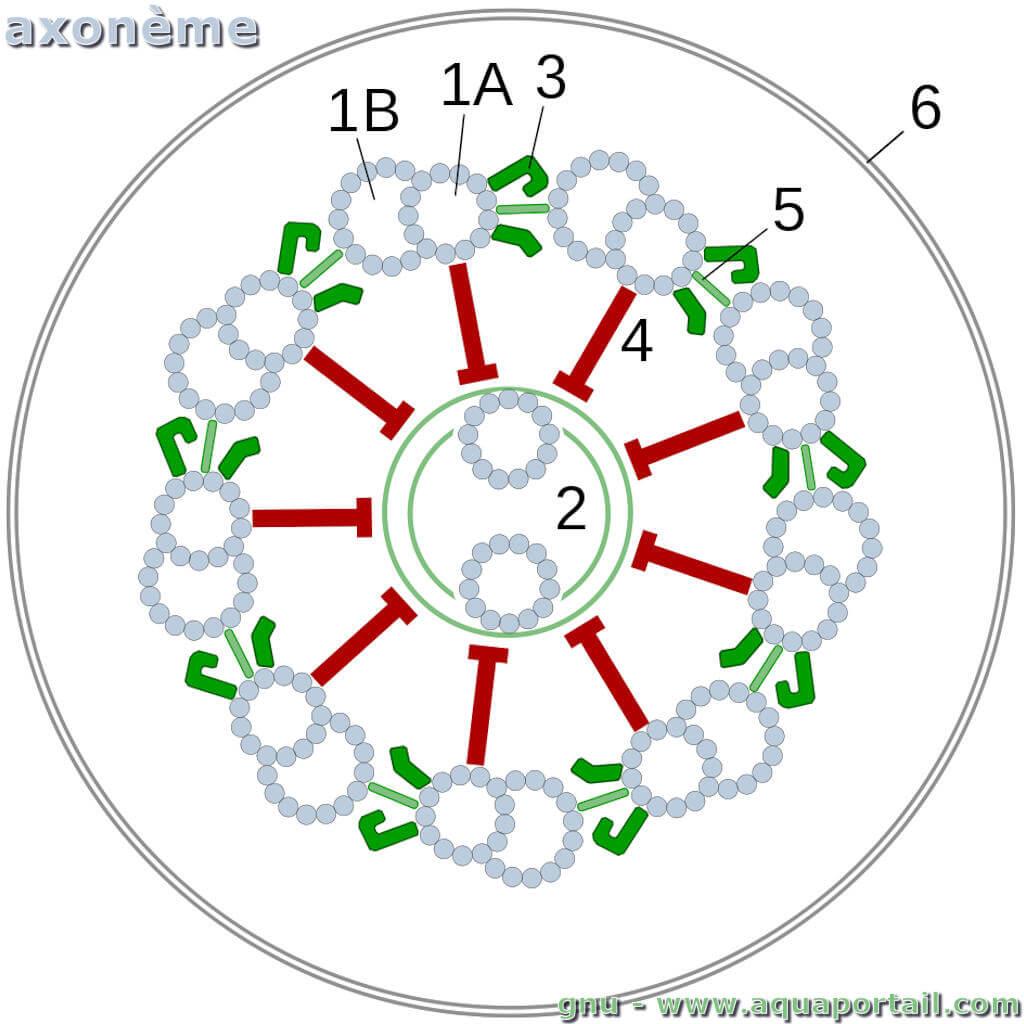
The axoneme is the axial structure of eukaryotic cilia and flagella, fundamentally microtubular, which is the essential element of motility.
lineage

A lineage consists of a group of living organisms (or genes) descending from a common ancestor.
taxon

In biology, a taxon is a taxonomic unit recognized by international codes within a given classification, or a systematic unit such as a family, genus...
abiotic

In biology and ecology, abiotic refers to what is not biotic, that is, not part of living beings.
Simple summary
An axon is a long, slender extension of a nerve cell, or neuron, that transmits electrical impulses from the neuronal cell body to other neurons, muscles, or glands. It enables communication within the nervous system by facilitating the transfer of information between different parts of the body.
