Excipient
noun (n.)
Definition
An excipient is a passive substance that serves as a vehicle or carrier for an active ingredient (active substance) in a generally medicinal mixture. Knowledge bases on excipients help optimize drug formulation and dosage.
A capsule with its active ingredient and excipient:
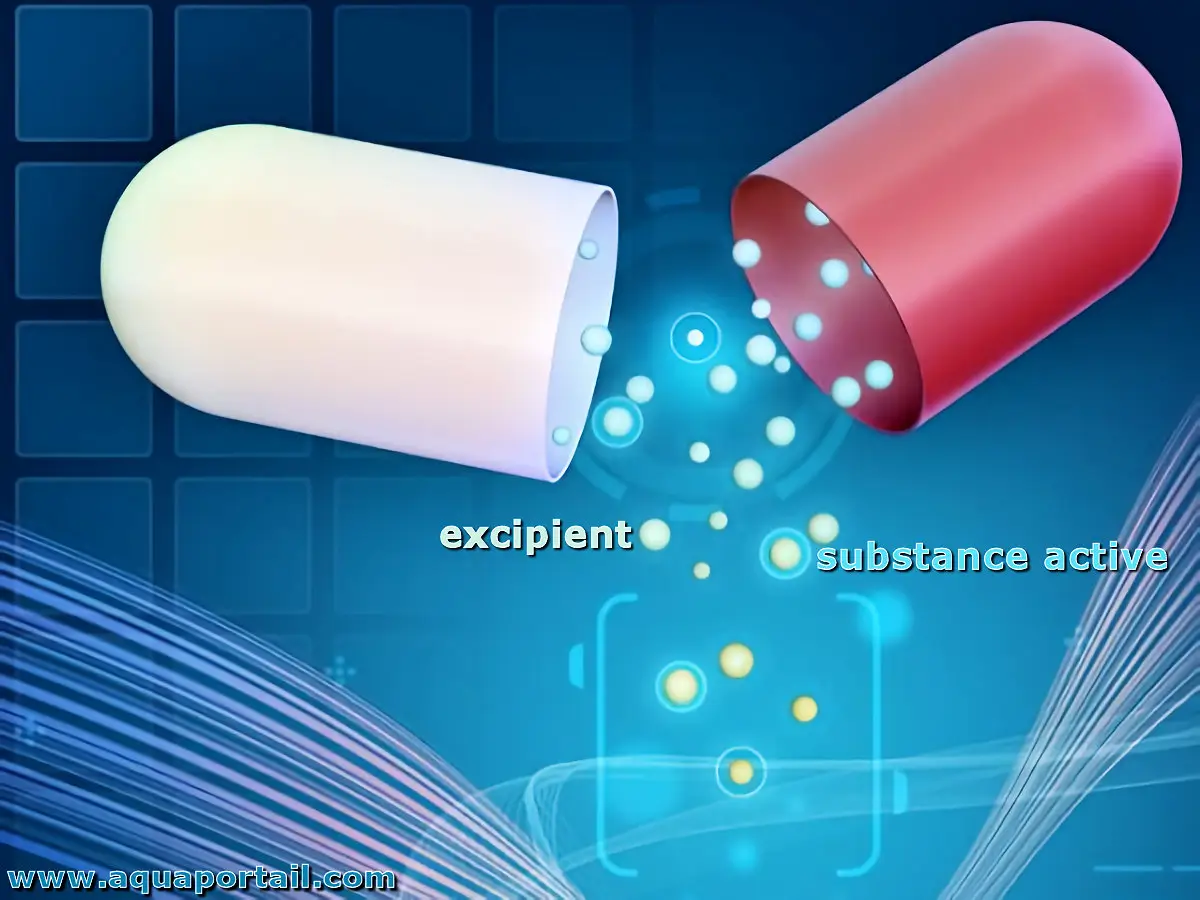
A capsule (or any other pharmaceutical compound) generally contains an active ingredient surrounded by an excipient. The hard-shell capsule itself is an excipient.
Explanations
A pharmaceutical excipient is a substance or group of substances that adds appropriate bulk and ensures content uniformity, serving as a vehicle and incorporating the active pharmaceutical ingredient into the formulation.
The International Pharmaceutical Excipients Council (IPEC) defines an excipient "as any substance other than the active drug or prodrug that is included in the manufacturing process or is contained in a finished pharmaceutical dosage form."
Excipients are substances other than active pharmaceutical ingredients contained in finished pharmaceutical dosage forms. Nearly all drug dosage forms include some type of excipient to ensure proper dosing, stability, and bioavailability.
Excipients range from simple, inert substances to complex, active ones that may be difficult to characterize. Traditionally, excipients were often structurally simple, biologically inert, and of natural origin, such as corn, wheat, sugar, and minerals. Many other novel and increasingly complex excipients have been developed as new drug delivery systems emerge and evolve.
The inert and harmless nature of excipients is no longer a given in pharmaceutical formulations.
The safety profiles of novel excipients must be systematically evaluated to detect potential risks in humans. Depending on available data and precedents, it may be necessary to experimentally assess genotoxicity, general toxicity, carcinogenicity, or other specialized toxicity parameters. Excipients must also be evaluated according to their source, quantity, purity, degradation profiles, and potential interactions with active ingredients and other components of the dosage form.
⭐ Excipients are found in many medications. In some cases, this is necessary because it would otherwise be impossible to formulate the active ingredient without them. Excipients can also be useful because added preservatives or other agents can enable a product to become commercially viable and marketable. The varied pharmaceutical function of certain excipients means that choices regarding their inclusion in a formulation must be made early in the product development process. While biologically inert, excipients often determine the functionality and performance of a medicinal product.
Risks
According to researchers, despite their importance in drug formulation, excipients are often overlooked as a potential source of pharmacokinetic interactions in co-formulated or co-administered medications. Thus, it is likely that their effects can reach clinical significance, potentially causing adverse effects or loss of efficacy. Collecting data helps identify knowledge gaps requiring further exploration and evidence.
Many excipients are potentially toxic at high doses in animals, although safe for humans at therapeutic doses, notably commonly used excipients such as cyclodextrins, dextrans, and polyethylene glycol.
Cyclodextrins (cycloamyloses) are macrocyclic oligosaccharides composed of α-(1,4)-linked glucopyranose subunits, featuring cage-like lipophilic internal cavities and hydrophilic outer surfaces. Cyclodextrins can solubilize and stabilize drugs by forming non-covalent inclusion complexes with various inorganic, organic, or organometallic molecules that are cationic, anionic, or neutral. Reversible toxicities in animals include elevated liver enzymes, decreased red blood cell parameters, epithelial vacuolation of renal proximal tubules and the urinary bladder, as well as accumulation of foamy macrophages in the lungs and Kupffer cells in the liver.
Dextrans are complex straight-chain (α-1,6 linkages) or branched (α-1,3 linkages) polysaccharide polymers composed of glucose molecules. Low-molecular-weight dextrans have been used clinically as antithrombotic (antiplatelet) anticoagulants and blood volume expanders. Dextran has proven relatively safe in clinical use, although anaphylaxis, volume overload, pulmonary and cerebral edema, platelet dysfunction, or acute kidney injury have been noted.
Polyethylene glycol (PEG) is an oligomer or polymer of ethylene oxide, synonymously known as polyethylene oxide or polyoxyethylene depending on molecular weight or mass. PEG may contain potentially toxic impurities such as ethylene oxide and 1,4-dioxane. PEG has been widely used as a laxative in medicine and as an excipient in pharmaceuticals. When conjugated to peptides or proteins, PEG induces vacuolation of renal tubular epithelial cells in animals at high doses.
Synonyms, antonyms
Spanish translation: excipiente
1 synonym (similar meaning) for "excipient":
0 antonyms (opposite meaning).
Related words and expressions to EXCIPIENT are directly connected by general or specific meaning.
The word EXCIPIENT is listed on page 1 of words starting with E in the dictionary glossary.
Related to "excipient"
E=mc2

The formula E=mc2 (E = m. c²) is a mass-energy equivalence equation according to the theory of relativity developed by Albert Einstein. It expresses that...
Ecdysozoa

Ecdysozoans, of the superphylum Ecdysozoa, are protostomes undergoing ecdysis within Bilateria.
echinoderm

An echinoderm belongs to a lineage of invertebrates, the phylum Echinodermata, found exclusively in the world's oceans : starfish, brittle stars, sea urchins...
eco-grazing

Eco-grazing is ecological grazing carried out with small ruminants on a meadow or green space in an urban environment.
