Bistort
noun and adjective (n. / adj.)
Definition
A bistort shape is defined by a double twist. In botany, plants are described as bistort when one of their parts exhibits a double knotting or adopts a sinusoidal shape, generally in the root system.
Bistort, the common bistort:

Common bistort is a perennial herbaceous plant belonging to the family Polygonaceae. Bistorta officinalis is so named because of its twice-twisted, highly knotted root system.
Explanations
Bistort is thus a Eurasian herbaceous plant bearing a flesh-colored flower spike and a twisted root that occasionally finds use in medicine.
A bistort root:
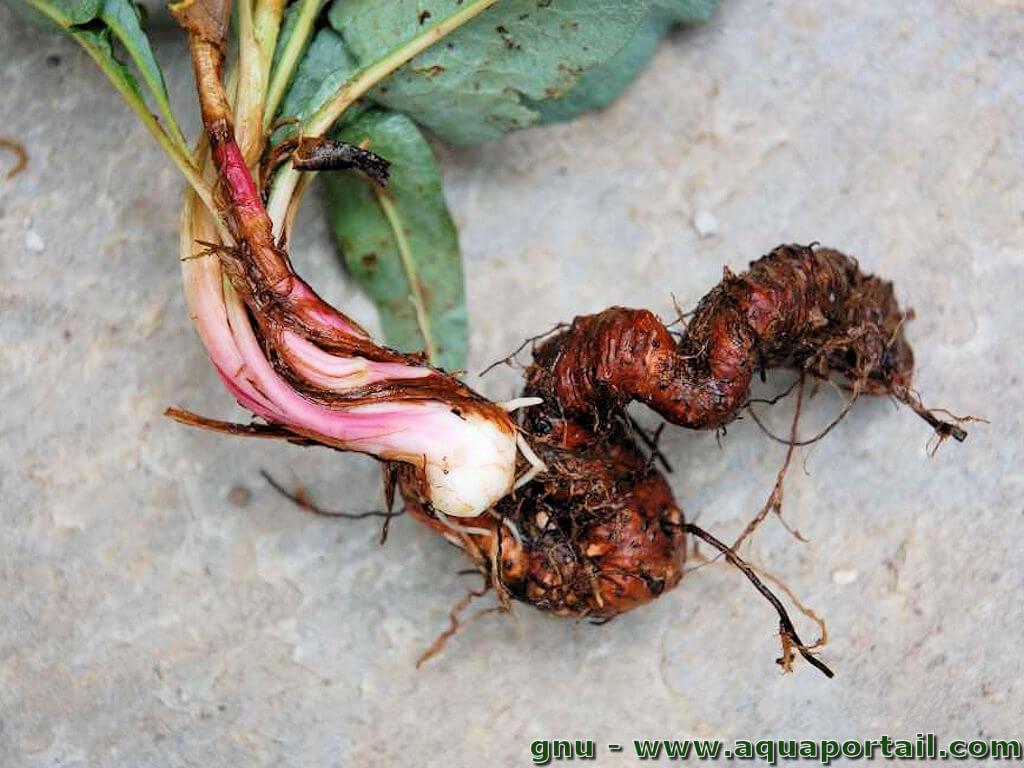
Common bistort has a sinuous, twice-twisted root.
Common bistort is a perennial plant. The root, underground stem (rhizome), and leaves are used to make medicine. Bistort is used for diarrhea, wound healing, and other conditions, though there is no strong scientific evidence to support these uses.
The origin of the word "bistort" dates to the early 16th century: from French bistorte or Medieval Latin bistorta, from bis "twice" + torta (feminine past participle of torquere = to twist).
Synonyms, antonyms
Spanish translation: bistorta
1 synonym (similar meaning) for "bistort":
0 antonyms (opposite meaning).
Related words and expressions to BISTORT are directly connected by general or specific meaning.
The word BISTORT is listed on page 1 of words starting with B in the dictionary glossary.
Related to "bistort"
echinoderm

An echinoderm belongs to a lineage of invertebrates, the phylum Echinodermata, found exclusively in the world's oceans : starfish, brittle stars, sea urchins...
node

In plants, a node is the point of attachment of a leaf on a stem that is swollen and somewhat articulated at that spot.
bacterial artificial chromosome

A bacterial artificial chromosome (BAC) is a DNA construct, based on a functional fertility plasmid or F-factor, used for transformation and bacterial cloning...
bacteriochlorophyll

A bacteriochlorophyll (BChl) is a pigment of photosynthetic eubacteria other than cyanobacteria, yet containing chlorophyll and able to carry...
