Sargassum
proper noun
Definition
Sargassum (gulfweed) is a yellow-brown alga of the genus Sargassum in the family Sargassaceae, very rich in yellow-brown pigments. Sargassum grows firmly attached to substrates, while certain species float freely in warm-temperate seas worldwide.
Sargassum washed ashore on a beach:
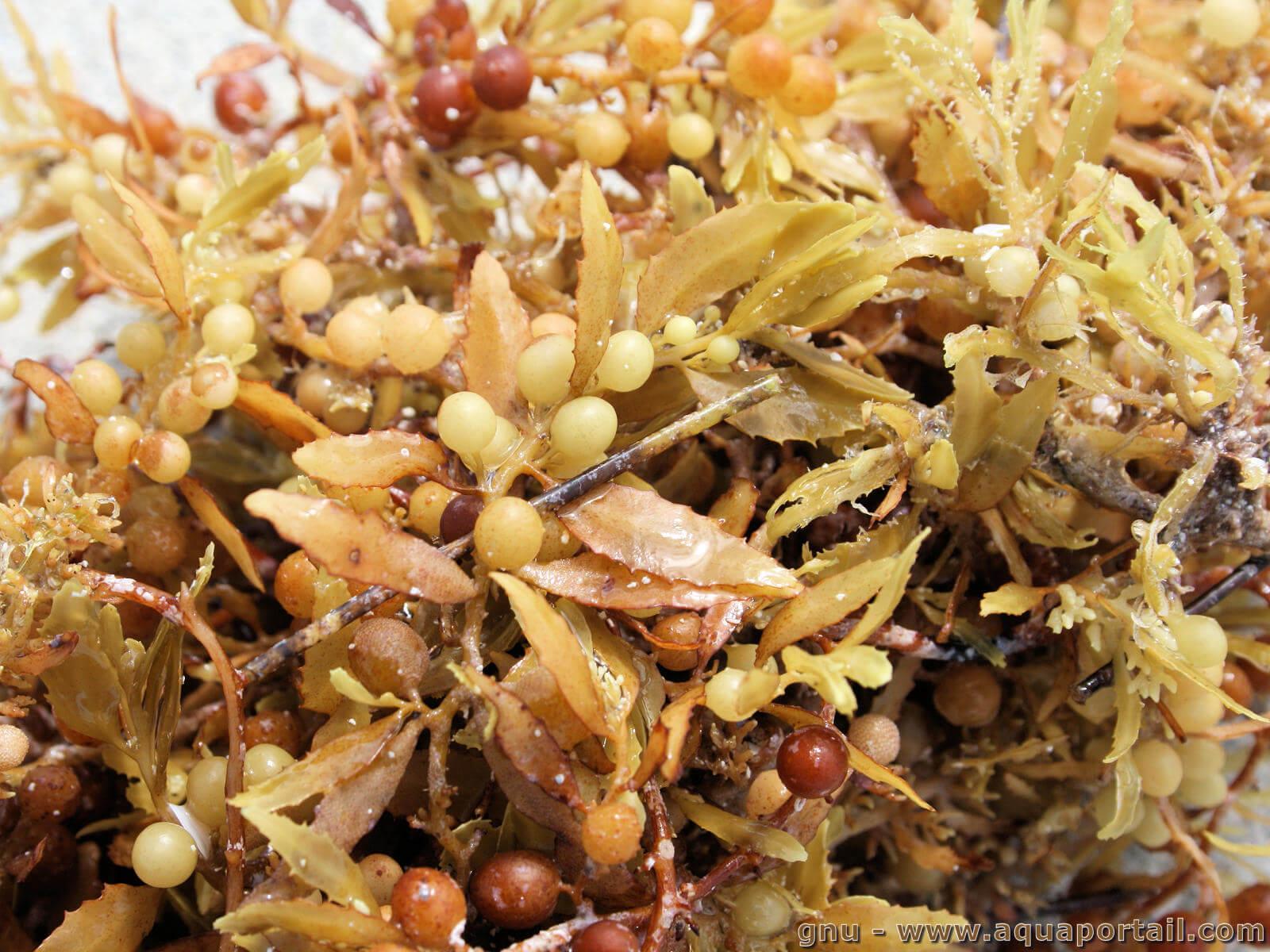
Some sargassum species have air bladders, or aerenchyma (a type of float offering buoyancy), that help them stay afloat. Pictured here is Sargassum fluitans, the floating gulfweed.
Explanations
The size of sargassum algae ranges from 10 centimeters (4 in) to over 2 meters (6.6 ft), rarely reaching up to 16 meters (52.5 ft) in length. From a disc-shaped or conical holdfast (rhizoid), one or a few round to flattened stems (cauloids) arise, measuring between 1 and 20 centimeters (0.4 to 8 in) long. These annually give off lateral shoots 10 cm (4 in) to about 2 meters (6.6 ft) in length, which shed at the end of the growing season. The primary branches are two-ranked or distichous on the cauloids, round or flattened, and branched in two or three ranks.
✅ Sargassum is also harvested and cleaned for use as an officinal herbal remedy. Many Chinese herbalists prescribe powdered Sargassum—either the species S. pallidum or, more rarely, S. fusiforme—in doses of 0.5 grams (0.018 oz), dissolved in hot water and drunk as a tea. It is called "hǎizǎo" in traditional Chinese medicine, where it is used to resolve "heat phlegm."
The lower (proximal) lateral branches may in turn be branched or unbranched and are often leaf-like (phyllodes), or at least flattened, and (1-)3–15(-25) mm (0.12–0.59 in) wide; when these "branches" are leaf-like (phylloids), they may be entire or serrated.
⭐ Species of this algal genus can reach lengths of several meters. Sargassum is generally brown or dark green in color and consists of a holdfast, a stipe, and a frond. The oogonia and antheridia are borne in conceptacles embedded within receptacles on specialized branches. Some free-floating species possess gas-filled bladders that help keep the fronds afloat to promote photosynthesis. Many have a rough, sticky texture which, combined with a sturdy yet flexible body, helps them withstand strong water currents.
Most species form swimming bladders (pneumatocysts, a type of aerenchymatous tissue), which may occupy the position of pinnules or sit in the axils of phylloids. These bladders are nearly spherical.
Sargassum may be monoecious or dioecious, with unisexual or hermaphroditic conceptacles formed in the axils of first- or second-order lateral branches. They generally grow in branched tufts, rarely singly. The conceptacle on its surface matures from the base upward, with the receptacle developing on top. spores (oospheres) may be round or flattened with a smooth, warty, or spiny surface.
The cauloids and their branches consist of a medulla of elongated cells (isodiametric at the center) surrounded by a plastid-bearing meristoderm. Lengthwise growth relies on a three-sided apical cell sunken into the shoot tip.
✅ Sargassum is distributed worldwide in tropical and warm seas. Most species settle benthically off coasts, though detached branches may occasionally drift out to sea in a pelagic mode. Along coastlines, they form underwater algal forests (sargassum beds), providing a specialized habitat for small crabs, worms, and other marine animals. A substantial portion of primary biomass production is thought to occur within these algal forests.
⭐ Dense stands of Sargassum provide an environment for a distinctive, specialized community of marine animals and plants, many of which are found nowhere else.
Two sargassum species: S. fluitans and S. natans:

Sargassum species including Sargassum fluitans (left) and Sargassum natans (right) are invasive drifting seaweeds.
The genus includes several hundred species (about 250), two of which are purely pelagic or planktonic (S. natans and S. fluitans); these float freely in surface waters, such as in the Sargasso Sea (Atlantic Ocean), whose name heralds the presence of yellow Sargassum algae. Their propagation is strictly vegetative due to thallus fragmentation during the "off-season."
Drifting sargassum, which becomes an invasive nuisance when washing ashore on beaches, is concentrated mainly in the Caribbean (Caribbean Sea in the western Atlantic Ocean) and the western Pacific Ocean (Philippines).
⭐ Tropical species of Sargassum are often preferentially grazed by herbivorous fishes and echinoids, as they contain relatively low levels of phenols and tannins.
Synonyms, antonyms
Spanish translation: sargazo
1 synonym (similar meaning) for "sargassum":
0 antonyms (opposite meaning).
Related words and expressions to SARGASSUM are directly connected by general or specific meaning.
The word SARGASSUM is listed on page 1 of words starting with S in the dictionary glossary.
Related to "Sargassum"
frond

In botany, a frond is the upright part of the vegetative apparatus of an alga or a fern. This leaf-like structure is generally flattened and spread out.
saccharide

A saccharide is a carbohydrate, a biomolecule composed of carbon, hydrogen, and oxygen atoms, usually with a hydrogen-to-oxygen atomic ratio of 2 :1.
sagittocyst

A sagittocyst is a capsule containing a spindle-shaped needle produced by epidermal cells of certain flatworms (acoels).
salinity

Salinity is the measure of dissolved salts in water. It takes into account all salts, and not only sodium chloride (table salt NaCl). The average salinity...
