Base
noun (n.)
Definition
A base is a substance, a chemical compound, that can accept hydrogen ions (protons) or, more generally, donate a pair of valence electrons. A base exhibits alkaline properties, being any substance capable of supplying OH- ions to a medium.
In chemistry, a base, or an alkali, is a chemical compound containing a hydroxyl group OH (a specific association of oxygen and hydrogen atoms appearing to move as a single unit in certain reactions) that dissociates in aqueous solution to yield negatively charged hydroxide ions OH-. basic (or alkaline) solutions have a characteristic brackish taste, such as sodium hydroxide NaOH.
Marseille soap is a base:
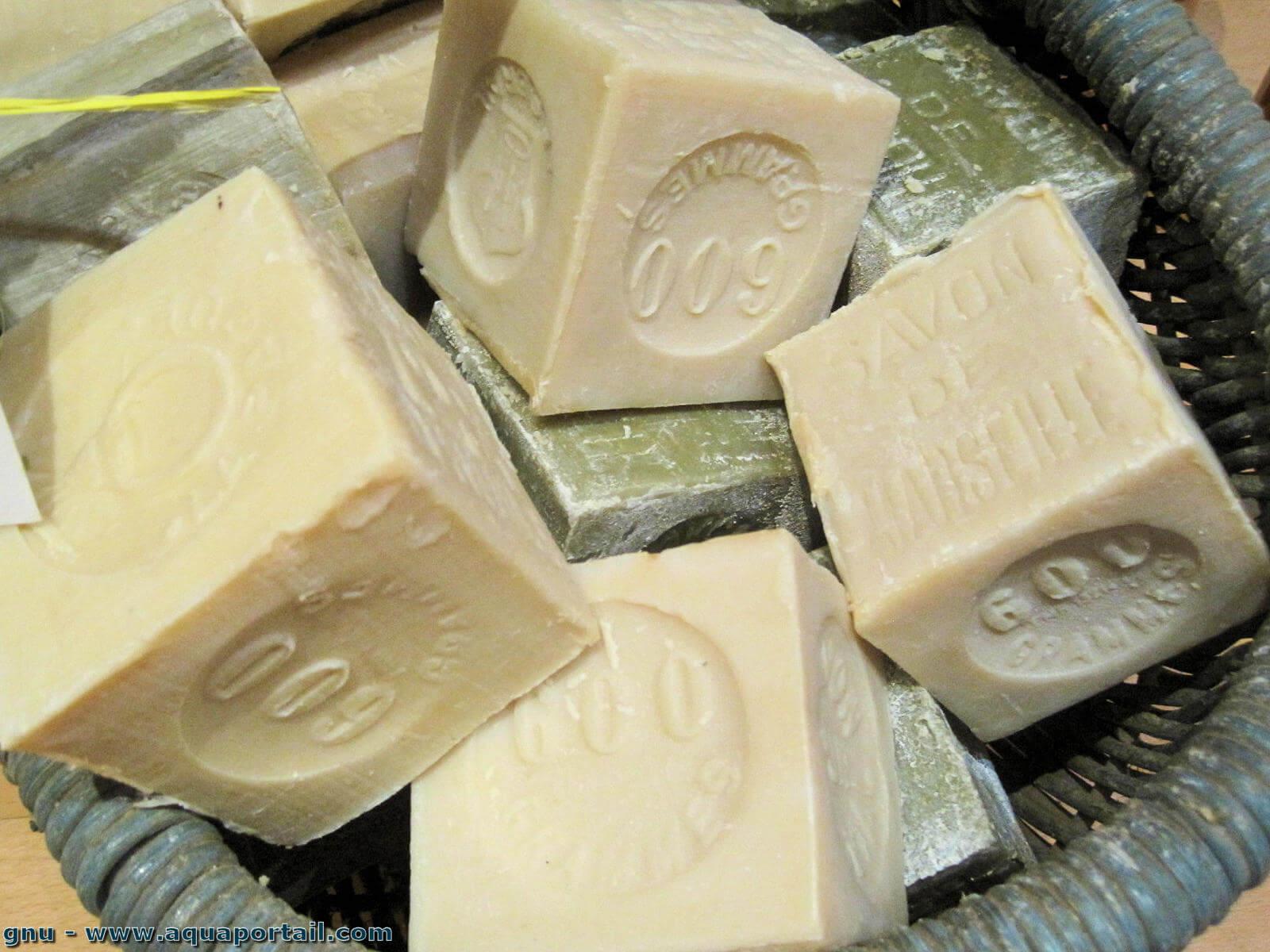
Soap is a base, notably Marseille soap, which is a traditional soap made from vegetable oils manufactured in the Marseille region of France. Marseille soap is a type of soap particularly effective for cleaning precisely because it contains bases (in the chemical sense), used primarily for human body hygiene.
Explanations
The concepts of base and acid are opposite. To measure the basicity (or alkalinity) of an aqueous medium, the concept of pOH is used, which is complemented by pH such that pH + pOH = pKw = 14 under STP, where Kw equals 10-14. For this reason, the use of pH (potential of Hydrogen) for both acids and bases is widespread.
The initial definition of a base corresponds to that formulated in 1887 by Svante August Arrhenius. However, the Brønsted-Lowry acid-base theory, formulated by Brønsted and Lowry in 1923, states that a base is a substance capable of accepting a proton (H+). This definition encompasses the previous one: in the earlier example, KOH dissociated in solution yields OH- ions that act as a base to accept a proton. This theory can also be applied in non-aqueous solvents.
Lewis in 1923 further broadened the definition of acids and bases, although this theory had no impact until years later. According to Lewis theory, a base is a substance that can donate a pair of electrons. The OH- ion, like other ions or molecules such as NH3, H2O, etc., has a lone pair of electrons and therefore acts as a base. All bases under Arrhenius theory or Brønsted-Lowry theory are Lewis bases.
Characteristics
According to Boyle, bases are substances that have the following properties:
- they have a characteristic bitter taste
- their solutions conduct electric current
- they turn red litmus paper blue (pH indicator)
- most are irritating to the skin (caustic) because they dissolve skin fats. They are destructive to human tissues to varying degrees. Dusts, mists, and vapors cause irritation of the respiratory tract, skin, and eyes, as well as damage to the nasal septum
- they feel soapy or slippery
- they are soluble in water (particularly hydroxides)
- they react with acids to form salts and water
- a strong base is one that dissociates completely in water, meaning it supplies the maximum number of OH- ions.
To name a base using different nomenclatures, one takes the names of the elements and joins them with a hydroxyl ion (OH), taking the valence number of the element and combining them (by swapping their positions); for example, copper(I) hydroxide is CuOH whereas copper(II) dihydroxide is Cu(OH)2.
A whole terminology exists around the term base, of which here are a few examples:
- a nitrogenous base
- a base pair (in genetics with DNA)
- base strength.
Synonyms, antonyms
Spanish translation: base
1 synonym (similar meaning) for "base":
1 antonym (opposite meaning):
Related words and expressions to BASE are directly connected by general or specific meaning.
The word BASE is listed on page 1 of words starting with B in the dictionary glossary.
Related to "base"
back-and-forth motion

A back-and-forth motion is a repeated reciprocating movement from one point to another. Moving back and forth indicates displacement in one direction and then...
bacterial

A bacterial organism or feature relates to bacteria. In bacteriology, bacterial cultures are grown in Petri dishes, allowing the bacteriologist to study...
bacterial artificial chromosome

A bacterial artificial chromosome (BAC) is a DNA construct, based on a functional fertility plasmid or F-factor, used for transformation and bacterial cloning...
bacterial flagellum

A bacterial flagellum is a prokaryotic flagellum found in bacteria or monerans. It is essential for motility, adhesion, and colonization, and forms part...
