Thermocline
noun (n.)
Definition
A thermocline distinguishes an aquatic water layer, a cline whose temperature decreases rapidly with depth, altitude, or height. It is the part of a stratified body of water or atmospheric air layers in which the temperature gradient reaches a maximum.
In oceanology, thermoclines are dividing lines between water masses based on temperature. These thermal transition layers are characterized by an abrupt temperature change at the interface between a deep, cold water mass and a shallower, warmer water mass.
The oceanic thermocline:
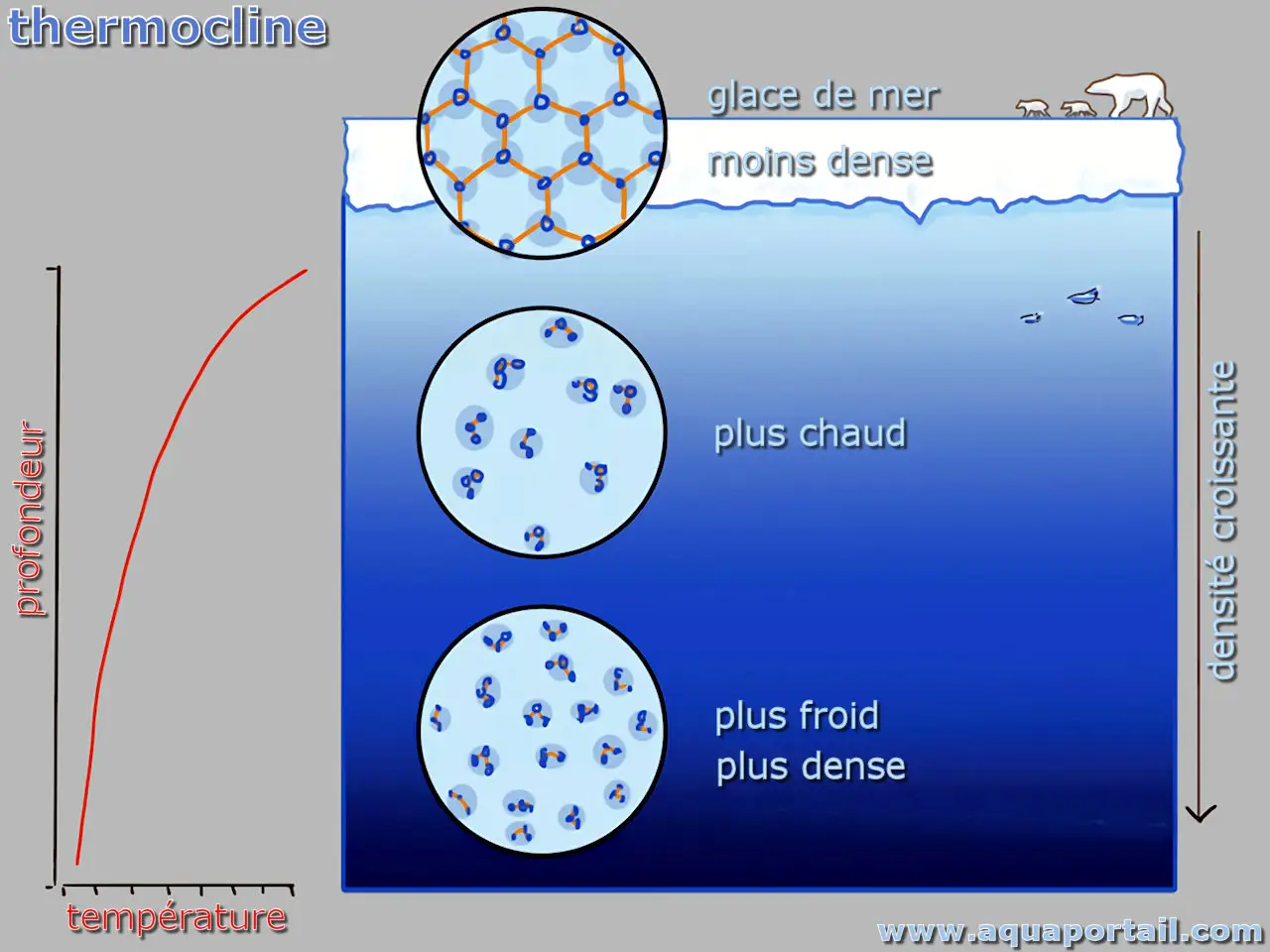
The thermocline is a distinct layer within a body of water, such as an ocean or a lake, characterized by a rapid change in temperature with depth. This layer separates warmer, well-mixed surface waters from colder, deeper waters. The formation of thermoclines is influenced by factors such as solar radiation, water density, and seasonal variations.
Explanations
A thermocline corresponds to a zone of a thermally stratified body of water (for example: sea, ocean, reservoir) located beneath the surface layer, where the temperature gradient increases abruptly, meaning that temperature decreases rapidly with increasing depth. A thermocline generally constitutes an ecological barrier, and its oscillations considerably influence the distribution and productivity of stocks.
The synonymous term used for a holomictic freshwater lake is metalimnion, the term thermocline being defined primarily for marine or atmospheric environments.
Oceanic thermocline
Since water is not perfectly transparent, most sunlight is absorbed by the surface layer, which warms up. wind and wave circulation move water within this layer, distributing heat throughout and making the temperature relatively uniform in the upper tens of meters. Below this mixed layer, the temperature drops very rapidly, sometimes by more than 20 °C (36 °F) over an additional depth of 150 m (492 ft).
This zone of rapid transition is the thermocline; below it, the temperature continues to drop, but much more gradually. In the oceans, 90% of the water lies below the thermocline. This deep ocean consists of layers of equal density that are poorly mixed and as cold as 0 to 3 °C (32 to 37.4 °F).
The thermocline varies with latitude and season: permanent in the tropics, variable in temperate climates (more pronounced in summer), and weak to nonexistent in polar regions, where the water column is just as cold at the surface as at the bottom.
In the open ocean, it is characterized by a negative sound velocity gradient, making the thermocline important in submarine warfare, as it can produce reflections in active sonar.
When diving, a thermocline of a few degrees Celsius gives the impression of being between two bodies of water. It gives the water an opaque, glassy appearance, caused by the altered refraction of the cold or warm water column; this same refraction can be observed when hot air rises from black asphalt on roads in desert areas, causing mirages.
Other bodies of water
Thermoclines can also be observed in relatively shallow lakes. In colder climates, this promotes the phenomenon called "turnover". Indeed, in summer, warmer, less dense waters sit above colder, denser waters that sink to the bottom, with a thermocline separating them.
Because the warm water is also exposed to sunlight during the day, the system is stable and there is very little mixing between cold and warm water. One result of this stability is that in summer, there is less and less oxygen below the thermocline, as water beneath the thermocline never recirculates to the surface.
Stratification of a thermocline:
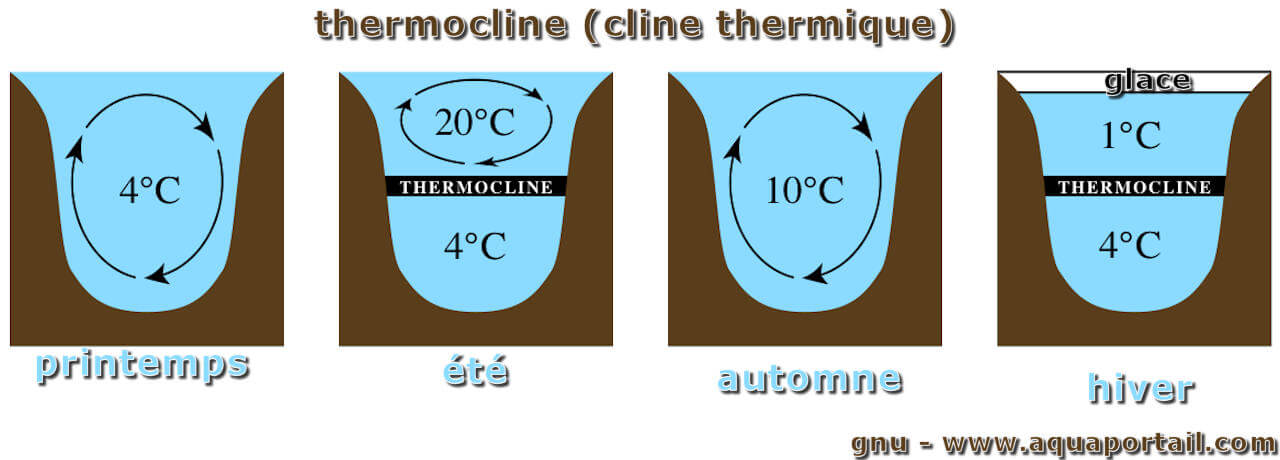
The thermocline of a body of water (in freshwater with a lake) varies according to the seasons: it is distinctly present in summer and winter, but may be absent in spring and autumn.
As winter approaches, the surface water temperature drops to 4 °C (39.2 °F), the temperature at which water is densest. 4 °C (39.2 °F) is generally the water temperature below the thermocline. When the entire water mass reaches 4 °C (39.2 °F), fall turnover begins: the thermocline disappears (or, put another way, reaches the surface) and bottom lake water can mix freely with surface water.
This process is facilitated by wind or any other process agitating the water. This effect also occurs in Arctic and Antarctic waters, enriching the surface with nutrients and producing algal phytoplankton blooms, making these ecosystems very rich in biodiversity.
As the temperature continues to drop in these locations, surface waters begin to freeze and the lake slowly becomes covered with a layer of ice. A new thermocline develops where the densest water (at 4 °C / 39.2 °F) sinks to the bottom and the least dense water (approaching the freezing point) remains at the surface. A new stratification is thus established, at least until the water warms enough to initiate "spring turnover", which occurs after the ice melts and the surface water reaches a temperature of 4 °C (39.2 °F).
Waves can exist within the thermocline, causing it to deepen when measured at a fixed oscillation point (typically in the form of a seiche). Alternatively, internal waves can be induced by flow over a rising bottom, producing a thermocline wave that is stationary over time, but whose depth varies when moving with or against the flow.
Atmospheric thermocline
The formation of a thermal profile is a very common phenomenon, particularly in the lower atmosphere, due to the diurnal effects of the solar heating-cooling cycle. For example, at noon, solar insolation is intense and Earth's surface temperature is generally higher than that of the air above.
This circumstance leads to the production of thermally stratified air layers, where the highest temperature occurs near the ground. Conversely, on cooler nights, denser air generally settles near the ground, generating an opposite thermal profile.
This phenomenon was applied to the field of noise pollution studies in the 1960s, contributing to the design of urban highways and acoustic barriers (noise walls).
Synonyms, antonyms
Spanish translation: termoclina
1 synonym (similar meaning) for "thermocline":
0 antonyms (opposite meaning).
Related words and expressions to THERMOCLINE are directly connected by general or specific meaning.
The word THERMOCLINE is listed on page 1 of words starting with T in the dictionary glossary.
Related to "thermocline"
thermophile

A thermophile thrives at high temperatures, loving heat and growing at temperatures between 40 and 70°C (104 and 158°F).
thermal water
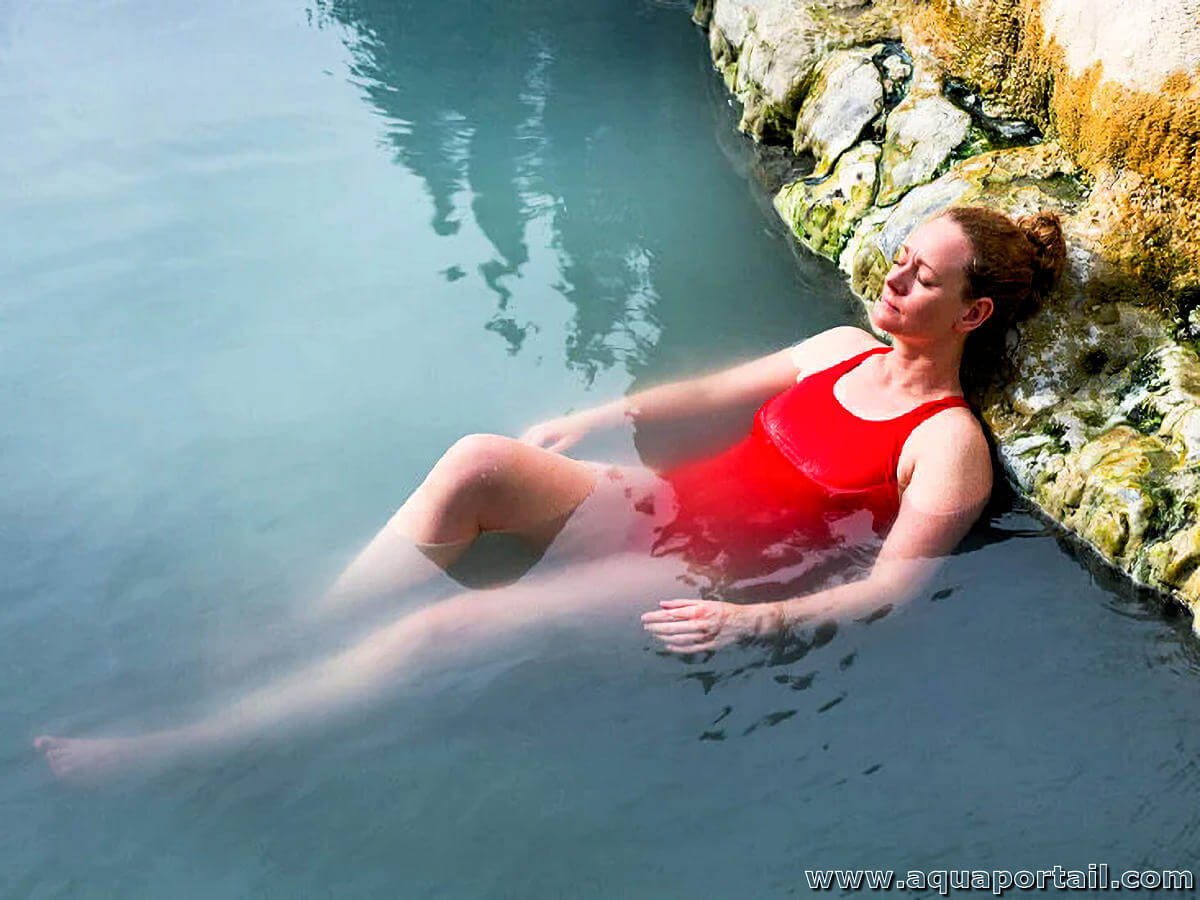
Thermal water is mineral water that naturally has an elevated temperature at its source, such as moderately warm groundwater (up to 50°C / 122°F).
thermie
The thermie (symbol th) is a heat energy unit equivalent to 1 million calories. One thermie equals 106 calories, 1 Mcal, 1,000 kcal, 4. 1868 MJ, or 3,968.
tagma

A tagma is a group of fused segments formed by series of metameres differentiated from the rest of an arthropod's body.
Simple summary
A thermocline refers to a distinct thermal layer within a body of water, such as an ocean or a lake, characterized by a rapid change in temperature with depth. This transition layer acts as a barrier separating warmer surface waters from deeper, colder waters. The presence of a thermocline can significantly influence the thermal structure and dynamics of aquatic environments, affecting both nutrient distribution and the behavior of marine fauna.
