Proteome
noun (n.)
Definition
The cellular proteome is the entire set of proteins of a living organism, tissue, cell, or cellular compartment under precisely defined conditions and at a specific moment. It is the totality of proteins expressed in a particular cell under specific environmental conditions and developmental stages or cell cycle phases, such as exposure to hormonal stimulation.
The proteome in metabolism:
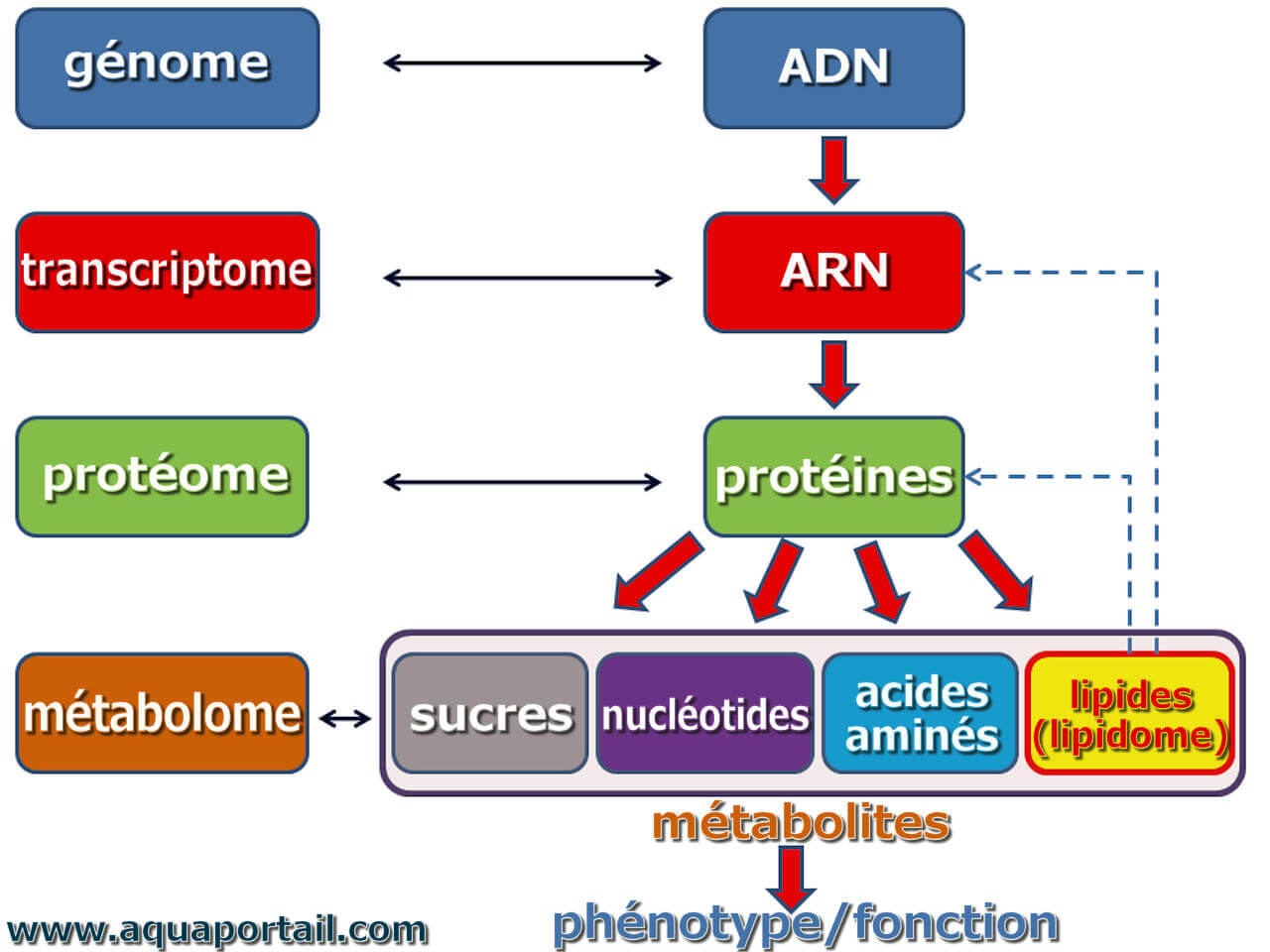
In this general diagram illustrating genome relationships, the proteome is associated with the transcriptome and metabolome (including the lipidome).
Explanations
The complete proteome of an organism can be conceptualized as the proteins from all varieties of cellular proteomes. It is roughly the protein equivalent of the genome.
The genome, transcriptome, proteome, and metabolome are all interconnected in the metabolism (interactome) of an organism (including a bacterium).
Study
✅ The term proteome was first coined in 1994 by Australian scientist Marc Wilkins, referring to the total number of proteins encoded by a genome (based on and analogous to the terms genome and transcriptome), and the definition has been applied at various scales across biological systems.
Proteomics is the study of the proteome, traditionally carried out using two-dimensional gel electrophoresis: in the first dimension, proteins are separated by isoelectric focusing, which separates proteins according to their electrical charge; in the second dimension, proteins are separated according to their molecular weight. The gel is stained with Coomassie blue or silver nitrate to visualize the proteins; spots on the gel represent proteins that have migrated to a specific location, enabling identification.
The proteome is in a constant state of new protein synthesis alongside simultaneous degradation of proteins that are no longer needed. Unlike the relatively static genome, the proteome is continually subject to changes in composition. These changes are controlled during spatiotemporal gene expression via complex regulatory processes and are heavily influenced by environmental stimuli, diseases, active substances, and drugs. The proteome is therefore a mirror of its environment and highly dynamic.
Steps
According to several scientists, studying the proteome can be summarized by completing 3 activities:
- identifying all proteins manufactured in a specific cell, tissue, or organism;
- determining how proteins form networks akin to electrical circuits inside bodies;
- determining the three-dimensional structures adopted by these proteins.
Studying the proteome through proteomic analysis is of major importance because it helps elucidate protein interactions within an organism. Knowing the proteome of organisms aids, for instance, in drug development through comparative studies of proteins present in a healthy organism versus a diseased one (such as in the case of melanoma).
Medicine
To develop such drugs, the following steps are carried out:
- performing electrophoresis on healthy tissue samples and comparing them with cancerous tissue samples; observing the abundant presence of a protein in a cancerous tissue gel;
- isolating said protein through a crystallization process;
- performing X-ray crystallography to determine its structure;
- once the protein structure is determined, designing a drug that acts at the active site of that protein.
The proteome can also be used to avoid drug side effects. Twenty-four anticancer drugs were examined, whose efficacy across 35 cancer cell lines was clearly linked to their protein profiles. Researchers hope that with knowledge of a tumor's protein profile, drugs can be used in a more targeted manner in the future.
Bacteria
⭐ In bacterial cells, the proteome comprises roughly 1,000 to 10,000 different types of protein molecules, depending on the species; in humans, 500,000 to 1,000,000 protein species are expected. A single protein-coding gene sequence can be synthesized via mRNA splicing (not in bacteria) and subsequent enzymatic modifications of the primary protein into up to several hundred protein species (modified forms). These post-translational modifications (occurring after protein synthesis) can be investigated using proteome analysis techniques.
Human proteome
In an initial comprehensive study, the proteome of seven human cell lines was examined and their intersection determined, forming the core proteome. This comprised 1,124 distinct proteins above the detection limit. The function of ten percent of these proteins was unknown at the time of publication. The metabolic components covered by the core proteome are protein biosynthesis, primary metabolism, the cell cycle, and apoptosis.
Humans are now known to possess approximately 20,350 putative protein-coding genes, including 8,874 housekeeping genes across all tissues, certain regulated genes across all tissues, and 6,942 tissue-specific genes. Roughly 80% of protein-coding genes also produce splice variants. By localization, there are about 3,171 genes (16%) for secreted proteins, 5,570 (27%) for membrane proteins, 12,467 (61%) for intracellular proteins, and 852 protein genes that have both membrane-bound and secreted isoforms.
So far, the question of which genes serve as the blueprint for which exact proteins and under what conditions they are read has not been fully resolved. The goal is to gain an in-depth understanding of the interaction among DNA, RNA, and proteins as the main molecular players of life.
Approximately 1,832 proteins have not been detected that, according to the gene map, should actually exist. It is hypothesized that a number of these proteins are present only during embryonic development, among other stages, and that many known genes have also become dysfunctional and no longer serve as templates for protein synthesis. According to current knowledge, the latter applies to olfactory receptors, among others, as the sense of smell is no longer indispensable for human survival.
On the other hand, nearly 200 proteins have been discovered whose function and properties remain unknown and which are not produced by known protein-coding genes, but rather by DNA regions outside those genes. These genomic regions, often referred to as "junk DNA," are thought to play a regulatory role in gene activity rather than encoding proteins of their own.
Synonyms, antonyms
Spanish translation: proteoma
1 synonym (similar meaning) for "proteome":
0 antonyms (opposite meaning).
Related words and expressions to PROTEOME are directly connected by general or specific meaning.
The word PROTEOME is listed on page 1 of words starting with P in the dictionary glossary.
Related to "proteome"
paedomorphosis

Paedomorphosis (juvenilization) is a phylogenetic change involving the retention of juvenile or even larval traits into a later (adult) stage.
pandemic

A pandemic is the widespread outbreak of an epidemic infectious disease across a vast geographic area at a given time.
parchment

Historically, true parchment is animal skin prepared (limed, dried, thinned, dressed) to write or print upon.
pasture

Pasture is agricultural land covered with grasses and herbaceous vegetation on which livestock graze.
