Ameboid
noun and adjective (n. / adj.)
Definition
An ameboid possesses the characteristics of an amoeba, such as radiolarians for example. In the case of amoebocytes, movement resembling that of an amoeba inside a mesoglea is termed ameboid or amoeboid. Amoeboid locomotion is called amoeboidism.
Ameboid describes cells that recall the characteristic movement of amoebae when they move: cytoplasmic extensions are projected through continual rearrangements of the cytoskeleton, particularly actin filaments.
The 2 types of ameboid movement:
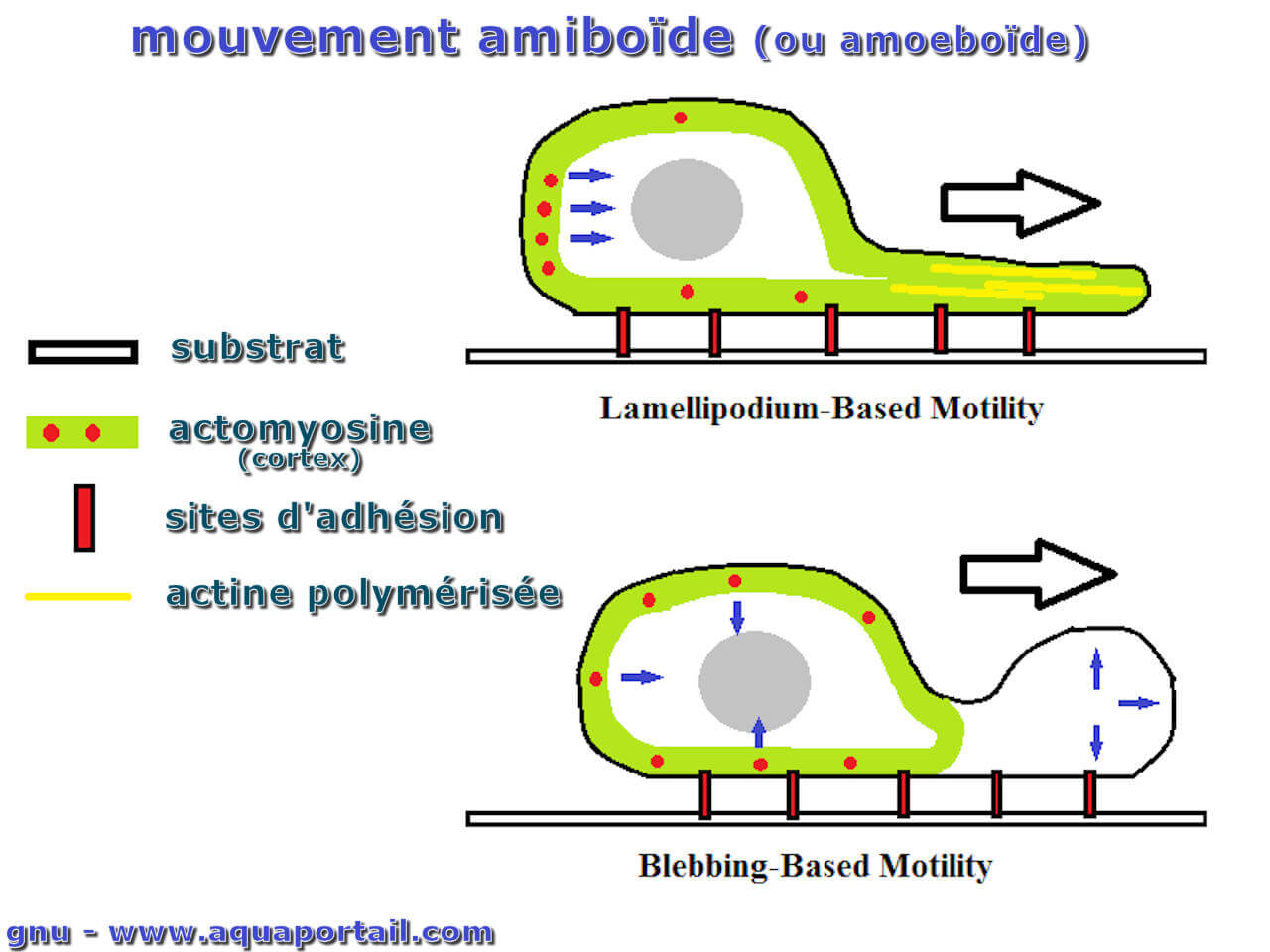
The two modes of ameboid movement, the locomotion of an amoeba and related organisms.
Explanations
The mechanism of ameboid locomotion proposes that actomyosin in the cell cortex contracts to increase hydrostatic pressure within the cell. The increased hydrostatic pressure causes the cell cortex to rupture in the desired direction of flow. During bleb-driven ameboid movement, the cytoplasmic sol-gel state is regulated.
Ameboid cell
Ameboid cells use a pseudopodium, or false foot, to move forward. They perform phagocytosis, which consists of eating or ingesting other cells. Examples of ameboid cells include our white blood cells that carry out phagocytosis, known as macrophages, and the cells of the middle layer of sponges.
An ameboid cell, such as a leukocyte, is capable of changing shape and moving like an amoeba. It is also called a wandering cell.
Ameboid movement is locomotion similar to that of amoebae (by deformation of pseudopodia). For example, white blood cells move by ameboid movement, and human germ cells migrate into the gonads in this way.
⭐ Sarcomas, or cancers arising from connective tissue cells, are particularly adept at ameboid movement, leading to their high rate of metastasis.
Amoeboidism
Amoeboidism is the ability of certain cells to move by means of ameboid movements, like amoebae. It is characterized by the extension of projections and pseudopodia whose shape changes constantly.
Movements similar to those of an amoeba indicate a condition sometimes present in certain nerve cells or leukocytes in which cell movements resemble those of an amoeba.
Ameboid movement
Ameboid movement is typical of amoebae and macrophages. This movement is due to the creation of a pseudopodium formed by a cytoplasmic flow extending in the direction of movement. In amoebae, this movement occurs only in contact with the substrate.
Cytoplasmic flow arises from:
- at the front, a transition from plasmasol to plasmagel through polymerization of actin subunits; the endoplasm moves along the sides of the pseudopodium and reforms the ectoplasm
- later, a transition from plasmagel to plasmasol occurs by splitting into single actin subunits, and the resulting endoplasm flows forward via contractile actomyosin force
Cell movements involving shape changes driven by cytoplasmic streaming are generally referred to as ameboid movements. The cytoplasmic streaming pattern of an ameboid cell consists of an axial flow moving continuously through a tubular body. While some amoebae are primarily monopodial, others extend numerous pseudopodia and are temporarily or permanently polypodial.
Pseudopodia shapes vary at the extremes from the sturdy, nearly cylindrical lobopodia of larger species to fine, straight filamentous filopodia, to the branched, anastomosing reticulopodia of foraminifera. Ameboid movement occurs in some form throughout the class Sarcodina in the orders Foraminiferida and Rhizomastigida.
Ameboid movement is a process of primary importance in the development of perhaps all multicellular organisms. The cytoplasm of amoebae contains a number of vacuoles. Clear vacuoles are most often observed in compressed, centrifuged, starved, injured, stained, or fixed cells. The nuclei of the largest multinucleate amoebae possess birefringent nuclear membranes.
Synonyms, antonyms
Spanish translation: ameboide
1 synonym (similar meaning) for "ameboid":
0 antonyms (opposite meaning).
Related words and expressions to AMEBOID are directly connected by general or specific meaning.
The word AMEBOID is listed on page 1 of words starting with A in the dictionary glossary.
Related to "ameboid"
amoeboid

What is amoeboid resembles an amoeba in appearance or characteristics. For example, amoeboid movement describes movements resembling those of amoebae that...
abiotic

In biology and ecology, abiotic refers to what is not biotic, that is, not part of living beings.
aboral

Aboral refers to what is situated away from or opposite the mouth in zoology, and especially in marine biology.
absence

Absence refers to non-presence at an expected location, or the complete non-existence of something.
