Amphibious
noun and adjective (n. / adj.)
Definition
An amphibious animal lives in dependence on water, for reasons other than thirst, while spending part of its life in a terrestrial environment. An amphibious plant has part of its organs submerged in water, generally at least the roots, while the aerial part remains out of the water.
Poison dart frogs, which are anurans, are amphibious animals :
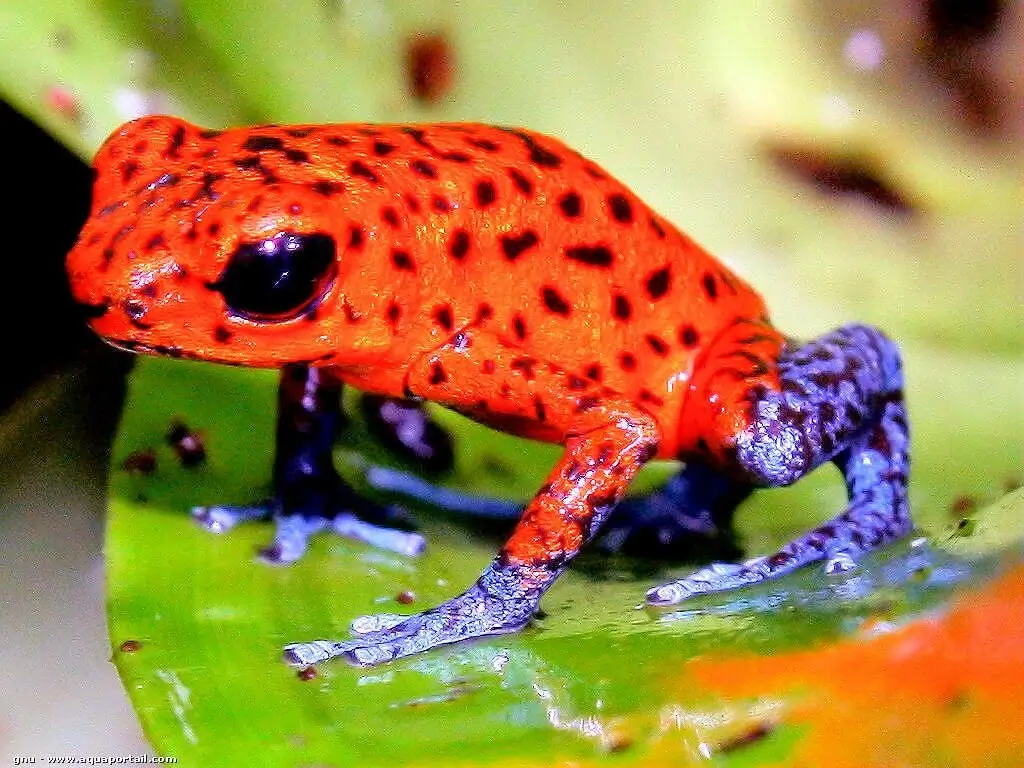
An amphibious animal such as an amphibian, anurans and urodeles, leads a semi-terrestrial, semi-aquatic lifestyle, including across stages of its life cycle. Tadpoles, the larval stage of amphibians, are strictly aquatic, whereas the adult stage is most often terrestrial: this dual lifestyle characterizes these animals as amphibious.
Explanations
An amphibious organism is a plant or animal capable of developing and living both on dry land and in water, thus able to live in air or in water. Any organism or object is described as amphibious if it can lead a dual submerged or emerged existence. The aquatic environment, whether freshwater or saltwater, must always be available nearby, even if the ecosystem is as small as a phytotelma (dendrotelma).
Amphibious animals
In zoology, an amphibious animal has the ability to live both on land and in water. This is the case for amphibians such as olms (urodeles of the family Proteids), which breathe both atmospheric air and oxygen from water through a dual lung-gill respiratory system. By extension, amphibians possess adaptive strategies for living in terrestrial or aquatic habitats.
Mammals and other animal groups such as seals, sea lions, harbor seals, hippopotamuses, crocodiles, beavers, otters, and coypus are amphibious animals, as are many reptiles and of course frogs, toads, newts, and salamanders. The amphibious centipede Scolopendra cataracta is an exceptional invertebrate in its genus. There are also numerous amphibious insects when distinguishing larval stages, often aquatic larvae, from adult stages. The dragonfly is a prime example, while the amphibious caterpillars of Hawaii (species discovered in 2010 and still undescribed as of 2017!) are the only insects that live just as readily underwater as on land.
Amphibious fish
An amphibious fish, a mudskipper:
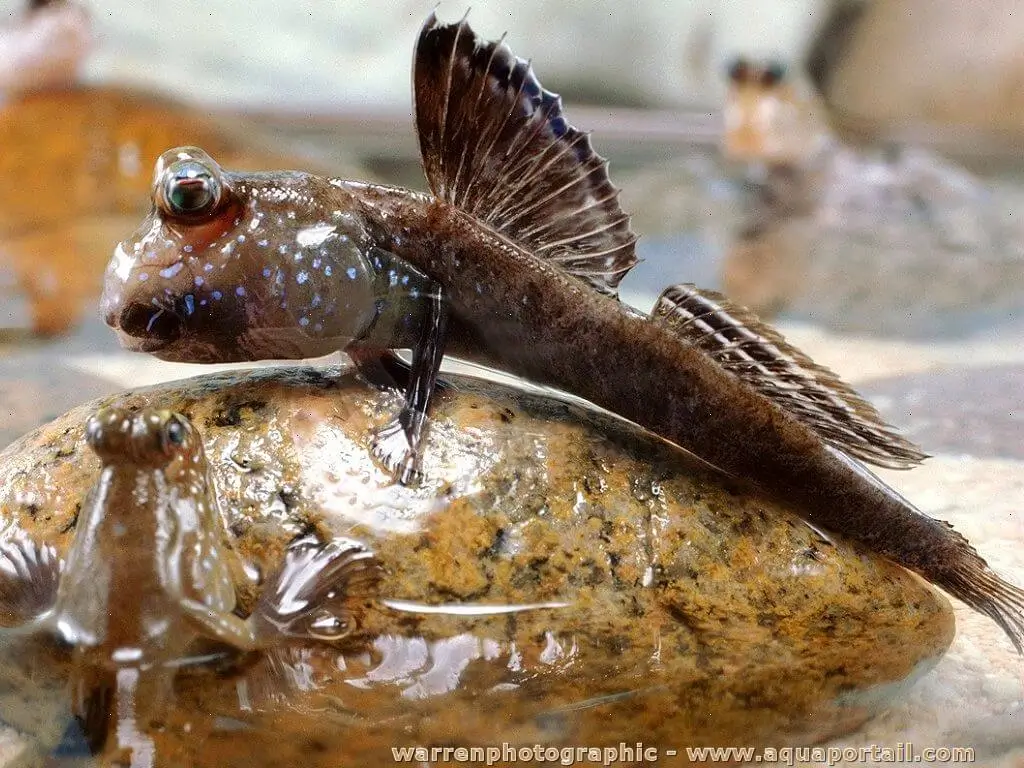
Many gobies and mudskippers are amphibious fish (here, the species Periophthalmus barbarus), capable of living underwater and on land, generally in brackish water.
Amphibious fish are able to leave the water for extended periods of time. Approximately 11 distantly related fish genera are considered amphibious. This suggests that many fish genera evolved independently, a process known as convergent evolution. These fish use various modes of terrestrial locomotion, such as lateral undulation, walking using paired fins and the tail, and jumping (as seen in "mudskippers"). Many of these locomotor modes incorporate multiple combinations of pectoral fin, pelvic fin, and tail movements.
Many ancient fish possessed lungs (the standard terrestrial respiratory organ), and a few, such as lungfish, still retain them. Some of these prehistoric fish are the ancestors of tetrapods. However, in most modern species, these organs evolved into a gas bladder, notably the swim bladder, which helps control buoyancy. Lacking pulmonary organs, modern amphibious fish and many other fish use dissolved oxygen from water via their gills, along with other methods such as modified gill chambers or their skin to breathe air. Amphibious fish may also have eyes adapted to allow them to see clearly in air despite the differing refractive densities between air and water. This is the case in certain eels and mudskippers. Labyrinth fish have developed a specialized organ, the labyrinth organ, to breathe equally well on land and in water, and this specific organ allows them to remain out of water for many hours.
Amphibious plants
The water smartweed Persicaria amphibium is an amphibious plant:

Many plants are amphibious, such as this Persicaria amphibium, having part submerged in water while another part rises above the surface into the air.
In botany, an amphibious plant refers to a helophyte, hygrophyte, or hydrophyte that exhibits both submerged and emerged organs. Amphibious plants can live in water like aquatic plants, yet also adapt to marshy or simply moist soil. These plants tolerate wide fluctuations in water levels.
Among the hundreds of amphibious plant species found along the edges of ponds, garden pools, rivers, streams, and other water bodies, water smartweed and water lobelia Lobelia dortmanna are highly valued in cultivation. Amphibious plants are often medicinal plants, proportionally more so than strictly terrestrial plants.
Among trees, willow and birch are two examples of large plants that thrive with their roots in water.
Amphibious technology
Amphibious vehicles are best known through the seaplane, an amphibious aircraft capable of landing on both water and land (as well as taking off). Certain amphibious technologies draw from biomimicry, such as a canoe or a raft (much as beavers use tree trunks).
For example, amphibious machinery is used for aquatic weed cutting and/or dredging in rivers or lakes.
Military forces employ amphibious warfare, combat conducted on land from the sea, such as with landing craft on a beach.
Synonyms, antonyms
Spanish translation: anfibio
1 synonym (similar meaning) for "amphibious":
0 antonyms (opposite meaning).
Related words and expressions to AMPHIBIOUS are directly connected by general or specific meaning.
The word AMPHIBIOUS is listed on page 1 of words starting with A in the dictionary glossary.
Related to "amphibious"
amphiesma

The amphiesma is the superficial layer of flattened alveoli, either empty or containing amorphous substances or cellulosic plates.
amphipod
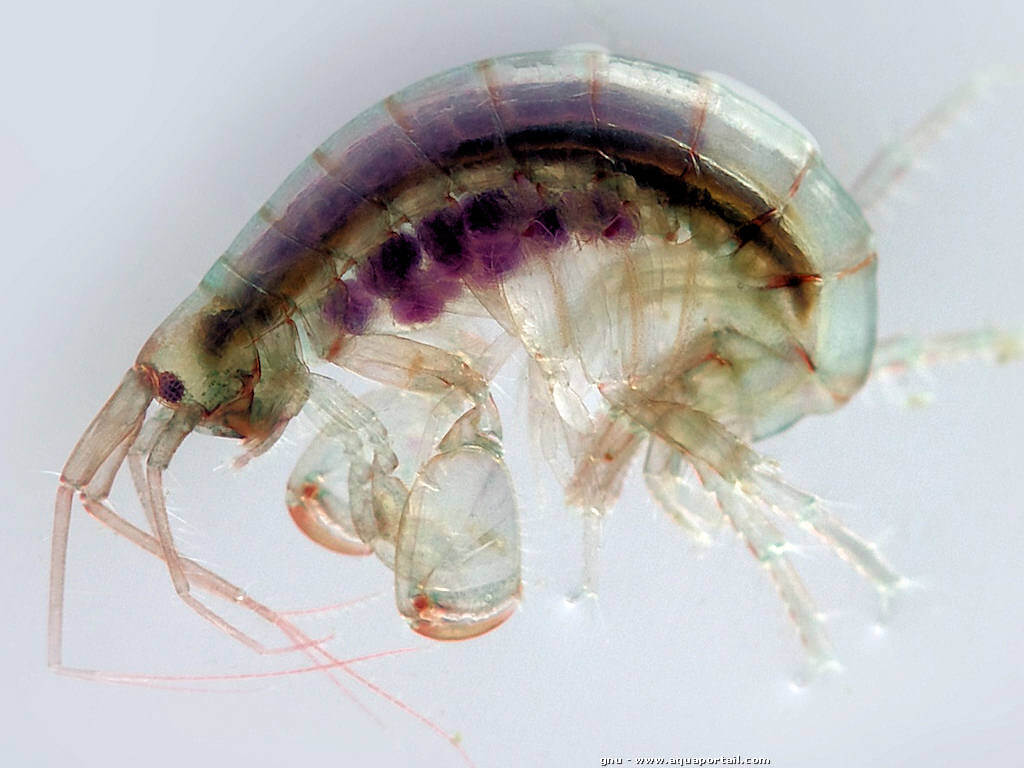
An amphipod is a small crustacean with a laterally compressed body, included within the Arthropoda.
abiotic

In biology and ecology, abiotic refers to what is not biotic, that is, not part of living beings.
aboral

Aboral refers to what is situated away from or opposite the mouth in zoology, and especially in marine biology.
