Epimerase
noun (n.)
Definition
Epimerase, an isomerase enzyme, catalyzes stereochemical inversion in biological molecules. It alters the configuration of an asymmetric carbon atom within a substrate possessing more than one chiral center and interconverts epimers.Production of epimerases:
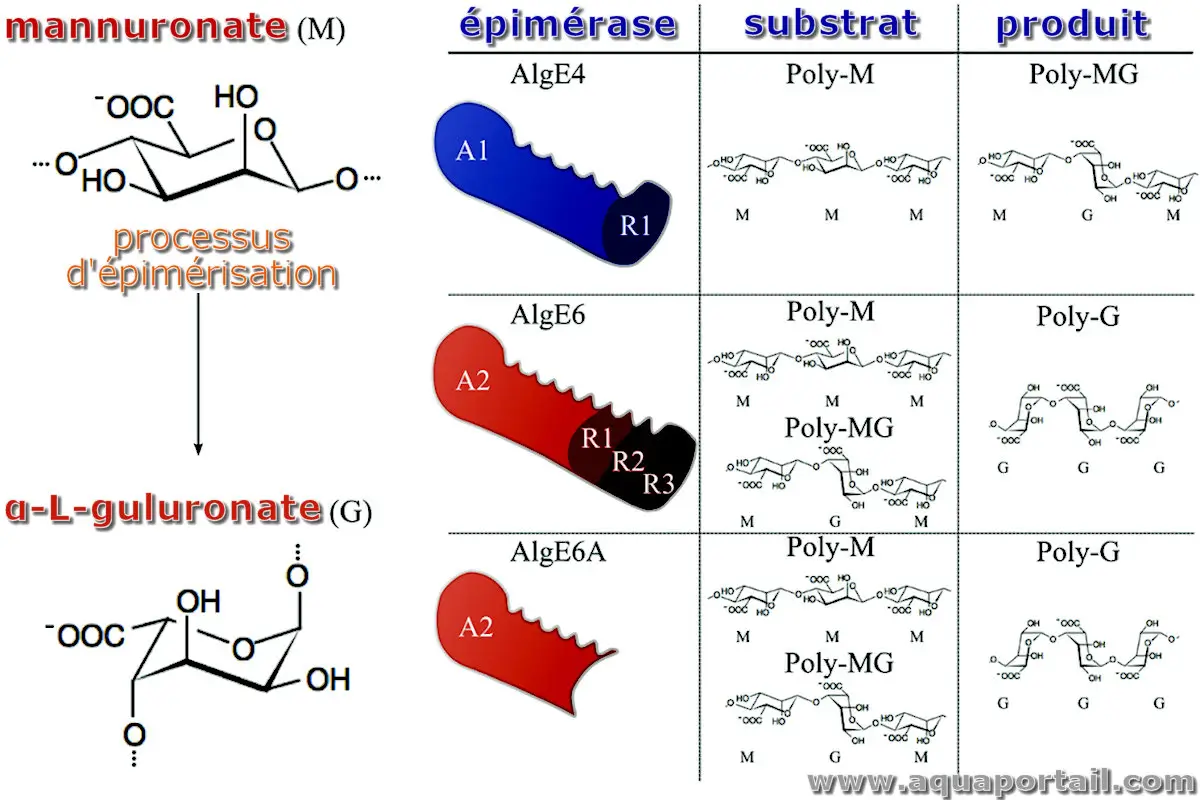
Diagram of epimerization processes, epimerases, and predominant alginate residue sequences of the different epimerase substrates and resulting products.
Explanations
An epimerase is an isomerase enzyme capable of catalyzing the transformation of mannuronic acid into guluronic acid via an epimerization reaction at carbon 5, a reaction resulting in the carboxyl group attached to this carbon being positioned either above (mannuronic acid) or below (guluronic acid) the mean plane of the ring of these uronic acids represented in Haworth projection.
Whereas epimerization takes place with epimerases, racemization takes place with racemases.
Mannuronic acid and guluronic acid, which constitute alginic acid, are C5 epimers; this difference seems minor yet governs their spatial structures and physicochemical properties, and consequently their functional properties and applications.
It is written C5-epimerase (capital C).
One specific mechanism consists of inverting the configuration of the 4' hydroxyl group of UDP-galactose. This is accomplished through a series of four steps. Once the substrate is bound, the conserved tyrosine residue in the active site abstracts a proton from the 4' hydroxyl group. Concurrently, the 4' hydride is transferred to the si face of the NAD+ cofactor. Thereafter, NADH as well as the 4-ketopyranose intermediate are generated. The latter then rotates by one hundred and eighty degrees around the pyrophosphate linkage, thereby presenting the opposite face of the ketopyranose intermediate. Once this rotation is complete, a hydride moves from NADH to the other face and inverts the stereochemistry of the 4' center. During this step, the conserved tyrosine donates back a proton, regenerating the 4' hydroxyl group.
Epimerase can also catalyze the conversion of UDP-GlcNAc into UDP-GalNAc in a reversible process. This occurs through a completely analogous mechanism involving stereochemical inversion at the 4' hydroxyl group of the sugars.
In the human body, epimerases participate in a wide range of metabolic pathways. This includes the catabolism of several amino acids such as valine, isoleucine, methionine, and alanine (via methylmalonyl-CoA epimerase). UDP-glucose 4-epimerase is used in the final stage of galactose metabolism. It catalyzes the conversion of UDP-galactose to UDP-glucose, which is a reversible reaction.
Epimerases function as key components of crucial metabolic pathways. This includes the Leloir pathway, where galactose is converted into glucose-1-phosphate. Furthermore, bacterial epimerases are also involved in synthesizing complex carbohydrate polymers. These are used in cell walls and are known as potential therapeutic targets when treating bacterial infection. There are different groups of epimerase enzymes, each with a distinct mechanism. Some rely on a keto intermediate, whereas others eliminate a nucleotide before re-adding it. Some reform carbon-carbon bonds, while still others cyclize and linearize the pyranose ring. As such, there is a wide variety of biochemical processes within what is often regarded as a simple reaction.
Because there are many different types of epimerase enzymes, they exhibit diverse architectures. A well-characterized example is the UDP-galactose 4-epimerase (GalE) dimer from Escherichia coli, where the UDP-glucose substrate as well as the NAD+ cofactor bind within the active site. The bacterial enzyme functions as a homodimer (while other related enzymes may adopt different oligomeric arrangements). The catalytic triad residues observed in GalE are also found in AGME, with structurally similar positions and analogous functions. There is also the NADPH-bound GMER dimer. Here again, the catalytic triad residues are present in GMER and carry out the reduction step catalyzed by the enzyme.
✅ Each monomer of GalE in E. coli consists of 338 amino acids (348 in humans). It also contains an NAD+ molecule, tightly bound in a syn conformation with the si face oriented toward the sugar substrate.
Synonyms, antonyms
Spanish translation: epimerasa
2 synonyms (similar meaning) for "epimerase":
0 antonyms (opposite meaning).
Related words and expressions to EPIMERASE are directly connected by general or specific meaning.
The word EPIMERASE is listed on page 1 of words starting with E in the dictionary glossary.
Related to "epimerase"
acetyltransferase
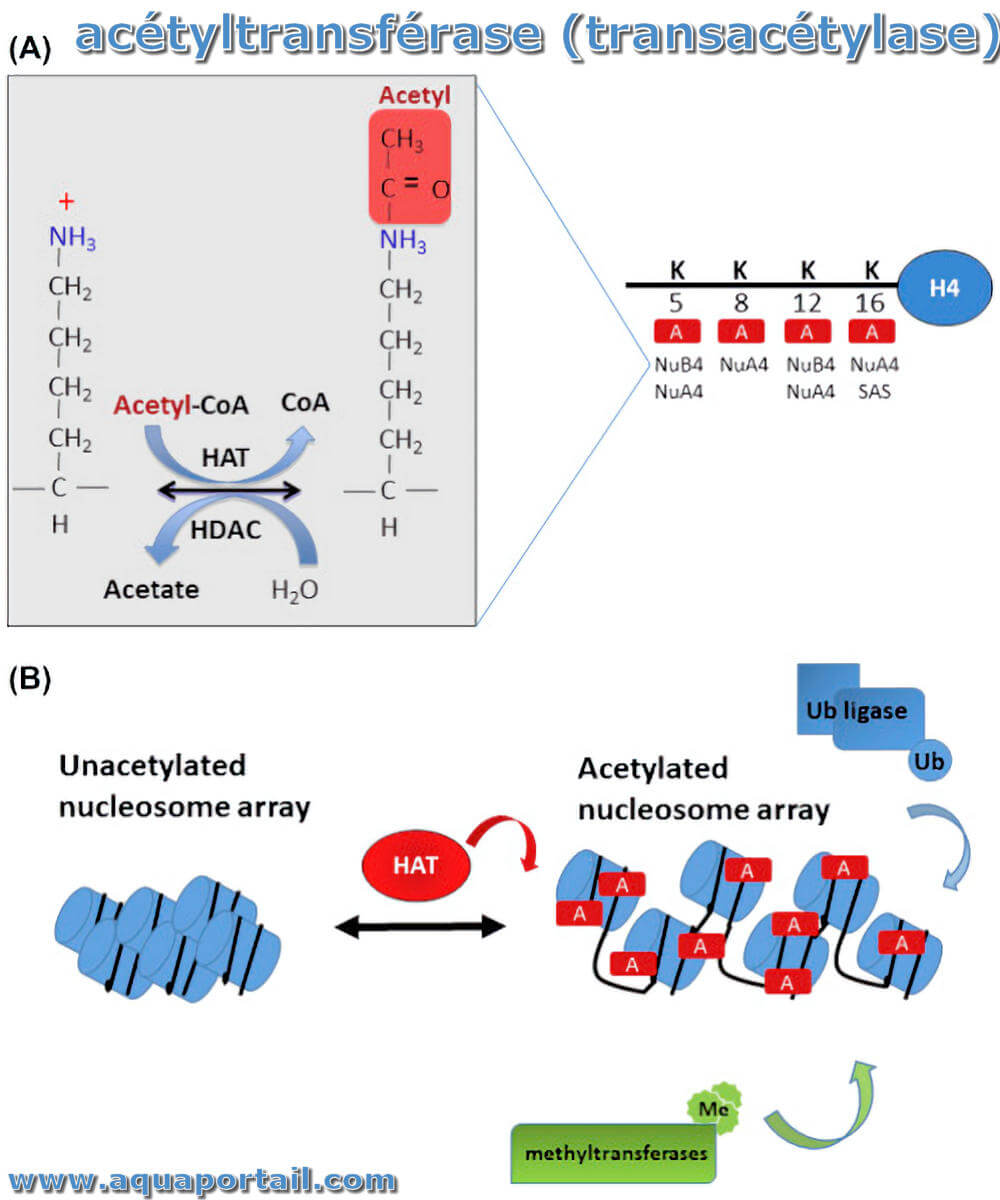
An acetyltransferase is an enzyme that transfers an acetyl group from acetyl-CoA to lysine amino acids.
luciferase

Luciferase is an oxidative enzyme catalyzing the conversion of luciferin into oxyluciferin with light emission during bioluminescence.
E=mc2
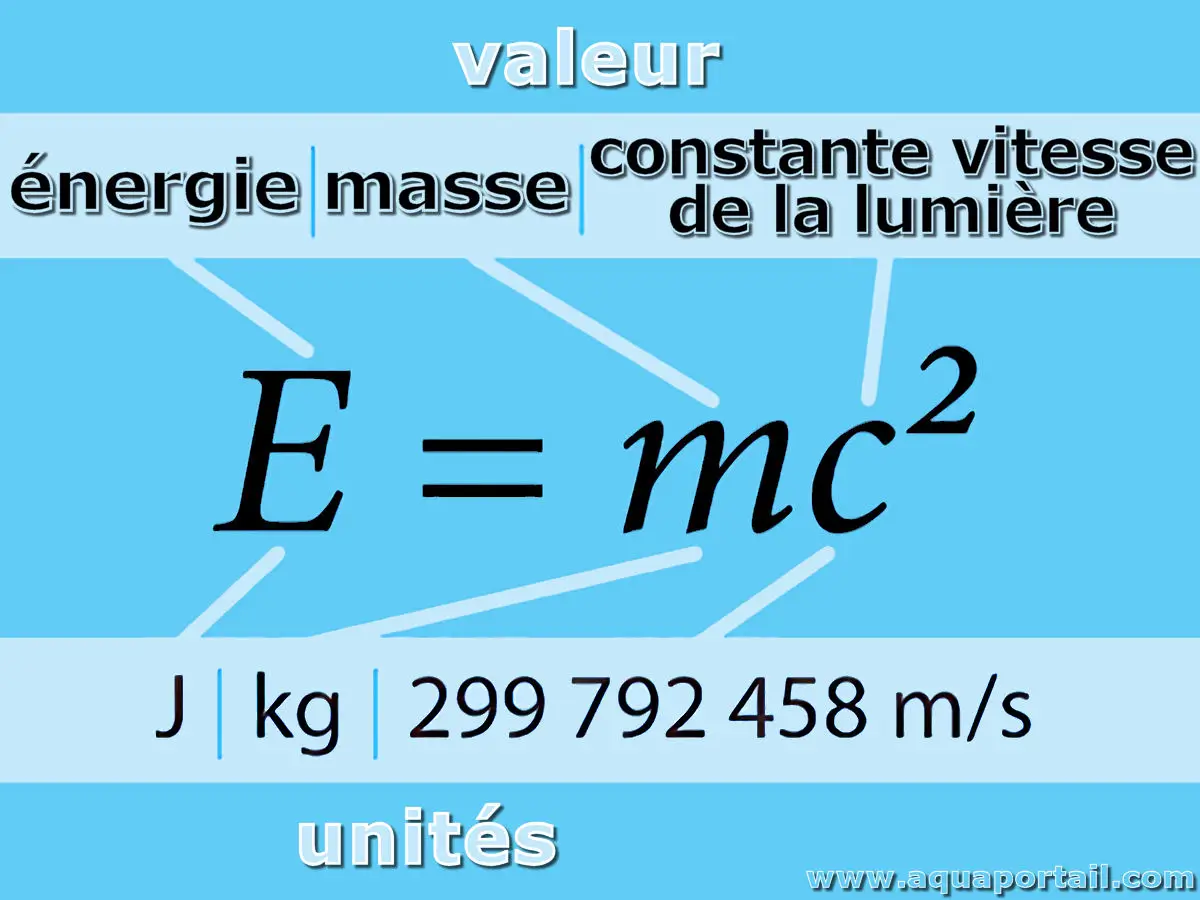
The formula E=mc2 (E = m. c²) is a mass-energy equivalence equation according to the theory of relativity developed by Albert Einstein. It expresses that...
ebb tide

Ebb tide designates the outgoing, falling tide of the sea that begins at high water, also known as reflux.
