Oligocene
noun (n.)
Definition
The Oligocene is a division of geologic time based on breaks between strata in the stratigraphic scale. This division of the geologic time scale belongs to the Paleogene Period. Within it, the Oligocene occupies the third and final epoch after the Eocene. It began about 34 million years ago and ended about 23 million years ago. The name refers to the scarcity of new modern mammals following the evolutionary burst of the Eocene.
An Oligocene landscape:
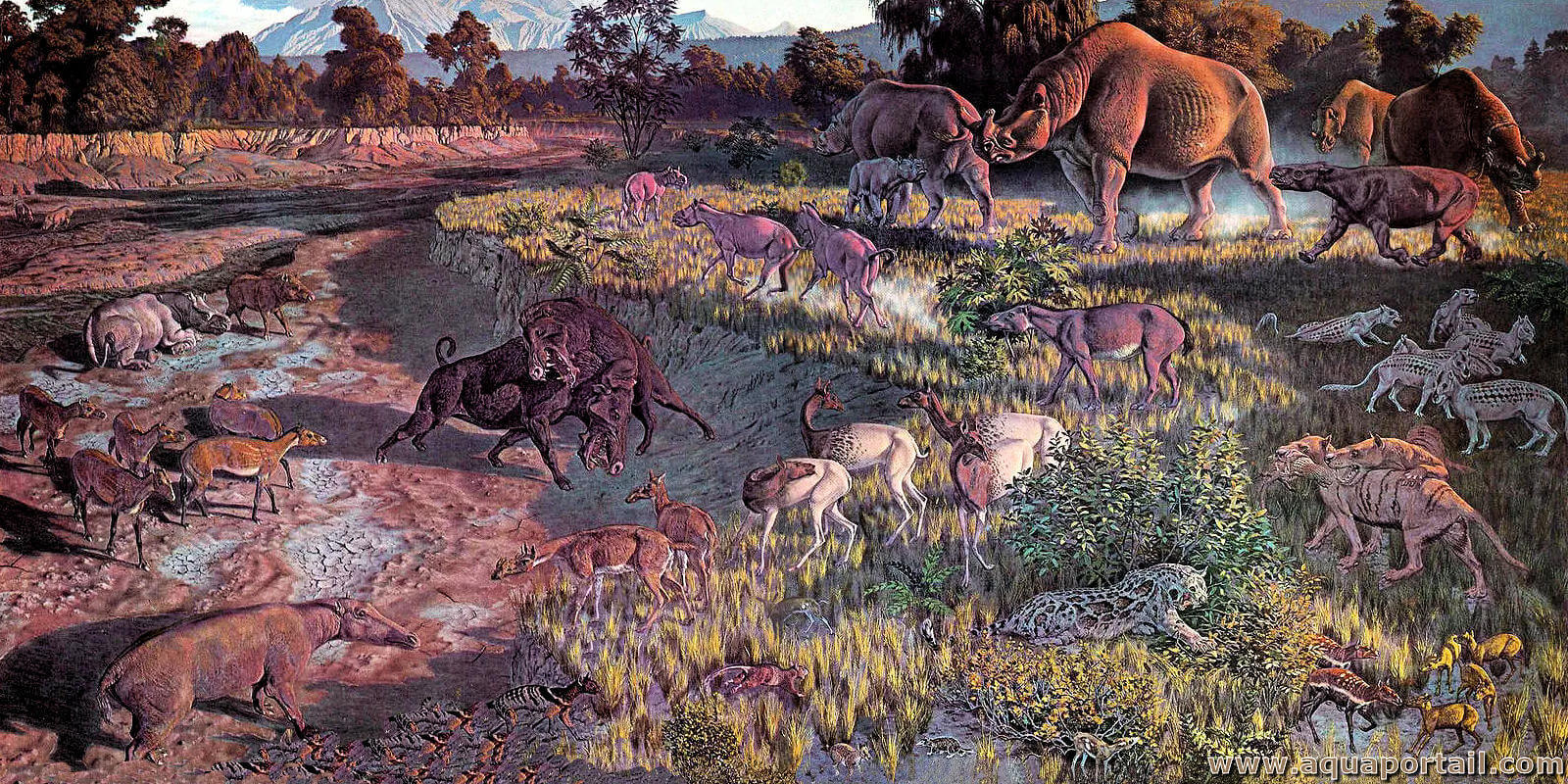
The Paleogene comprises three epochs: the Paleocene, the Eocene, and the Oligocene. Through these epochs, the world began to resemble the one we know today. Most modern mammalian genera also evolved during this time, including our own primate ancestors.
Explanations
The Oligocene is often regarded as a transitional time between the archaic tropical world of the Eocene and the more modern ecosystems of the Miocene. The most significant change in Oligocene ecosystems was the global expansion of grasslands and a retreat of tropical forests from the equatorial belt.
The beginning of the Oligocene is marked by a major extinction event, a replacement of European fauna by Asian fauna, with the exception of endemic families of rodents and marsupials, known as Stehlin's "Grande Coupure". The Oligocene–Miocene boundary is not marked by such an easily identifiable event, but rather by regional transitions between the late Oligocene and the relatively cool Miocene. The extinction that occurred during the Oligocene was not very severe, though it eliminated the massive Titanotheres.
When South America separated from Antarctica, the Drake Passage opened near the Eocene–Oligocene boundary, allowing complete oceanic circulation around Antarctica for the first time. The Antarctic Circumpolar Current caused rapid cooling by preventing warm waters from reaching Antarctica and enabling glaciers to form on a continent that had previously been covered in forests. Consequently, sea levels dropped.
By the early Oligocene, the broadleaf forests of the poles had disappeared, and across Asia, North America, and Europe at high latitudes, a mix of coniferous forests and temperate deciduous forests predominated. With the cold temperatures of the Oligocene, there were fewer tropical and paratropical forests than today, although vast expanses of grassland, desert, or semi-desert had not yet developed. A tiny tundra had appeared in Antarctica around the newly formed ice sheet.
Synonyms, antonyms
Spanish translation: Oligoceno
0 synonyms (similar meaning) for "oligocene".
0 antonyms (opposite meaning).
Related words and expressions to OLIGOCENE are directly connected by general or specific meaning.
The word OLIGOCENE is listed on page 1 of words starting with O in the dictionary glossary.
Related to "Oligocene"
Eocene
The Eocene epoch spans a geological time of the Cenozoic era, extending from 56 to 34 million years ago, belonging to the Paleogene period and system; within...
Holocene
The Holocene is the most recent geological epoch of the Quaternary Period, spanning the past 11,700 years and representing the current epoch of Earth's...
Paleocene

The Paleocene is the geological epoch of the Cenozoic era spanning from -66 to -56 Ma in the stratigraphic scale.
Pleistocene

The Pleistocene is a geological epoch, the earliest of the Quaternary period (Cenozoic era), spanning from -2.
