Disproportionation
noun (n.)
Definition
Disproportionation (or dismutation) is a simultaneous oxidation and reduction process, notably occurring in compounds involved in biological pathways. During disproportionation, both oxidized and reduced forms of a single chemical species are produced concurrently.Several disproportionation reactions:
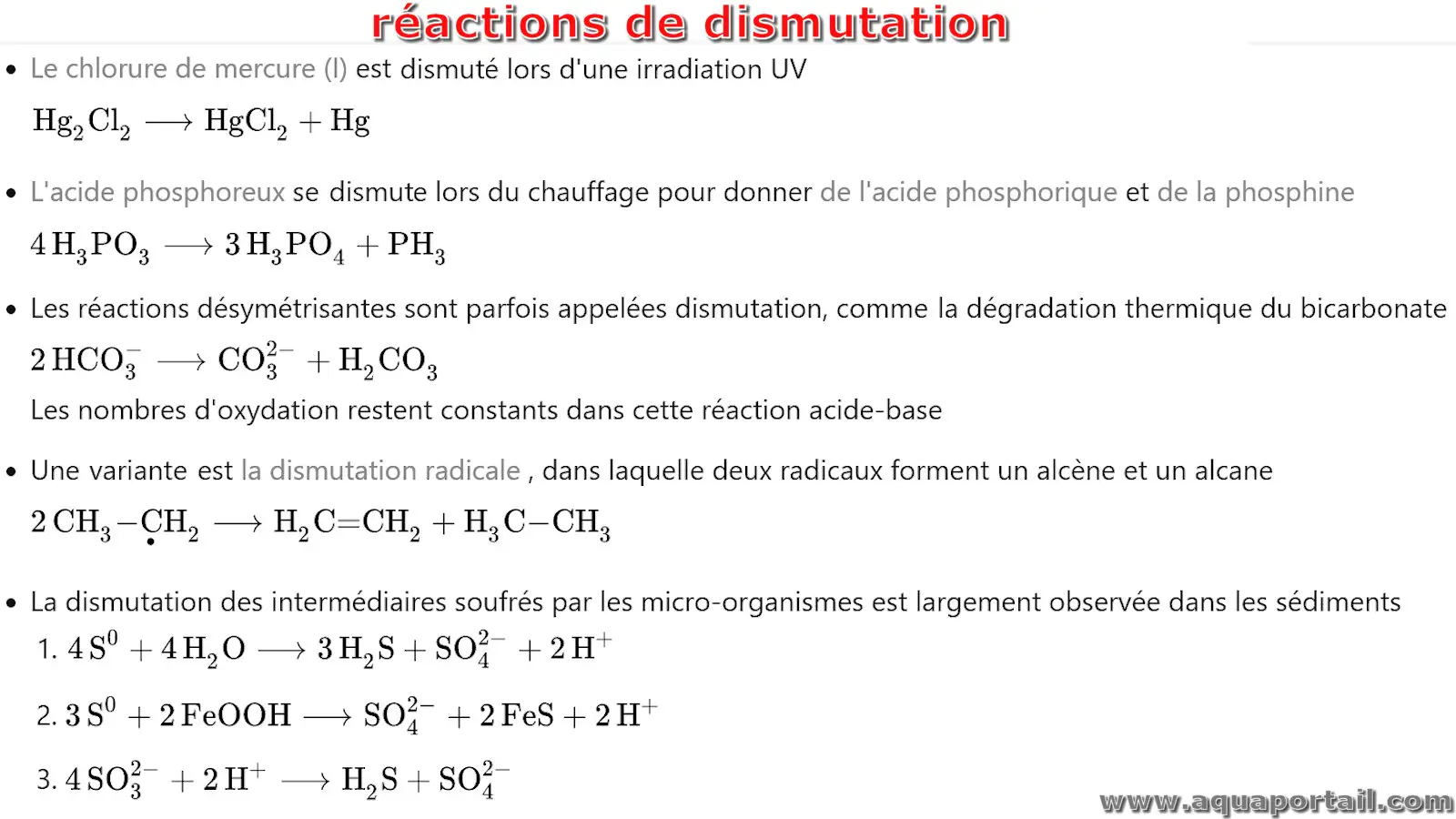
Examples of disproportionation with several reactions.
Explanations
Any oxidation-reduction reaction in which an element is simultaneously oxidized and reduced—when the potential difference between the corresponding redox couples is favorable (greater than 0 V)—is called disproportionation.
Disproportionation takes two main forms:
- a reaction of the type 2 A → A' + A'', in which A' and A'' are distinct chemical species;
- a redox reaction in which a single chemical element is both oxidized and reduced.
In disproportionation, an element present in an intermediate oxidation state acts simultaneously as both an oxidizing agent and a reducing agent. Following disproportionation, that element is distributed into both a higher (oxidized) and a lower (reduced) oxidation state.
Examples
A classic example is the disproportionation of hydrogen peroxide, yielding molecular oxygen and water as products.
The redox half-reactions are: H2O2 → O2 + 2 H+ + 2 e- and H2O2 + 2 H+ + 2 e- → 2 H2O, giving the overall balanced equation 2 H2O2 → O2 + 2 H2O.
Oxygen in hydrogen peroxide has an oxidation state of -1; upon decomposition, it is oxidized to an oxidation state of 0 in molecular oxygen while simultaneously being reduced to an oxidation state of -2 in water.
⭐ Many other examples exist, such as the calomel reaction, in which mercury(I) chloride (Hg2Cl2) reacts with ammonia (NH3) to form a mercury(II) amido compound and elemental metallic mercury, imparting a black color to the reaction mixture and giving calomel its name (from Greek kalomelas, "beautiful black").
⭐ The formation of chloride and hypochlorite ions from elemental chlorine (Cl2) in alkaline solution results from the disproportionation of chlorine in the presence of sodium hydroxide, a reaction used to manufacture bleach.
Case of O2- (superoxide anion)
The disproportionation of O2- can be catalyzed by pentacationic manganese (Mn) porphyrins and Mn biliverdin (and its derivatives). Disproportionation of O2- by pentacationic Mn complexes involves the Mn(III)/Mn(II) redox couple.
The disproportionation mechanism demonstrates that superoxide dismutase (SOD) mimics exhibit both pro-oxidant and antioxidant actions during O2- dismutation: they can accept (1st step) an electron from O2- to produce dioxygen (O2), and donate an electron to another O2- molecule (2nd step) to yield H2O2 when their metal-centered half-wave reduction potential, E1/2 for the MnIIIP/MnIIP redox couple, lies between +100 and +500 mV vs. NHE (normal hydrogen electrode).
Such E1/2 values indicate that SOD mimics act as mild oxidants as well as reductants/antioxidants, with biologically compatible reduction potentials enabling them to couple with numerous other biological targets. However, the 2nd step (although antioxidant with respect to O2-) generates another oxidant, H2O2.
SOD enzymes and their mimics therefore function as a complete antioxidant defense only when coupled (under physiological conditions) with enzymatic H2O2-removing systems (such as catalase and peroxidases).
This explains why, in many in vivo reactions (oxidation of thiols, ascorbate, lipids, NADPH, or NADH), manganese porphyrins (MnPs) can act as pro-oxidants while still producing therapeutic effects.
A distinction must therefore be drawn between the direct chemical reactions of redox-active compounds and the resulting biological effects. MnPs with a very negative E1/2 < 0 mV vs. NHE (highly electron-rich, such as MnTBAP3- or MnTSPP3-) are relatively redox-inert toward O2- and cannot initially be reduced by O2-, yet can act as antioxidants (reductants) against strong oxidants (such as ONOO-, ClO-, or reactive lipid species).
Because they are electron-rich and their oxidation by such species involves binding to the Mn center, these reactions are kinetically less favored than those with electron-deficient Mn porphyrins (such as MnTE-2-PyP5+) having E1/2 between +100 and +500 mV vs. NHE. Conversely, MnPs with E1/2 > +450 mV (highly electron-deficient, such as MnIIBr8TM-3(or 4)-PyP4+ and Cl5MnIITE-2-PyP4+) are stabilized in the +2 oxidation state and readily lose Mn at pH 7.8.
By comparison, Mn(III) N-alkylpyridylporphyrins, with manganese in the +3 oxidation state, withstand even 98% sulfuric acid and 36% hydrochloric acid. Such compounds initiate disproportionation by reducing O2- while oxidizing Mn(III) in the 1st step, and are reduced back to Mn(III) while oxidizing O2- in the 2nd step—reversing the sequence of the previous pathway.
Disproportionation of O2- by Mn(III) biliverdin and its analogs utilizes the Mn(IV)/Mn(III) redox couple, as illustrated for Mn(III) biliverdin dimethyl ester (BVDME). Mn(III) and Fe(III) corroles likewise employ a +3/+4 metal redox couple: in the first step, these metal centers reduce O2- while undergoing oxidation to an M(IV) complex, and in the reverse step they are reduced by O2- and restored as catalysts.
Regardless of the metal redox couple involved (+3/+2 or +3/+4), efficient O2- disproportionation depends on the metal center's ability to readily accept and donate an electron at an E1/2 potential roughly midway between the oxidation and reduction potentials of O2-, thereby facilitating both half-reactions to a comparable extent.
Synonyms, antonyms
Spanish translation: dismutación, desproporción
1 synonym (similar meaning) for "disproportionation":
3 antonyms (opposite meaning):
- comproportionation
- redox amphoterization
- synproportionation
Related words and expressions to DISPROPORTIONATION are directly connected by general or specific meaning.
The word DISPROPORTIONATION is listed on page 1 of words starting with D in the dictionary glossary.
Related to "disproportionation"
redox

The redox potential (rH) is the standardized abbreviation for oxidation-reduction potential via an oxidation-reduction reaction.
bio-purification
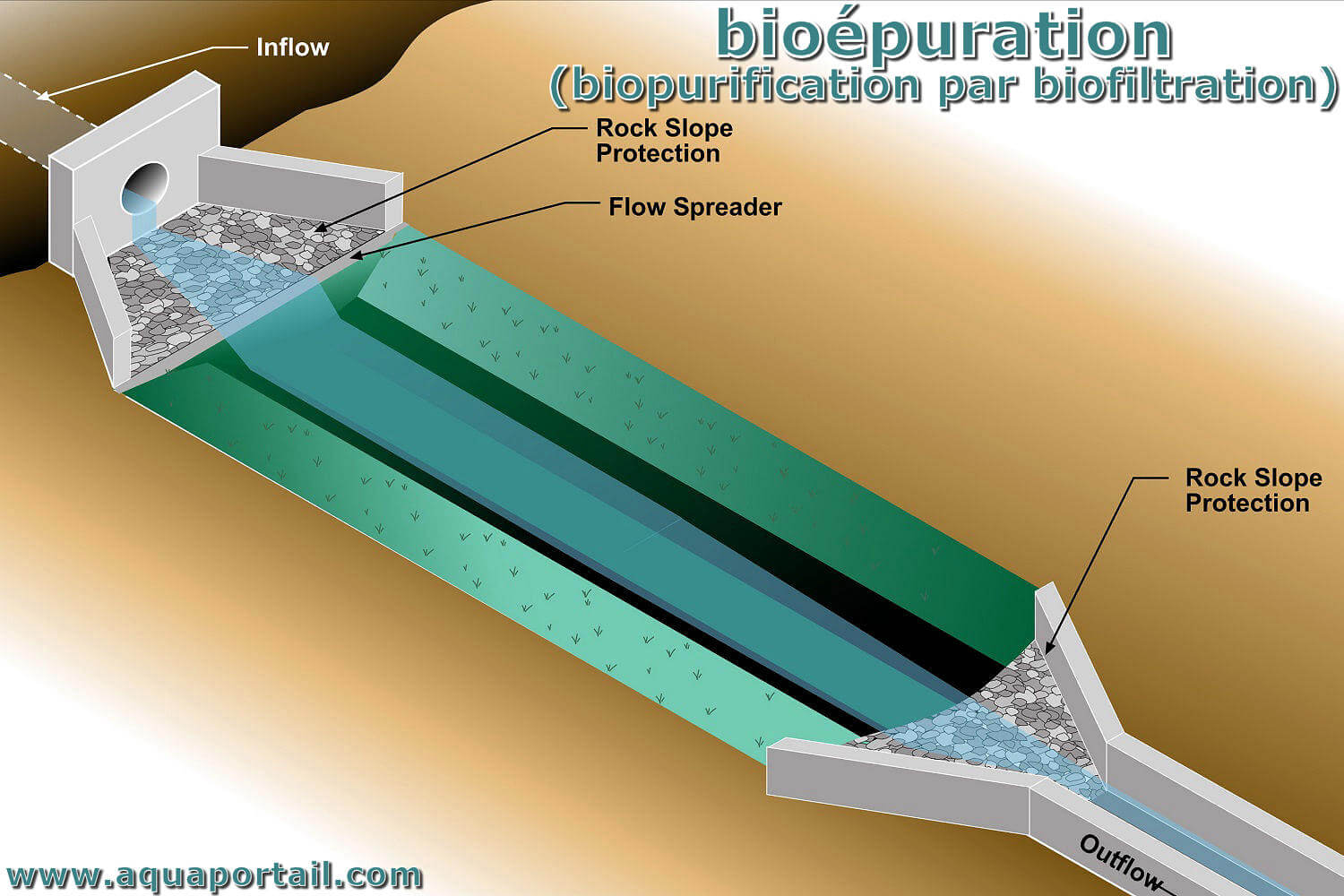
Bio-purification (biodepuration) refers to harnessing living organisms—such as plants, fungi, and symbiotic bacteria—to reduce pollution in an environment.
civilization

A civilization is generally defined as an advanced state of human society containing highly developed forms of government, culture, industry, and social...
cohabitation

Cohabitation is the simultaneous coexistence of several elements, similar or different, in the same place (habitat) over the same (extended) period.
